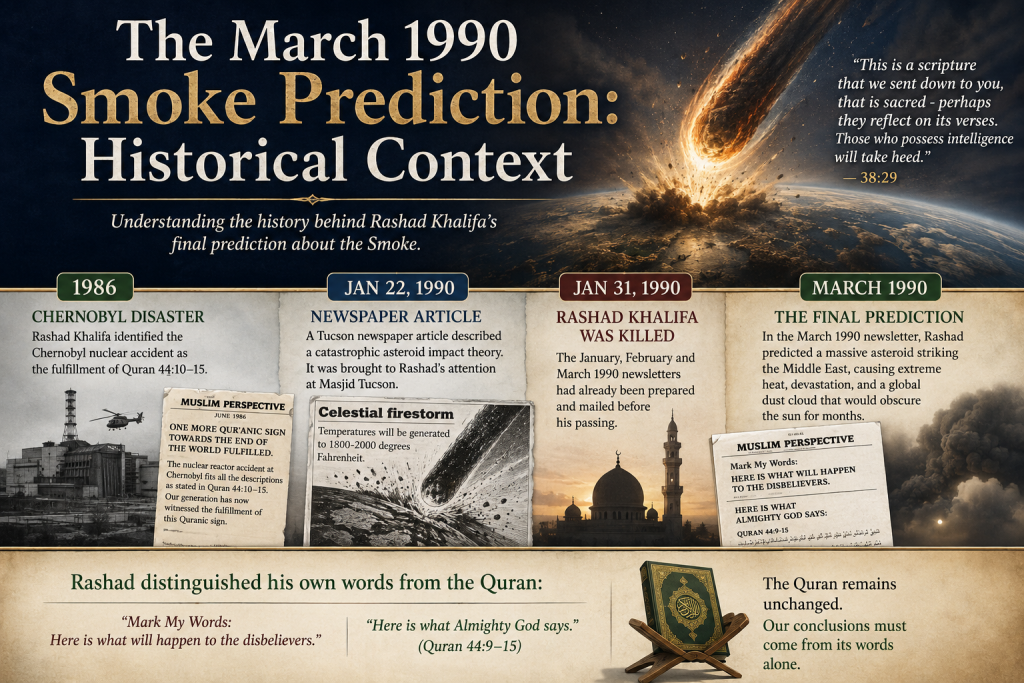
The March 1990 issue of Submitters Perspective contains Rashad Khalifa’s final published comments concerning the Smoke prophecy of Surah 44. Because statements from this newsletter are sometimes used as criteria for determining the fulfillment of 44:10–15, it is useful to understand the historical circumstances surrounding what Rashad wrote.
The purpose here is not to question Rashad Khalifa’s messengership. It is to make an important distinction between what the Quran says and Rashad’s own understanding and expectations concerning what the Quran says.
An Earlier Understanding: Chernobyl
The March 1990 newsletter was not the first time Rashad attempted to identify the fulfillment of the Smoke prophecy.
Following the Chernobyl nuclear disaster in 1986, Rashad wrote about it on the last page of the June 1986 Muslim Perspective. The heading was unequivocal:
“ONE MORE QUR’ANIC SIGN TOWARDS THE END OF THE WORLD FULFILLED”
He then stated that the nuclear reactor accident at Chernobyl “fits all the descriptions as stated in Quran 44:10–15,” concluding that his generation had witnessed the fulfillment of this Quranic sign.
This is important historical context. In 1986, Rashad understood Chernobyl as the fulfillment of 44:10–15. By early 1990, his understanding had changed.
There is nothing unusual about a human being reconsidering an interpretation in light of subsequent information. The significance is that Rashad’s understanding changed while the words of the Quran did not.
The January 1990 Newspaper Article
On January 22, 1990, a Tucson newspaper published an article concerning the theory that a massive meteor or asteroid impact had contributed to the extinction of the dinosaurs.
The article described the enormous heat and atmospheric consequences that scientists believed could result from such an impact. Its accompanying illustration was titled “Celestial firestorm.” It showed a comet or asteroid striking the Earth, vaporized rock and debris being thrown into space, and that debris subsequently re-entering the atmosphere.
The illustration stated that as the debris re-entered the atmosphere, trillions of grains could generate temperatures of approximately 1,800 to 2,000 degrees Fahrenheit. The accompanying newspaper discussion described the catastrophic consequences of such intense atmospheric heating for life on the Earth’s surface.
The newspaper article was brought to Rashad’s attention at Masjid Tucson.
Rashad Khalifa was killed nine days later, on January 31, 1990. The January, February and March newsletters had been prepared and mailed before his passing. The March 1990 issue therefore preserves his final published expectations concerning the Smoke.
“Mark My Words”
Page 2 of the March 1990 Submitters Perspective is particularly revealing because Rashad himself separates his expectations from the words of God.
The page begins:
“Mark My Words: HERE IS WHAT WILL HAPPEN TO THE DISBELIEVERS.”
Under that heading Rashad predicts, among other things:
- a massive asteroid striking somewhere in the Middle East;
- resulting heat burning living organisms within a 100-mile radius;
- devastation enveloping the Arab world;
- a giant dust cloud enveloping the whole world and obscuring the sun for several months.
He then asks when this will happen and answers that he does not know, although he has “a strong feeling” that it will occur before the end of 1990. He immediately qualifies this by stating that only God knows the exact time.
Immediately below these statements appears another large heading:
“HERE IS WHAT ALMIGHTY GOD SAYS:”
Rashad then presents his rendering of Quran 44:9–15.
The distinction on the page is significant.
Rashad did not place the asteroid prediction under “Here Is What Almighty God Says.” He placed it under “Mark My Words.”
His own layout therefore distinguishes between his expectations concerning the prophecy and the Quranic words upon which those expectations were based.
The “Celestial Firestorm”
There is also a direct visual connection between the January newspaper article and the March newsletter.
The March newsletter reproduces the same basic “Celestial firestorm” illustration and scenario: a comet or asteroid strikes Earth, material is projected outward, and debris re-entering the atmosphere generates enormous heat.
The January newspaper article therefore provides important historical context for understanding why an asteroid, enormous temperatures, and worldwide atmospheric consequences appear in Rashad’s March discussion of the Smoke.
This should not be confused with questioning Rashad’s sincerity. The evidence indicates that he was attempting to understand how the Quranic prophecy might manifest itself physically and was considering contemporary scientific information in doing so.
The history itself is informative:
1986: Chernobyl was identified as the fulfillment of 44:10–15.
January 1990: Rashad was shown a contemporary scientific account of the catastrophic effects of an asteroid impact.
March 1990: His final newsletter anticipated an asteroid striking the Middle East and producing the Smoke.
Through all three stages, Quran 44:10–15 remained unchanged.
Rashad’s Rendering of 44:9–15
Another small but revealing detail appears on the same page.
Rashad’s English rendering of 44:9–15 in the March newsletter differs in places from the wording in his published English translation of the Quran.
This was not necessarily unusual. Rashad could translate or render Quranic passages directly from the Arabic while writing or speaking rather than feeling bound to reproduce the exact English wording he had previously published.
This distinction is worth noting because some later readers can give extraordinary importance to the precise wording of Rashad’s English translation.
Rashad’s own practice indicates something simpler:
The Arabic Quran was the source. His English translation was a translation of that source.
His willingness to render the same Arabic somewhat differently in another context illustrates that he did not treat his own English wording as an additional fixed text alongside the Quran.
The Quranic Prophecy and Rashad’s Expectation
None of this requires diminishing Rashad Khalifa’s role as God’s Messenger of the Covenant.
Quite the opposite: Rashad repeatedly directed people back to the Quran rather than to himself.
The historical evidence simply allows us to distinguish two things that should remain distinct:
What does Quran 44:10–15 actually say?
and
How did Rashad at a particular time expect those verses to be fulfilled?
In 1986, he identified Chernobyl as their fulfillment. In March 1990, his expectation involved an asteroid and a worldwide celestial firestorm. The latter incorporated scientific information and imagery that had appeared in a Tucson newspaper shortly before his death.
The Quran itself does not change with these interpretations.
And perhaps Rashad provided the clearest distinction himself on that final newsletter page:
“Mark My Words”
followed separately by:
“Here Is What Almighty God Says.”
Nearly four decades later, there is no reason for us to erase the distinction that Rashad himself made.
His expectations can be understood in their historical context. The fulfillment of the Smoke prophecy, however, must ultimately be determined from the words of the Quran itself.