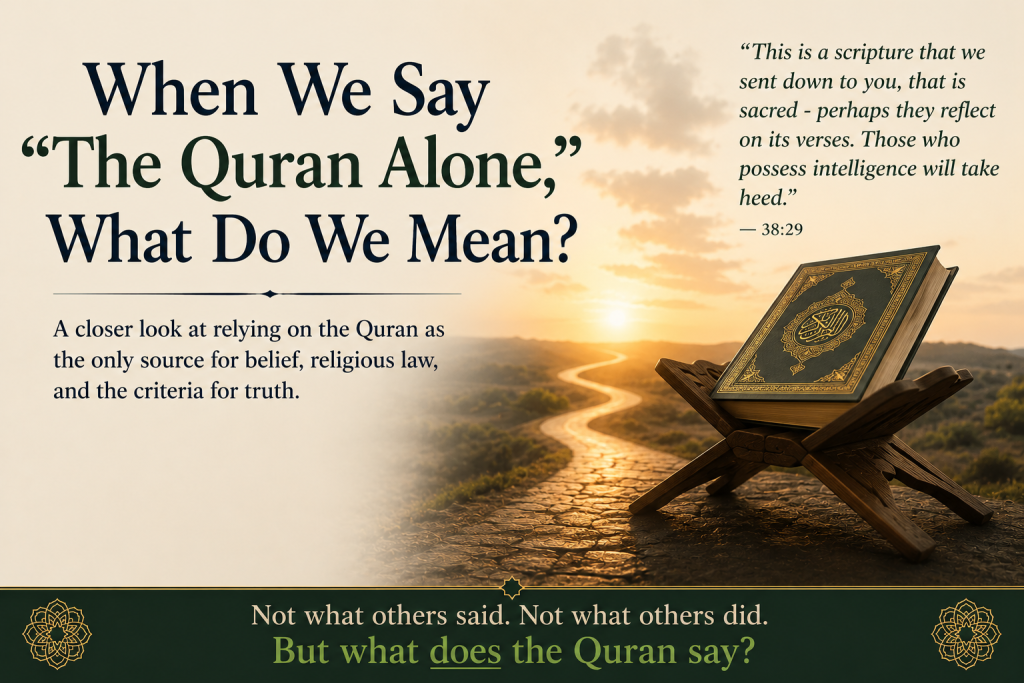
Many of us say that we follow the Quran alone. We believe that the Quran is complete, fully detailed, and sufficient for religious guidance. We reject Hadith and other sources as authorities for establishing religious law.
But there is a more difficult question:
Do we apply the same principle consistently to everyone?
It is possible to uphold “Quran alone” in principle while, perhaps unknowingly, allowing the words of a respected messenger, teacher, scholar, or community to become an additional source for our religious conclusions.
That is where the difference between one source and two sources begins.
The Quran as the Source
God describes the Quran as fully detailed (6:114), complete (6:115), and tells us to follow what has been revealed by Him rather than other religious authorities (7:3). We are also told not to follow that of which we have no knowledge (17:36).
This does not mean that every religious practice originated with the Quran. The Quran itself tells us to follow the religion of Abraham (16:123). Religious duties originating with Abraham were inherited from generation to generation, while the Quran confirms them and corrects the distortions that had entered them.
But religious authority belongs to God. No human being becomes an independent source of religious law or knowledge alongside His revelation.
This distinction is fundamental.
[Further reading: The Quran — Fully Detailed for Guidance]
How Does a Second Source Arise?
The transition can be very subtle.
Suppose the Quran establishes A.
A messenger or respected individual subsequently says A + B.
If B can also be established from the Quran, there is no problem. The Quran remains the source.
But what happens when B cannot be established from the Quran, yet we continue to accept B because of who said it?
We now need to ask ourselves:
Are we still deriving our religious conclusion from one source, or have we effectively introduced a second source?
The sincerity of the individual is not the issue. Neither is our respect for that individual. The question is simply one of authority and verification.
Rashad Khalifa and “Go by the Quran”
This question is particularly relevant to those who accept Rashad Khalifa as the Messenger of the Covenant.
Rashad repeatedly directed people away from himself and back to the Quran. His message was straightforward:
Do not go by what I say. Go by the Quran.
Accepting a messenger does not mean that every statement, opinion, expectation, or explanation made by that messenger becomes part of the Quran or an independent source alongside it.
In fact, applying the Quranic test to Rashad’s own words is entirely consistent with the principle he advocated.
The danger arises when our respect for a messenger gradually causes us to treat his words differently from everyone else’s: Rashad said it; therefore, there must be a way to make the Quran support it.
The Quran-alone method works in the opposite direction:
First establish what the Quran says. Then evaluate everything else by it.
[Further reading: Rashad Khalifa and the Quranic Method]
The Smoke Provides a Useful Example
The Smoke of Surah 44 provides a practical example of this distinction.
Verses 44:10–15 describe the sky bringing a visible smoke, the smoke enveloping the people and causing suffering, their imploring God for relief, a messenger who had already come and been rejected, temporary relief, and subsequent reversion.
Rashad Khalifa’s March 1990 newsletter included additional expectations concerning the Smoke, including an asteroid and a smoke that would envelop all people on earth.
The purpose here is not to debate whether the Smoke was fulfilled in 1991. That analysis is presented separately.
The more fundamental question is this:
When determining the Quranic requirements for fulfillment of the Smoke prophecy, do we derive those requirements from 44:10–15 and the Quran—or from the Quran together with Rashad’s statements?
If the Quran does not require an asteroid, can we require an asteroid because Rashad mentioned one?
If the Quran says the people, can we require all people on earth because Rashad subsequently used those words?
These questions illustrate the difference between one source and two sources.
[Further reading: The Smoke in the Quran]
Disagreement Is Not the Issue
This distinction should not be confused with disagreement over interpretation.
Two people can rely exclusively upon the Quran and nevertheless understand a verse differently. Each can present the Quranic evidence and allow the other to examine it. Neither has necessarily introduced another source.
Likewise, someone does not have to accept the conclusion that the Smoke was fulfilled in 1991 in order to uphold the Quran alone.
The decisive question is not:
Do you agree with my conclusion?
It is:
What is the source from which you reached your conclusion?
That distinction is important.
One Source
The Quran repeatedly shows what happened to communities after messengers. With time, attention could shift from God’s revelation toward human beings associated with that revelation.
Recognizing a messenger does not make a community immune from this danger.
The safeguard is simple.
When confronted with a religious teaching, interpretation, requirement, or claim, we should be willing to ask:
Can this be established from the Quran?
If it cannot, the identity or stature of the person who said it cannot turn it into something the Quran says.
The Quran remains the criterion.
“Quran alone” should not merely describe what we say we believe. It should describe the method by which we arrive at our religious beliefs.
Related Topics
Quranic Manifestations After the Prophets
The March 1990 Newsletter Smoke Prediction: Historical Context