Introduction
Many believers accept that Rashad Khalifa was the messenger spoken of in God’s covenant with the prophets:
“GOD took a covenant from the prophets, saying, ‘I will give you the scripture and wisdom. Afterwards, a messenger will come to confirm all existing scripture. You shall believe in him and support him…'” (Quran 3:81)
Accepting this conclusion, however, is only the beginning. The more important question is whether we have embraced the Quranic method that the messenger himself consistently taught.
Perhaps no statement summarizes Rashad Khalifa’s mission more accurately than this simple reminder:
“Don’t go by what I say. Go by the Quran.”
Ironically, this is also one of his most misunderstood teachings.
The Messenger Pointed People to the Quran
Like every messenger before him, Rashad Khalifa did not seek to become the source of religious authority. His constant effort was to direct people back to God’s revelation.
This is precisely the methodology established by the Quran itself.
God asks:
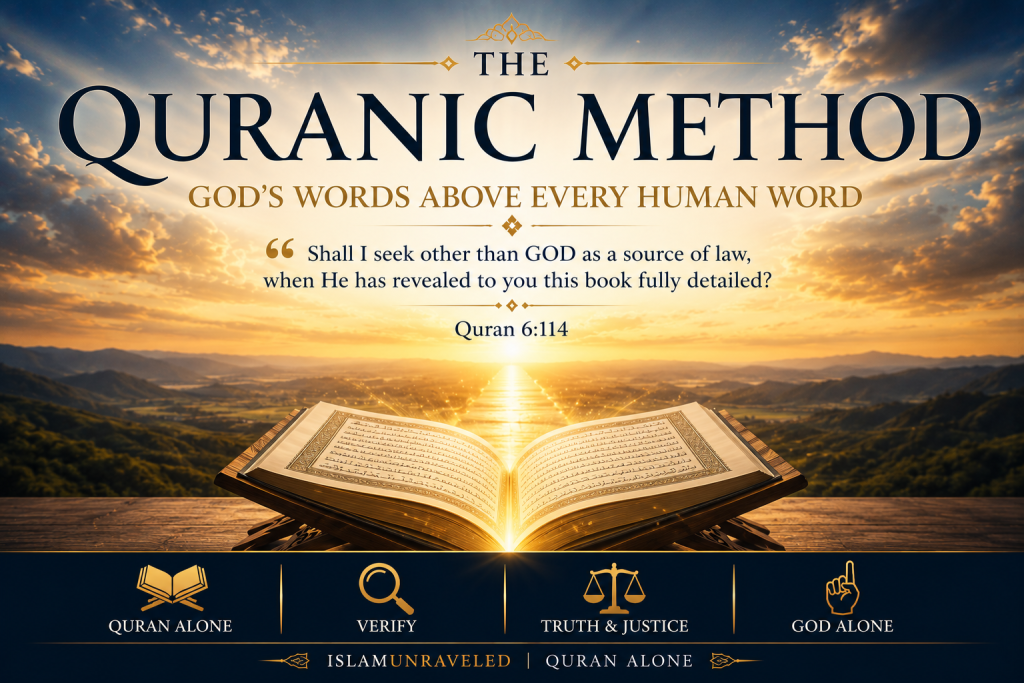
“Shall I seek other than God as a source of law, when He has revealed to you this book fully detailed?” (6:114)
And immediately assures us:
“The word of your Lord is complete in truth and justice. Nothing shall abrogate His words.” (6:115)
The Quran repeatedly describes itself as:
- fully detailed (6:114)
- fully explained (41:3)
- clarifying all things necessary for guidance (16:89)
- containing the best explanation (25:33)
If God’s revelation is complete, then every religious conclusion must ultimately rest upon God’s words.
This was not merely a Quranic principle. It is the Quranic method.
What Does “Go by the Quran” Really Mean?
Some have misunderstood Rashad Khalifa’s reminder.
When they hear, “Go by the Quran,” they conclude that his discoveries, explanations, or observations should simply be ignored.
That is not what he taught.
Neither does it mean that we should pretend God did not bring remarkable knowledge to light through him.
Rather, it means something much deeper.
It means that while we may learn through God’s messenger, we must ultimately prove our religious conclusions through God’s revelation.
There is a profound difference between these two statements:
“Rashad Khalifa said…”
and
“The Quran says…”
The first appeals to a human being.
The second appeals to God.
A believer who has truly adopted the messenger’s method which is the Quranic method, should increasingly find himself speaking in the second way.
God Brought Hidden Knowledge to Light
By God’s leave, Rashad Khalifa drew attention to numerous truths that had remained hidden within the Quran for over fourteen centuries.
Among them are:
- the distinction between prophets and messengers, including the covenant of 3:81;
- the mathematical structure centered on the number nineteen (74:30–31);
- the Quran’s distinction between Muhammad as the last prophet, while leaving open the office of messenger (33:40);
- many linguistic, structural, and thematic relationships embedded within the Quran itself.
These discoveries were not intended to replace the Quran.
They direct us back to the Quran.
Their value lies precisely in the fact that they can be examined, tested, and verified from God’s words.
If a conclusion cannot ultimately be demonstrated from the Quran, then it should not become part of our religion.
Learning Is Not the Same as Proving
There is nothing wrong with learning from God’s messenger.
Indeed, the Quran commands believers to believe and support the messenger mentioned in 3:81.
But there is an important distinction between learning from a messenger and proving a religious point.
Suppose someone asks why we distinguish between prophets and messengers.
Our response should not end with,
“Because Rashad Khalifa taught it.”
Rather, we should be able to say,
“Because the Quran distinguishes between them.”
Likewise, when discussing the mathematical structure of the Quran, the last prophet, or any other subject, our goal should never be merely to repeat what Rashad Khalifa said.
Instead, we should present the Quranic evidence that he pointed us toward.
In doing so, we are not diminishing God’s messenger.
We are following his example.
Obeying the Messenger
The Quran commands believers to obey God’s messenger.
As discussed elsewhere on this site, obedience to a living messenger included operational matters that arose during his lifetime.
The companions obeyed Muhammad in matters such as travel, defense, community organization, and other practical affairs. The same principle naturally applied during Rashad Khalifa’s lifetime.
But once a messenger completes his mission and passes away, those operational responsibilities come to an end.
What remains is God’s revelation.
The messenger’s enduring legacy is not an ongoing personal authority, but the Quranic understanding that God enabled him to bring to light.
Supporting the Messenger Today
How, then, do we support God’s messenger today?
Certainly not by placing his words alongside the Quran as a second source of religious authority.
Nor by quoting him when the Quran itself provides the evidence.
Supporting God’s messenger today means preserving and sharing the Quranic understanding that God brought to light through him.
It means encouraging every sincere seeker to verify these matters directly from the Quran.
It means allowing God’s words—not the messenger’s words—to have the final say.
In this way, we honor both the messenger and the message.
Why Rashad Khalifa’s Translation Remains Important
When introducing someone to the Quran, it is often beneficial to recommend Rashad Khalifa’s translation.
This is not because readers should accept every footnote without examination.
Rather, his translation preserves many of the Quranic relationships and discoveries that God enabled him to uncover.
Without them, a new reader may never become aware of subjects such as the covenant of 3:81, the significance of the mathematical structure described in 74:30–31, or other Quranic insights that deserve careful study.
Even then, the objective remains the same.
The translation is a guide to the Quran.
The Quran itself remains the final authority.
The Messenger’s Method
Every genuine messenger directs people away from himself and toward God.
That is exactly what Rashad Khalifa did.
His greatest contribution was not simply uncovering remarkable truths embedded within the Quran.
It was demonstrating how believers should approach God’s revelation.
Study the Quran.
Reflect upon it.
Verify everything.
Allow God’s words to speak for themselves.
If we truly accept Rashad Khalifa as the messenger mentioned in Quran 3:81, then we should also accept the method he tirelessly taught.
The greatest tribute we can pay God’s messenger is not to quote him more often, but to imitate his method – the Quranic method: point people to God’s words, let the Quran speak for itself, and ensure that every religious conclusion rests upon the revelation rather than the teacher. The messenger did not establish a new method; he called believers back to the Quranic method that had been neglected for centuries.
In the end, every messenger succeeds only when people look beyond the messenger and devote themselves completely to the message from God.
Continue the Study
If this article was helpful, you may also wish to explore:
- Who Explains the Quran?
Does God explain His own revelation? - God Alone Teaches the Quran
Understanding the significance of Quran 55:1–2. - The Quran Is Fully Detailed
What does the Quran itself claim about its completeness? - Obey the Messenger: What Does the Quran Mean?
Understanding obedience to God’s messenger in its Quranic context. - The Quranic Criteria for God’s Messengers
How does the Quran identify a genuine messenger? - Belief in God vs. Believing God
The difference between acknowledging God and trusting His words. - Beyond Manifestation: The Quran’s Path to True Freedom
Freedom through trusting God’s revelation rather than human philosophies.