By: Mehdi Golafshani
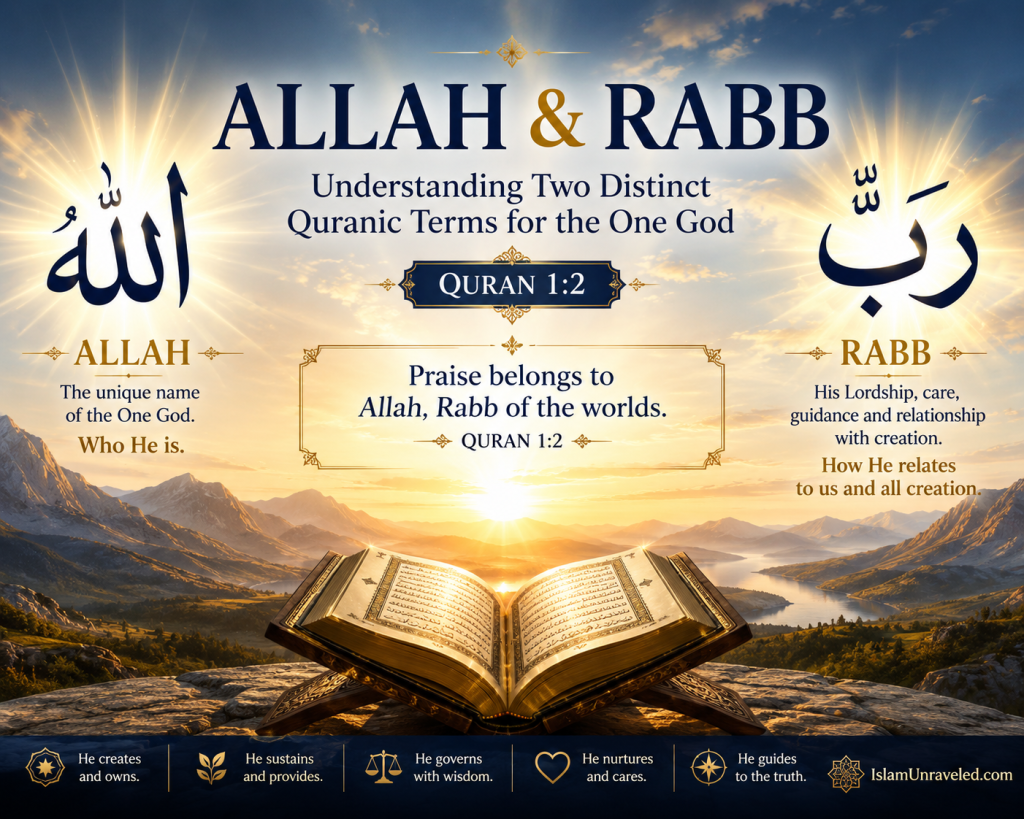
The Quran uses Allah as the unique name of the One God, while Rabb describes His relationship with creation as Lord, Sustainer, Guide, and Nurturer.
“Praise belongs to Allah, Rabb of the worlds.” (1:2)
To many readers, the words Allah and Rabb appear to mean the same thing. English translations often render them simply as “God” and “Lord,” giving the impression that they are interchangeable.
While both refer to the One God, the Quran consistently uses them with different emphases. Recognizing this distinction enriches our understanding of the Quran and helps explain why the prophets so often addressed God by saying “My Rabb” in their prayers.
Allah: The Unique Name of the One God
The Quran uses Allah as the unique divine name of the One God.
It answers the question:
Who is God?
Allah is the One:
- who alone deserves worship,
- who possesses all perfect attributes,
- who has no partners,
- who has no equals.
The Quran repeatedly emphasizes His uniqueness:
“Say, He is Allah, One.” (112:1)
“Indeed, I am Allah. There is no god except Me, so worship Me…” (20:14)
God Himself bears witness:
“God bears witness that there is no god except Him…” (3:18)
Throughout the Quran, Allah is never used as the proper name of a human being, an angel, or any created entity. It uniquely identifies the One God.
Rabb: God’s Relationship with His Creation
While Allah identifies who God is, Rabb describes His relationship with His creation.
The Arabic word Rabb encompasses meanings such as:
- Lord
- Owner
- Master
- Sustainer
- Provider
- Governor
- Guide
- Nurturer
Thus, Rabb answers a different question:
How does God relate to His creation?
When the Quran opens with:
“Praise belongs to Allah, Rabb of the worlds.” (1:2)
it is not merely stating that God exists. It praises Him because He is the Lord who created, owns, sustains, governs, and continually cares for every aspect of creation.
This beautiful pairing is intentional.
The One identified as Allah is also the Rabb of everything that exists.
Why the Prophets Frequently Prayed, “My Rabb”
One striking pattern throughout the Quran is that the prophets frequently address God as Rabbi (“My Rabb”) or Rabbana (“Our Rabb”).
For example, Abraham prayed:
“My Rabb, grant me wisdom and join me with the righteous.” (26:83)
Moses prayed:
“My Rabb, expand my chest for me.” (20:25)
Noah prayed:
“My Rabb, forgive me, my parents, and whoever enters my house as a believer…” (71:28)
Zechariah prayed:
“My Rabb, do not leave me childless…” (21:89)
This is not accidental.
When seeking guidance, forgiveness, provision, mercy, or help, the prophets appealed to God in His active relationship with His servants – as their Lord, Sustainer, Protector, and Guide.
The title Rabb beautifully conveys God’s continual care for His creation.
Can “Rabb” Refer to Someone Other Than God?
Unlike Allah, the word rabb is occasionally used in the Quran for a human master or owner.
Joseph tells his fellow prisoner:
“Mention me to your lord (rabb).” (12:42)
Here, rabb refers to the king or earthly master – not to God.
This demonstrates an important distinction.
Allah uniquely identifies the One God.
Rabb, however, is a descriptive title that can, depending on the context, refer to one who exercises authority over another.
When the Quran speaks of:
- My Rabb
- Our Rabb
- Rabb of the worlds
- Rabb of all things
the intended reference is clearly the One God.
Allah Alone Is Our Ultimate Rabb
The Quran joins both terms beautifully:
“Say, ‘Shall I seek other than Allah as a lord (rabb), when He is the Rabb of all things?'” (6:164)
This verse carries an important lesson.
While human beings may exercise limited authority over one another in worldly matters, no person or institution deserves the ultimate authority, obedience, dependence, or devotion that belongs exclusively to God.
The Quran repeatedly warns against elevating others into positions that properly belong to Him alone.
Whether it is:
- religious leaders,
- scholars,
- traditions,
- political systems,
- wealth,
- ideology,
- or even one’s own desires,
none should become a rival to God in determining religious truth or commanding ultimate obedience.
Our worship belongs to Allah alone, and our ultimate Lord is Allah alone.
A Simple Way to Remember the Difference
The distinction can be summarized simply:
Allah answers:
Who is God?
Rabb answers:
How does God relate to His creation?
Allah is the unique name of the One God.
Rabb describes Him as the Lord, Owner, Sustainer, Provider, Guide, and Nurturer of everything He has created.
These are not two different beings or two separate concepts. Rather, they are two complementary ways the Quran introduces us to the same God.
The believer worships Allah alone while relying upon Him alone as Rabb—the One who created us, sustains us, guides us, forgives us, and ultimately returns us to Himself.
Conclusion
Every time we recite the opening chapter of the Quran, we proclaim:
“Praise belongs to Allah, Rabb of the worlds.” (1:2)
These words are far richer than they may first appear.
They remind us that the One whose unique name is Allah is also our Rabb—the Lord who continually sustains every heartbeat, provides every blessing, answers every sincere prayer, and guides those who seek Him.
Understanding this distinction deepens our appreciation of the Quran’s precision and reinforces one of its central messages: there is no god except Allah, and there is no ultimate Rabb besides Him.