by: Mehdi Golafshani
The Source of Faith, Worship, and Character
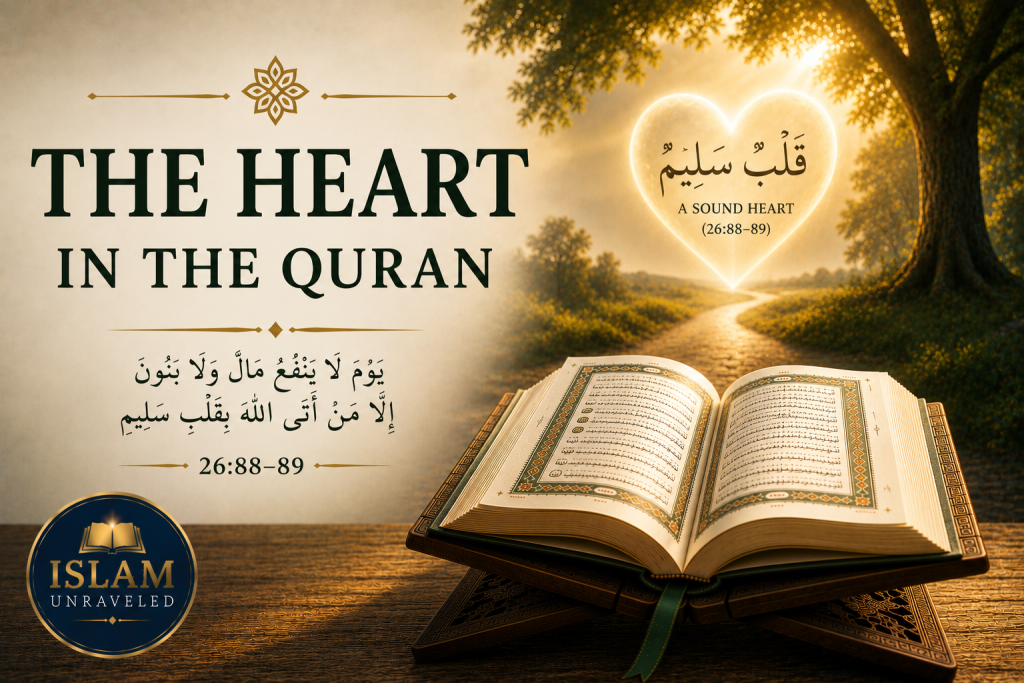
“The Day when neither wealth nor children will benefit, except one who comes to God with a sound heart.” (26:88–89)
Among the many organs of the human body, unique attention to one: the heart in the Quran. It is not merely the seat of emotion, nor simply a physical organ. In the Quran, the heart represents the inner person—the center of belief, intention, understanding, sincerity, and moral character.
People often judge one another by outward appearances, words, religious affiliation, or visible acts of worship. God, however, repeatedly directs our attention inward. While actions certainly matter, they originate from something deeper. A corrupt heart eventually produces corrupt actions, while a purified heart naturally bears the fruit of sincere faith and righteousness.
The Quran therefore calls believers not merely to reform their behavior but to purify the heart from which behavior flows.
A Sound Heart Is the Goal
When describing the Day of Judgment, the Quran presents a striking criterion for success:
“The Day when neither wealth nor children will benefit, except one who comes to God with a sound heart.” (26:88–89)
A sound heart (qalbin salīm) is one that is whole, sincere, and free from spiritual corruption. It is not divided between devotion to God and devotion to worldly idols, desires, or religious authorities.
The Quran does not say that success belongs to the wealthiest, the most knowledgeable, or even the most outwardly religious. It points instead to the condition of the heart.
Everything else flows from there.
Sincere Worship Begins in the Heart
God commands believers:
“They were commanded only to worship God, devoting the religion sincerely to Him…” (98:5)
Likewise:
“Worship God, devoting the religion sincerely to Him. Surely, sincere devotion belongs to God alone.” (39:2–3)
The Arabic expression mukhliṣīn lahu ad-dīn describes worship that is purified from every competing motive.
Sincerity cannot be manufactured by external rituals. It begins within the heart. A person may perform the same outward act as another, yet only God knows whether it was motivated by love of Him, desire for praise, fear of people, tradition, pride, or personal gain.
The Quran repeatedly reminds us that worship is not merely what we do, but whom we do it for.
God Knows What Lies Within
The Quran repeatedly shifts our attention away from appearances toward the unseen reality inside every person.
God says:
“God will not call you to account for what is unintentional in your oaths, but He will call you to account for what your hearts have earned.” (2:225)
This remarkable verse distinguishes between accidental speech and deliberate intention. God judges according to what the heart has truly embraced.
Elsewhere:
“He knows what you conceal and what you declare, and God knows what the hearts contain.” (64:4)
And:
“We created the human being, and We know what his soul whispers to him…” (50:16)
Nothing within the human heart is hidden from God—not motives, fears, ambitions, resentments, or secret desires.
This truth should produce both humility and hope. We cannot deceive God with outward appearances, but neither are sincere hearts overlooked simply because others fail to recognize them.
The Heart Produces the Fruit
Modern culture often separates belief from behavior.
The Quran does not.
The heart is the root.
Faith, repentance, patience, generosity, honesty, and righteousness are the fruit.
Jesus expressed the same universal principle when speaking of trees and their fruit, but the Quran consistently teaches this relationship through its own language.
A purified heart naturally inclines toward truth.
A diseased heart naturally inclines toward corruption.
Actions therefore reveal what already exists within.
The Quran repeatedly connects inward belief with outward conduct because the two cannot remain separated indefinitely.
The Diseases of the Heart
The Quran speaks not only of sound hearts but also of diseased hearts.
Regarding the hypocrites:
“In their hearts is a disease, so God increased their disease…” (2:10)
Elsewhere it describes hearts that become hardened through persistent rejection of truth:
“Then your hearts became hardened after that, becoming like stones or even harder.” (2:74)
Other hearts become sealed because of continual arrogance and disbelief (2:7; 16:108).
These descriptions remind us that spiritual decline rarely begins with outward actions.
It begins inside.
Small compromises accumulate until the heart itself becomes resistant to truth.
Purifying the Heart
The good news is that the Quran never presents the condition of the heart as irreversible.
God says:
“Except those who repent, reform, hold firmly to God, and purify their devotion to God…” (4:146)
Notice the progression.
Repentance.
Reform.
Holding firmly to God.
Purifying devotion.
The heart is transformed not by rituals alone but through sincere turning back to God and allowing His guidance to reshape one’s inner life.
Beware of Outward Religion Without Inner Transformation
Throughout history, religious people have often assumed that external performance guarantees God’s acceptance.
The Quran repeatedly challenges this assumption.
Prayer, fasting, charity, pilgrimage, knowledge, or religious identity cannot substitute for sincerity.
Nor can religious labels.
The hypocrites outwardly belonged to the believing community, yet the Quran repeatedly exposed the corruption hidden within their hearts.
Conversely, someone whose devotion is known only to God may possess a heart far more pleasing to Him than one admired by society.
The Quran therefore calls believers to examine themselves before judging others.
A Heart Devoted to God Alone
The greatest corruption of the heart is shirk—allowing devotion, fear, reliance, or religious authority to compete with God.
The greatest purification of the heart is ikhlāṣ—devoting religion sincerely to God alone.
This is why every messenger proclaimed the same central message:
“We did not send before you any messenger except that We revealed to him: There is no god except Me, so worship Me alone.” (21:25)
Exclusive devotion to God begins in the heart long before it is expressed in words or actions.
Conclusion
The Quran continually directs believers inward.
Our words matter.
Our actions matter.
But both are ultimately expressions of something deeper.
The heart is where faith begins.
The heart is where hypocrisy begins.
The heart is where repentance begins.
The heart is where worship begins.
One day every hidden motive will be exposed before the One who has always known it.
On that Day, wealth, status, religious affiliation, and public reputation will no longer matter.
What will matter is whether we come before God with a sound heart.
For that reason, the believer’s greatest lifelong task is not merely to improve outward behavior but to continually ask God to purify the heart from which every thought, word, and action flows.
“The Day when neither wealth nor children will benefit, except one who comes to God with a sound heart.” (26:88–89)