The Quran’s Purpose for Humanity
By: Mehdi Golafshani
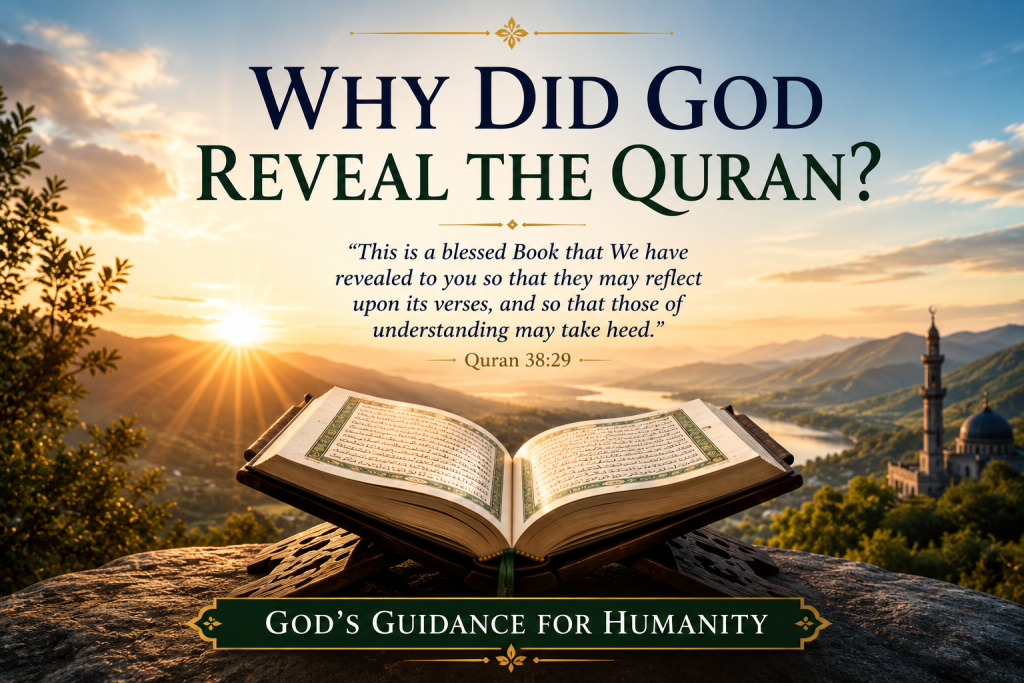
“This is a blessed Book that We have revealed to you so that they may reflect upon its verses, and so that those of understanding may take heed.” (38:29)
Introduction – A Question Every Reader Should Ask
The Quran has influenced the lives of billions of people over the past fourteen centuries. It has been recited, memorized, studied, translated, and discussed in every corner of the world. Yet one fundamental question is often overlooked:
Why did God reveal the Quran?
Was it merely to establish religious rituals?
Was it simply a record of history?
Was it intended only for seventh-century Arabia?
Or does the Quran itself explain its purpose?
Remarkably, it does.
Rather than leaving its mission to speculation, the Quran repeatedly describes itself. It calls itself guidance, light, mercy, healing, a reminder, a criterion, and a detailed explanation for humanity’s guidance. It explains where we came from, why we exist, how we should live, and where we are ultimately going.
The Quran is not simply a book to be admired. It is God’s guidance for humanity.
The Quran Describes Itself in 2:2, 2:185, 3:138, 5:15–16, 10:57, 12:111, 16:89, 17:9, 38:29, 41:44.
The Quran Introduces Humanity to Its Creator
The Quran does not begin with humanity.
It begins with God.
Its opening chapter introduces the One who created everything:
“Praise belongs to God, Lord of all worlds, the Most Gracious, the Most Merciful, Master of the Day of Judgment.” (1:2–4)
Before speaking about laws, worship, or morality, the Quran answers humanity’s most important question:
Who is God?
It repeatedly describes Him as:
- the Creator,
- the Sustainer,
- the Most Merciful,
- the All-Knowing,
- the All-Wise,
- the One without partner,
- the One to whom everyone will return.
The Quran’s central message is therefore not simply about religion – it is about restoring humanity’s relationship with its Creator.
God declares:
“O people, worship your Lord, who created you and those before you, so that you may become conscious of Him.” (2:21)
Everything else in the Quran flows from this foundation.
The Quran Is Guidance for Humanity
The Quran repeatedly describes itself as guidance.
Not guidance for one race.
Not guidance for one nation.
Not guidance only for Muslims.
Guidance for humanity.
God says:
“Ramadan is the month in which the Quran was revealed as guidance for mankind, with clear proofs of guidance and the criterion.” (2:185)
And He says:
“O mankind, there has come to you an instruction from your Lord, a healing for what is within the hearts, guidance, and mercy for the believers.” (10:57)
The Quran does not ask humanity to invent its own purpose.
It reveals the purpose given by the One who created humanity.
The Quran Explains Why We Exist
Every generation asks the same questions.
Is life merely an accident?
Does anything ultimately matter?
The Quran answers these questions directly.
God says:
“I did not create the jinn and mankind except to worship Me.” (51:56)
Human life is not random.
It has purpose.
Nor is life without accountability.
God says:
“He created death and life to test you as to which of you is best in deeds.” (67:2)
Every choice matters.
Every word matters.
Every action matters.
Life is neither meaningless nor predetermined. God grants every person freedom to choose while reminding each of us that we will meet Him.
The Quran Builds Character
The Quran does not merely tell us what to believe.
It teaches us what kind of people we should become.
It repeatedly calls us toward:
truthfulness,
justice,
patience,
gratitude,
humility,
mercy,
forgiveness,
keeping promises,
kindness to parents,
care for the needy,
and honesty in all dealings.
At the same time, it warns against:
arrogance,
oppression,
greed,
envy,
dishonesty,
hypocrisy,
and corruption.
These are not presented as arbitrary rules.
They are qualities that build individuals, families, and societies.
God says:
“Indeed, God commands justice, excellence, and giving to relatives, and He forbids immorality, wrongdoing, and transgression.” (16:90)
The Quran consistently calls people to become better human beings—not for the approval of society, but because these qualities reflect obedience to God.
The Quran Builds Strong Families and Communities
The Quran recognizes that individuals do not live in isolation.
Families become the foundation of society.
Communities rise or fall according to how people treat one another.
The Quran therefore gives guidance regarding:
marriage,
parents,
children,
neighbors,
orphans,
business,
charity,
justice,
contracts,
inheritance,
and resolving disputes.
Its guidance extends far beyond personal devotion.
It seeks to establish a society in which justice and compassion become the norm.
The Quran Invites Reflection
One of the Quran’s remarkable features is that it continually appeals to reason.
It repeatedly asks:
Will you not think?
Will you not reflect?
Will you not reason?
Rather than asking people to abandon thought, it directs them toward reflection.
It points to the heavens.
The earth.
The mountains.
The rain.
History.
The human being.
Even the smallest creatures become teachers.
Regarding the bee, God says:
“Your Lord inspired the bee: ‘Build homes in the mountains, the trees, and in what people construct. Then eat from every kind of fruit and follow the ways of your Lord made easy for you.’ From their bellies comes a drink of varying colors in which there is healing for people. Surely in this is a sign for people who reflect.” (16:68–69)
The bee follows the order established by its Creator and fulfills the purpose for which it was created.
The Quran invites humanity to consider whether lasting peace and purpose can likewise be found by living according to the guidance of the One who created us.
The Quran Warns Against What Destroys Humanity
Just as the Quran teaches what builds human life, it also warns against what destroys it.
Its greatest warning is against associating partners with God, for this corrupts humanity’s relationship with its Creator.
But the Quran also warns against the qualities that destroy individuals and societies:
arrogance,
oppression,
injustice,
blindly following inherited beliefs,
corruption,
greed,
and hypocrisy.
History is presented not merely as information but as instruction.
The rise and fall of earlier civilizations demonstrate that moral corruption eventually produces social collapse.
The Quran repeatedly asks its readers to learn from those who came before.
The Quran Offers Peace Through Submission to God
People seek peace through wealth.
Through success.
Through power.
Through relationships.
The Quran points elsewhere.
It points to God.
He says:
“Surely, in the remembrance of God do hearts find tranquility.” (13:28)
Again and again, God gives the same promise:
“They shall have no fear, nor shall they grieve.” (2:38; see also 2:62, 2:112, 2:277, 5:69, 6:48, 7:35, 10:62, 46:13)
This does not promise a life without hardship.
The prophets themselves experienced rejection, loss, persecution, and hardship.
Rather, it promises that those who trust God and follow His guidance possess something circumstances cannot remove:
hope,
purpose,
and inner peace.
The Quran Prepares Humanity for the Meeting with God
Ultimately, the Quran looks beyond this temporary life.
Every human being will stand before the Creator.
Nothing will remain hidden.
God says:
“And every soul will come, accompanied by a driver and a witness.” (50:21)
On that Day,
wealth will not matter,
status will not matter,
reputation will not matter.
Only truth.
Only faith.
Only righteous deeds.
The Quran continually reminds us that this meeting with God gives meaning to every decision we make today.
Conclusion – God’s Invitation to Humanity
The Quran was not revealed merely to be recited.
Nor merely to be admired.
Nor merely to be placed on a shelf.
It was revealed so that humanity might know its Creator, understand its purpose, distinguish truth from falsehood, develop upright character, establish justice, and prepare for the inevitable meeting with God.
Throughout its pages, the Quran describes itself as guidance, mercy, healing, light, reminder, and criterion—not because God needs anything from us, but because we need His guidance.
Its invitation remains as relevant today as when it was first revealed.
Follow God’s guidance. Worship Him alone. Live according to His revealed guidance.
In doing so, we discover not merely a religion, but the purpose for which we were created.
Continue Your Study
Worship God Alone
Who Explains the Quran?
God Alone Teaches the Quran
Belief in God
The Most Gracious and the Most Merciful in the Quran
Beyond Manifestation: The Quran’s Path to True Freedom