Introduction
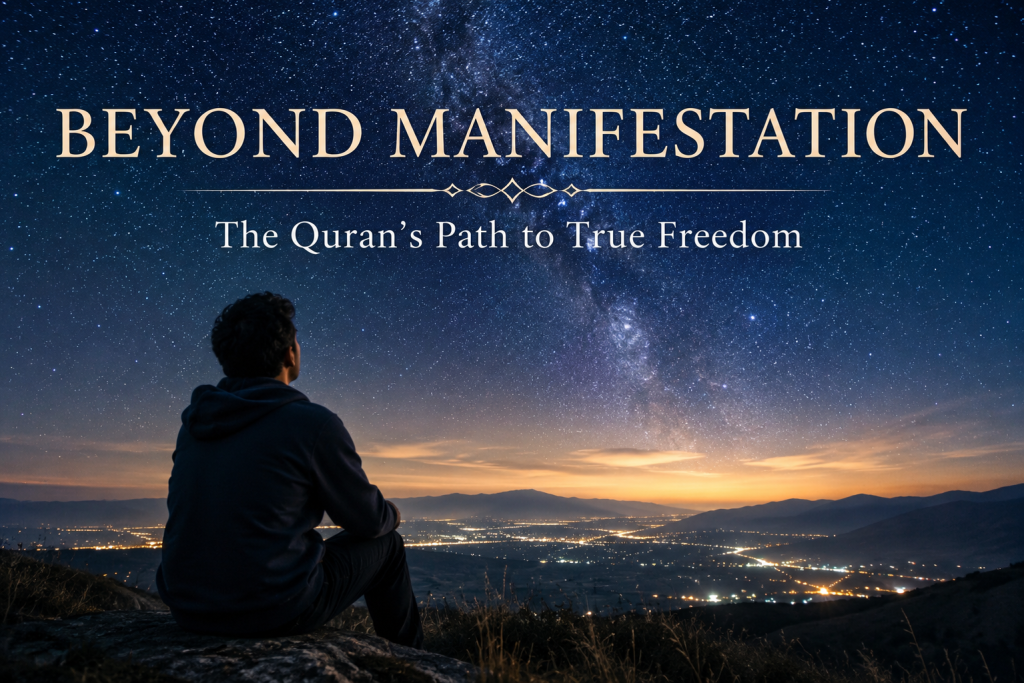
Exploring the concept of Beyond manifestation, the Quran can provide deeper insights into spiritual growth. In recent years, millions of people have turned to wellness coaches, manifestation teachers, and personal development experts seeking:
- healing,
- peace of mind,
- freedom from anxiety,
- emotional well-being,
- better relationships,
- financial abundance,
- and a greater sense of purpose.
Among the most influential voices are individuals such as Joe Dispenza, who emphasizes the power of thought, meditation, and the mind-body connection, and Peter Crone, who focuses on freeing people from limiting beliefs and emotional conditioning accumulated throughout life.
Many people report genuine benefits from such teachings:
- reduced stress,
- improved health,
- emotional healing,
- greater optimism,
- and freedom from self-imposed mental burdens.
The Quran does not oppose healing, self-improvement, or personal growth.
However, it frames these pursuits within a profoundly different worldview.
Modern manifestation teachings often focus on:
- the universe,
- the self,
- the mind,
- and this worldly life.
The Quran redirects attention toward:
- the Creator,
- worship,
- the soul,
- and the Hereafter.
The difference is not merely one of technique.
It is a difference in purpose.
Why Modern Wellness Teachings Appeal to So Many People
Human beings naturally seek relief from suffering.
People struggle with:
- fear,
- anxiety,
- illness,
- grief,
- trauma,
- uncertainty,
- and disappointment.
Wellness teachers often help people identify:
- destructive thought patterns,
- emotional wounds,
- unhealthy beliefs,
- and self-defeating habits.
There is nothing inherently wrong with such efforts.
The Quran itself repeatedly calls upon human beings to:
- reflect,
- think,
- observe,
- and examine themselves.
The desire to heal is natural.
The desire to improve one’s life is natural.
The question is:
What is the ultimate source of healing and freedom?
The Universe Is a Creation, Not a Source of Power
One of the most common themes in manifestation teachings is the idea that:
- “The universe will provide.”
- “The universe responds.”
- “The universe gives you what you focus on.”
The Quran presents a fundamentally different perspective.
The universe is not a source of power.
It is a creation.
The heavens, the earth, the stars, and everything within them are signs pointing toward God.
“In the creation of the heavens and the earth, and the alternation of night and day, there are signs for those who possess intelligence.” (3:190)
The Quran repeatedly directs human attention away from creation and toward:
The universe possesses no independent will.
It neither rewards nor punishes.
It neither hears nor responds.
God alone:
- creates,
- sustains,
- provides,
- heals,
- and controls all things.
The believer therefore places trust not in “the universe,” but in:
the Lord of the universe.
Manifestation vs Trust in God
Modern manifestation teachings often encourage people to ask:
How can I change my thoughts to change my reality?
The Quran asks a different question:
Upon whom are you relying?
The Quran encourages:
- effort,
- planning,
- optimism,
- and hope.
But it also teaches that outcomes ultimately belong to God.
“Once you make a decision, carry out your plan, and trust in GOD. GOD loves those who trust in Him.” (3:159)
The believer works hard, seeks improvement, and pursues goals.
But the believer understands that:
- success comes from God,
- provision comes from God,
- and protection comes from God.
This perspective removes a tremendous burden from the human being.
One is no longer required to control the universe.
One is only required to strive sincerely and trust God.
Healing, Disease, and Human Suffering
Many participants in wellness retreats report significant improvements in:
- physical health,
- emotional well-being,
- and quality of life.
The Quran does not deny the relationship between:
- mind and body,
- hope and healing,
- stress and illness.
Indeed, emotional states can profoundly affect physical well-being.
However, the Quran places healing within a larger framework.
Abraham declared:
“And when I get sick, He heals me.” (26:80)
The source of healing is ultimately God.
The Quran also describes itself as:
“A healing and mercy for the believers.” (17:82)
Physical healing is valuable.
Emotional healing is valuable.
But from the Quranic perspective, healing is not the highest goal of life.
The Deepest Shackles Are Not Physical
Peter Crone often speaks about:
- limiting beliefs,
- childhood conditioning,
- emotional wounds,
- and invisible mental prisons.
There is considerable truth in the observation that many people are trapped by:
- fear,
- resentment,
- insecurity,
- guilt,
- and false beliefs about themselves.
The Quran goes deeper.
The greatest prison is not:
- illness,
- poverty,
- trauma,
- or difficult circumstances.
The greatest prison is separation from God.
A person may possess:
- wealth,
- health,
- success,
- recognition,
and still remain trapped by fear and anxiety.
The Quran repeatedly identifies:
- attachment to the world,
- dependence upon creation,
- and forgetfulness of God
as deeper sources of human suffering.
The Freedom That Comes From God Alone
This is where the Quran’s message becomes profoundly liberating.
A worshipper of God alone gradually releases many of the deepest burdens carried by human beings.
Why?
Because the believer accepts certain truths:
- God controls all things.
- God is the provider.
- God is the protector.
- God is sufficient.
- Nothing occurs outside God’s knowledge.
- Death is not the end.
- The Hereafter is real.
The Quran assures believers:
“Nothing happens to us except what GOD has decreed for us. He is our Lord and Master. In GOD the believers shall trust.” (9:51)
And:
“Is GOD not sufficient for His servant?” (39:36)
And:
“Absolutely, by remembering GOD, the hearts rejoice.” (13:28)
The Quran even provides a remarkable reassurance:
“GOD never burdens a soul beyond its means.” (2:286)
And:
“We never burden any soul beyond its means.” (7:42)
For the believer, these are not merely theological statements.
They are sources of profound inner freedom.
Many who turn to the worship of God alone discover that countless worries begin to fall away.
Not because life becomes easy.
But because the believer no longer carries the impossible burden of controlling life.
That burden belongs to God alone.
The Danger of Making the Self the Center
Many wellness teachings place the self at the center:
- You create.
- You attract.
- You manifest.
- You become.
The Quran warns of a subtle danger.
The self can become an object of devotion.
“Have you seen the one whose god is his own ego?” (45:23)
The Quran repeatedly teaches:
- humility,
- gratitude,
- dependence upon God,
- and awareness of human limitations.
The center of reality is not:
- the self,
- the mind,
- or the universe.
The center is God.
This Life Is Not the Final Destination
Perhaps the greatest difference between modern wellness spirituality and the Quran concerns the Hereafter.
Most manifestation teachings focus almost entirely upon:
- health,
- relationships,
- abundance,
- success,
- longevity,
- and happiness in this life.
The Quran asks:
Then what?
The Quran repeatedly reminds humanity that worldly life is temporary.
“This worldly life is no more than illusion and vanity, while the abode of the Hereafter is the real life.” (29:64)
“You are preoccupied with this first life, even though the Hereafter is far better and everlasting.” (87:16-17)
The believer may seek:
- health,
- provision,
- success,
- and happiness.
But these are never the ultimate goal.
The Hereafter remains central.
What Is Real Success?
Modern culture often defines success as:
- wealth,
- health,
- influence,
- achievement,
- and comfort.
The Quran defines success differently.
“Whoever is spared the Hellfire, and admitted into Paradise, has attained the greatest triumph.” (3:185)
The Quran repeatedly links success to:
- purification,
- righteousness,
- faith,
- and God’s acceptance.
The greatest victory is not obtaining everything one desires in this life.
The greatest victory is succeeding in the life that never ends.
The Quran’s Balanced Path
The Quran does not oppose:
- healing,
- medicine,
- emotional growth,
- self-improvement,
- or personal development.
It encourages:
- gratitude,
- patience,
- reflection,
- optimism,
- and trust.
But it places all of these within a larger framework:
- God is the source.
- The universe is a creation.
- Healing is temporary.
- Death is inevitable.
- The Hereafter is eternal.
- Worship of God alone is life’s highest purpose.
This balance protects the believer from two extremes:
- neglecting this world,
- or becoming obsessed with it.
Conclusion
Modern wellness teachers often ask:
How can I improve my life?
The Quran asks a deeper question:
Why was I given this life?
Manifestation seeks:
- a better life.
The Quran seeks:
- a better soul.
Manifestation focuses primarily on:
- this world.
The Quran prepares human beings for:
- this world and eternity.
Wellness teachings may help remove some of the chains imposed by fear, trauma, and limiting beliefs.
The Quran offers something even greater:
freedom from dependence upon creation through complete trust in the Creator alone.
That is the path to true freedom.