Introduction
Modern religious culture often equates understanding with:
- scholarship
- credentials
- language mastery
- academic expertise
The Quran certainly values:
- knowledge
- reflection
- reason
- contemplation
Yet the Quran repeatedly teaches that the deepest barrier between a human being and divine guidance is not lack of intelligence.
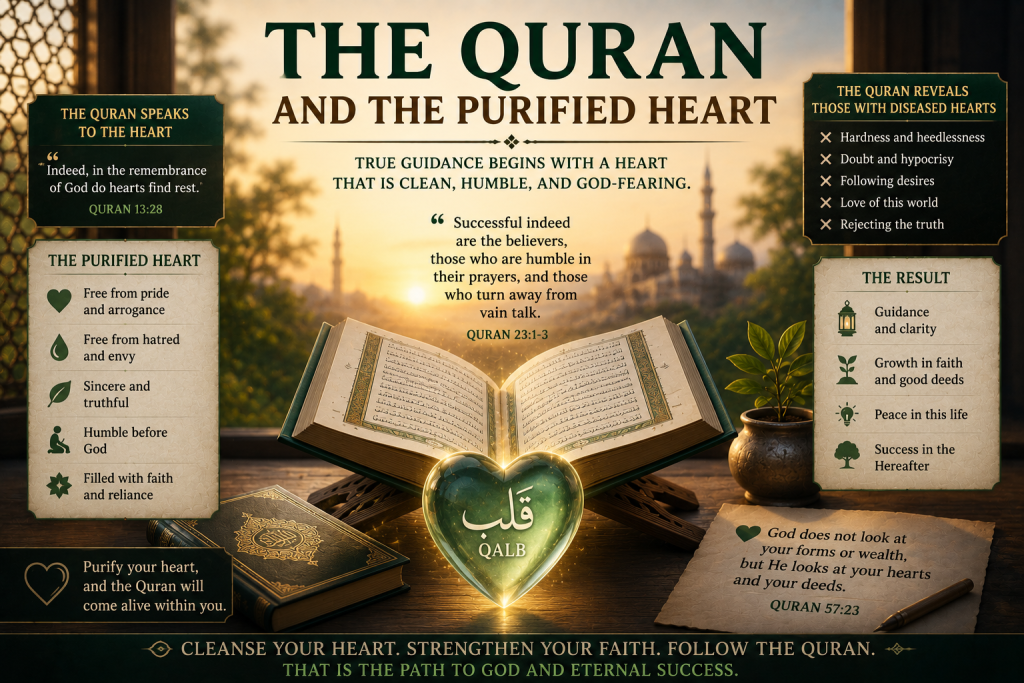
It is the condition of the Quran and the purified heart.
Again and again, the Quran emphasizes:
- sincerity
- humility
- reverence toward God
- purification of the soul
as essential conditions for receiving guidance.
The Quran therefore presents a profound principle:
A purified heart may perceive truths that a knowledgeable but arrogant heart cannot.
The Quran and Spiritual Receptivity
One of the Quran’s most striking statements appears in Surah 56:
“None can grasp it except the purified.” (56:79)
Regardless of the detailed interpretive discussions surrounding this verse, the Quran repeatedly reinforces the same central idea elsewhere:
Spiritual receptivity matters.
The human being’s internal condition affects:
- perception
- understanding
- guidance
- sincerity before revelation
The Heart in the Quran
The Quran repeatedly places spiritual understanding within the heart.
“They have hearts with which they do not understand…” (7:179)
“The day when neither money nor children can help. Only those who come to GOD with a sound heart.” (26:88–89)
The Quran does not portray the heart merely as an emotional center.
It represents:
- inner sincerity
- moral condition
- spiritual orientation
- receptivity toward truth
Knowledge Without Purification
The Quran repeatedly warns that knowledge alone does not guarantee guidance.
A person may:
- study scripture extensively
- master religious terminology
- memorize revelation
- become intellectually sophisticated
yet remain:
- arrogant
- insincere
- spiritually resistant
The Quran repeatedly presents examples of people possessing knowledge while rejecting truth due to:
- ego
- pride
- attachment to status
- worldly interests
Satan Had Knowledge
One of the Quran’s deepest warnings is that Satan himself possessed knowledge.
Satan:
- knew God existed
- spoke directly to God
- understood divine command
Yet knowledge did not save him.
Why?
Because the problem was not ignorance.
It was arrogance.
“He refused, became arrogant, and thus became a disbeliever.” (2:34)
The Quran therefore teaches that purification of the heart is more fundamental than mere accumulation of information.
The Quran Prioritizes Humility
The Quran repeatedly praises humility before revelation.
“The believers are those whose hearts tremble when GOD is mentioned…” (8:2)
“Their skins and hearts soften up for GOD’s message…” (39:23)
The sincere believer approaches revelation:
- seeking truth
- willing to change
- open to correction
- reverent toward God
This humility creates receptivity.
Arrogance as Spiritual Blindness
One of the Quran’s recurring themes is that arrogance blocks understanding.
“I will divert from My revelations those who are arrogant on earth without justification.” (7:146)
The arrogant person often approaches revelation:
- defensively
- selectively
- seeking self-confirmation
- protecting inherited beliefs
Instead of allowing revelation to transform him, he attempts to reshape revelation around ego.
The Quran repeatedly exposes this condition.
The Purified Heart and Sincerity
The Quran consistently links guidance with sincerity.
“This scripture is infallible; a beacon for the righteous.” (2:2)
The Quran does not say:
- guidance automatically reaches every reader equally
Rather, the Quran repeatedly emphasizes receptivity within the human being.
Sincerity includes:
- honesty before God
- willingness to surrender to truth
- rejection of self-deception
- humility toward revelation
The Quran and Reflection
The Quran repeatedly commands reflection:
“Why do they not reflect upon the Quran?” (4:82)
“This is a scripture full of blessings that they may reflect upon its verses…” (38:29)
But reflection in the Quran is not merely intellectual analysis.
It is moral and spiritual engagement.
The Quran repeatedly calls human beings not merely to analyze revelation, but to allow revelation to analyze them.
The Disease of the Heart
The Quran frequently describes spiritual corruption as disease.
“In their hearts there is disease…” (2:10)
This disease includes:
- hypocrisy
- arrogance
- dishonesty
- attachment to worldly authority
- resistance to truth
A diseased heart approaches revelation differently than a purified one.
The same verses:
- soften one soul
- harden another
The revelation itself remains pure.
The differing outcomes reflect the internal condition of the reader.
The Quran and God Alone
The Quran repeatedly reveals that many people become uncomfortable when:
- God alone is emphasized
- human religious authority is challenged
- inherited traditions are questioned
“When GOD ALONE is mentioned, the hearts of those who do not believe in the Hereafter shrink with aversion…” (39:45)
This reaction itself becomes exposure.
The Quran functions as a mirror revealing hidden attachments within the heart.
Purification Before Certainty
Modern thinking often assumes:
- certainty comes first
then - transformation follows
The Quran frequently reverses this order.
The Quran repeatedly teaches that purification itself opens the path toward deeper understanding.
A sincere person:
- reflects honestly
- repents
- abandons arrogance
- seeks God sincerely
and gradually receives greater clarity.
Why Some Learned People Remain Unguided
The Quran repeatedly demonstrates that:
- intelligence alone
- scholarship alone
- religious status alone
cannot guarantee guidance.
A person may possess:
- vast information
- linguistic expertise
- theological sophistication
yet remain spiritually distant because the heart itself resists surrender.
Meanwhile, another person with little formal knowledge but sincere devotion to God may receive profound guidance.
The Quran and the Fear of God
The Quran repeatedly connects understanding with reverence toward God.
“Those who truly reverence GOD among His servants are the knowledgeable.” (35:28)
This verse is often misunderstood.
The Quran is not glorifying information alone.
True knowledge produces:
- humility
- reverence
- awareness of God
- moral responsibility
Knowledge without reverence becomes spiritually dangerous.
The Purified Heart and Guidance
The Quran repeatedly teaches that guidance is ultimately granted by God.
“The Most Gracious. Teacher of the Quran.” (55:1–2)
The purified heart becomes receptive because it:
- seeks truth sincerely
- abandons arrogance
- approaches revelation humbly
The Quran repeatedly calls human beings toward this state.
The Final Reality
The Quran is not merely testing:
- intelligence
- memory
- analytical ability
It is testing:
- sincerity
- humility
- moral honesty
- willingness to submit to God
This is why the Quran repeatedly emphasizes purification of the soul.
The greatest barrier to understanding is often not intellectual limitation.
It is the ego.
Related Articles in This Series
The themes explored in this article connect to broader Quranic discussions on sincerity, accountability, guidance, ego, leadership, and the human soul. The following companion articles explore these subjects in greater depth:
- The Quran Reads You — Sincerity and Guidance in the Quran
How the Quran is not merely read to the human being but the Quran reads the human being. - Why Some People Cannot Understand the Quran
A Quranic study of arrogance, sincerity, inherited beliefs, and spiritual blindness. - The Quran Is a Mirror — Human Nature and Divine Guidance
How the Quran exposes sincerity, hypocrisy, ego, and the internal condition of the reader. - God Alone Teaches the Quran
The Quran’s repeated emphasis that true understanding and guidance come from God alone. - The Quran Is Not a Passive Book
How the Quran actively interacts with the conscience, intellect, and spiritual state of the human being.
Conclusion
The Quran repeatedly teaches that the condition of the heart determines receptivity to guidance.
Knowledge alone cannot guarantee understanding.
A person may possess:
- scholarship
- religious status
- linguistic mastery
yet remain spiritually blind due to arrogance and insincerity.
Meanwhile, a purified and sincere heart may receive profound guidance from God.
The Quran therefore repeatedly calls human beings toward:
- humility
- reflection
- sincerity
- repentance
- reverence toward God
because ultimately, the deepest understanding of revelation belongs not merely to the informed mind, but to the purified heart.
Related Discussion (Video)
This article was inspired in part by themes discussed in the following video: