Introduction
Most books remain passive.
A person may:
- read them
- ignore them
- reinterpret them
- place them on a shelf
and the book itself remains unchanged and inactive.
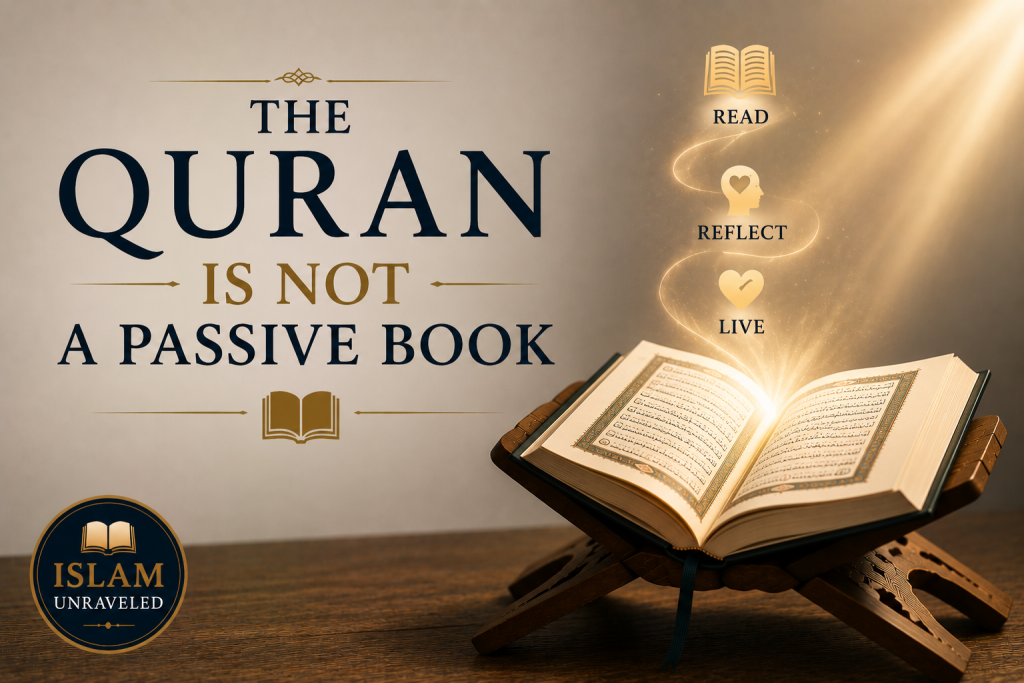
The Quran is not a passive book, and presents itself very differently.
The Quran repeatedly describes itself as:
- guidance
- light
- criterion
- healing
- reminder
- mercy
- wisdom
- and living revelation from God
The Quran does not describe itself merely as information to be stored in the mind.
It presents itself as an active force interacting with:
- the soul
- the conscience
- the intellect
- the moral condition of the human being
The Quran therefore cannot be approached as a passive religious artifact.
It confronts, exposes, guides, separates, warns, heals, and transforms.
The Quran Produces Different Outcomes
One of the Quran’s most remarkable statements appears in Surah 2:
“He guides many with it, and misguides many with it.” (2:26)
This verse immediately demonstrates that the Quran is not passive.
The same revelation:
- guides one person
while - increasing another in resistance
A passive book simply transmits information identically to all readers.
The Quran repeatedly teaches something far deeper:
the revelation interacts with the internal condition of the human being.
The Quran Acts Upon the Heart
The Quran repeatedly describes its effect on the human heart.
“The believers are those whose hearts tremble when GOD is mentioned…” (8:2)
“Their skins and hearts soften up for GOD’s message…” (39:23)
The Quran is not presented merely as:
- intellectual material
- theology
- philosophy
It acts upon:
- emotion
- conscience
- humility
- reverence
- spiritual awareness
The Quran repeatedly engages the whole human being.
The Quran Exposes Internal Reality
The Quran repeatedly functions as exposure.
It reveals:
- hypocrisy
- arrogance
- sincerity
- attachment
- hidden motives
This is why the Quran often provokes strong emotional reactions.
“When GOD ALONE is mentioned, the hearts of those who do not believe in the Hereafter shrink with aversion…” (39:45)
The reaction itself becomes revelation.
The Quran exposes what already exists beneath the surface.
The Quran Challenges Rather Than Entertains
Modern reading culture often treats books as:
- entertainment
- intellectual consumption
- emotional comfort
The Quran repeatedly disrupts comfort.
It:
- questions assumptions
- confronts ego
- dismantles inherited beliefs
- challenges human authority
- exposes contradictions
This is why the Quran repeatedly asks:
“Will you not reason?”
“Will they not reflect?”
The Quran demands engagement rather than passive consumption.
The Quran Is Designed for Reflection
The Quran repeatedly commands contemplation:
“Why do they not reflect upon the Quran?” (4:82)
“This is a scripture full of blessings that they may reflect upon its verses…” (38:29)
Reflection in the Quran is ongoing.
The believer is not meant merely to:
- finish reading
- memorize words
- repeat inherited interpretations
The Quran repeatedly invites:
- reconsideration
- deeper reflection
- internal examination
- growth in understanding
Repeated Reading Reveals New Depth
One of the remarkable characteristics of the Quran is that repeated reading often reveals:
- new dimensions
- overlooked connections
- deeper psychological insight
- stronger spiritual impact
This does not mean the Quran changes.
Rather:
- the human being changes
- experiences deepen
- sincerity increases
- awareness expands
The Quran continues interacting dynamically with the reader.
The Quran and the Human Ego
The Quran repeatedly confronts the ego.
This is one reason many people resist its message.
The Quran challenges:
- self-righteousness
- inherited certainty
- sectarian attachment
- personality worship
- worldly arrogance
For the humble, this confrontation becomes healing.
For the arrogant, it becomes disturbance.
The Quran Is Not Merely Historical
Many people attempt to reduce the Quran into:
- historical narrative
- ancient culture
- theological documentation
The Quran repeatedly refuses this limitation.
It consistently addresses:
- the present human condition
- recurring human behavior
- timeless spiritual patterns
The Quran describes itself as:
“A reminder for the world.” (68:52)
Its message remains active because human nature itself remains active.
The Quran Responds to the Reader
The Quran repeatedly describes different responses depending on the reader’s condition.
“As for those who harbor doubt in their hearts, it only adds impurity to their impurity…” (9:125)
“It is a healing and mercy for the believers…” (17:82)
The same Quran:
- heals one person
- disturbs another
This is not the behavior of a passive text.
The revelation interacts with the soul itself.
The Quran and Divine Teaching
The Quran repeatedly attributes understanding directly to God.
“The Most Gracious. Teacher of the Quran.” (55:1–2)
“Then it is for Us to explain it.” (75:19)
The Quran is therefore not merely a human intellectual object to be mastered independently from God.
Its deepest understanding requires:
- sincerity
- humility
- divine guidance
The Quran Separates Truth From Falsehood
The Quran calls itself:
Al-Furqan
The Criterion
A criterion actively separates.
The Quran separates:
- truth from falsehood
- sincerity from hypocrisy
- humility from arrogance
This separation occurs continuously whenever human beings engage with revelation.
The Quran Is Alive in Human Experience
The Quran repeatedly reappears within:
- personal struggle
- moral conflict
- suffering
- repentance
- social corruption
- human psychology
Verses often become newly meaningful through lived experience.
This dynamic interaction is one reason sincere believers repeatedly return to the Quran throughout life.
The revelation continues speaking to changing circumstances while remaining unchanged itself.
The Quran and Accountability
The Quran repeatedly refuses passive religion.
It does not allow the human being to:
- outsource responsibility
- inherit truth blindly
- follow leaders uncritically
- avoid self-examination
Instead, it constantly calls people toward:
- reflection
- repentance
- conscious submission to God
The Quran therefore becomes an active moral force confronting the reader continuously.
The Quran Is Meant to Transform
The Quran was never intended merely to:
- inform the mind
It was meant to:
- transform the soul
This is why the Quran repeatedly emphasizes:
- purification
- remembrance of God
- humility
- reverence
- righteousness
Information alone does not transform human beings.
Revelation does.
The Final Reality
The Quran repeatedly demonstrates that human beings do not stand neutrally before revelation.
The Quran:
- questions
- exposes
- guides
- warns
- softens
- separates
- transforms
Some people approach it sincerely and receive light.
Others approach it defensively and become more resistant.
The revelation itself remains unchanged.
What changes is the human being standing before it.
Related Articles in This Series
The themes explored in this article connect to broader Quranic discussions on sincerity, accountability, guidance, ego, leadership, and the human soul. The following companion articles explore these subjects in greater depth:
- The Quran Reads You — Sincerity and Guidance in the Quran
How the Quran is not merely read to the human being but the Quran reads the human being. - Why Some People Cannot Understand the Quran
A Quranic study of arrogance, sincerity, inherited beliefs, and spiritual blindness. - The Quran Is a Mirror — Human Nature and Divine Guidance
How the Quran exposes sincerity, hypocrisy, ego, and the internal condition of the reader. - God Alone Teaches the Quran
The Quran’s repeated emphasis that true understanding and guidance come from God alone. - The Quran and the Purified Heart — Sincerity Before Knowledge
Why the Quran prioritizes humility and purification of the soul over mere scholarship.
Conclusion
The Quran repeatedly presents itself as far more than a passive religious text.
It is:
- guidance
- light
- healing
- criterion
- reminder
- revelation from God
The Quran actively interacts with:
- the conscience
- the intellect
- the ego
- and the condition of the human soul
It confronts arrogance, exposes hypocrisy, strengthens sincerity, and calls human beings toward reflection and transformation.
This is why the Quran continues affecting people so profoundly across generations.
The Quran does not merely sit silently waiting to be analyzed.
It speaks, confronts, separates, and transforms.
The Quran is not a passive book.
Related Discussion (Video)
This article was inspired in part by themes discussed in the following video: