The Day of Resurrection — Events Described in the Quran
Introduction
The Day of Resurrection in the Quran is one of the central themes. The Quran repeatedly reminds us that earthly life is temporary, that the dead will be raised, and that every person will ultimately stand before God.
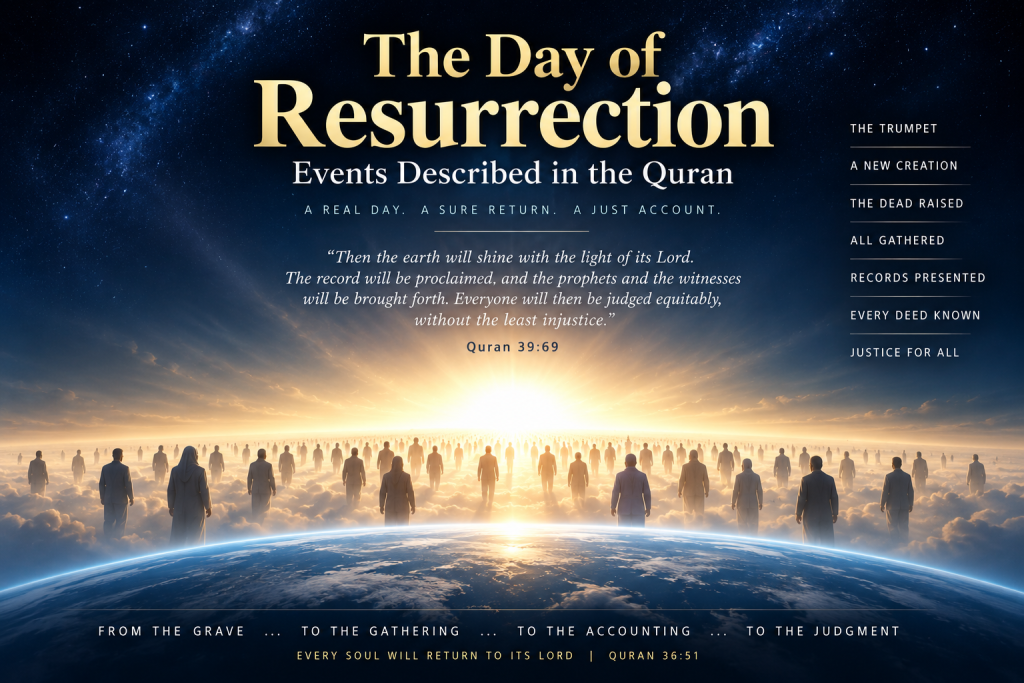
Rather than presenting the Day merely as an abstract doctrine, the Quran describes a series of extraordinary events: the Trumpet is blown, the present cosmic order is disrupted, the dead emerge from their graves, humanity is gathered, records are presented, deeds become known, and God judges with perfect justice.
At the same time, the Quran does not necessarily describe one identical experience for everyone. Some passages describe questioning, witnesses, denial, and testimony against people. Other passages describe believers receiving an easy accounting, while still others tell us that God has already forgiven the sins of those who repent, believe, and lead righteous lives.
This study therefore asks a straightforward question:
What does the Quran itself tell us will happen on the Day of Resurrection?
The purpose is not to construct details that God has not given us, but to bring together the events that the Quran actually describes.
1. The Trumpet Is Blown
The Quran repeatedly associates the beginning of Resurrection with the blowing of the Trumpet.
“The horn will be blown, whereupon everyone in the heavens and the earth will be struck unconscious, except those who will be spared by GOD. Then it will be blown another time, whereupon they will all rise up, looking.”
Quran 39:68
Another passage describes the dead coming directly from their graves:
“The horn will be blown, whereupon they will rise from the grave and go to their Lord.”
Quran 36:51
The Quran therefore connects the Trumpet with the ending of the present condition and the resurrection of the dead.
2. The Present Cosmic Order Is Radically Changed
Resurrection is accompanied by an extraordinary transformation of the world as we presently know it.
The Quran describes:
- the earth being shaken — 99:1–2
- the mountains being removed — 18:47; 20:105–107
- the heaven being split — 69:16; 82:1; 84:1
- the stars losing their present order — 81:2; 82:2
- the sun being folded up — 81:1
One verse summarizes the transformation particularly powerfully:
“The day will come when this earth will be substituted with a new earth, and also the heavens, and everyone will be brought before GOD, the One, the Supreme.”
Quran 14:48
Whatever details we may not know, the Quran makes clear that Resurrection involves much more than human beings simply returning to life. The present created order itself undergoes profound change.
3. The Dead Emerge From Their Graves
The Quran repeatedly describes people physically emerging from their graves.
“The horn will be blown, whereupon they will rise from the grave and go to their Lord.”
Quran 36:51
Another striking description appears in Surah 70:
“The day will come when they will come out of the graves quickly, as if they were racing towards erected goals.”
Quran 70:43
The resurrection is therefore not presented merely as a spiritual awakening. Those who were dead are brought back and emerge from their burial places.
See also 54:7–8.
4. The Resurrected Realize What Has Happened
The resurrected become conscious that the event they had been promised has arrived.
Following the resurrection described in 36:51, they say:
“They will say, ‘Woe to us. Who resurrected us from our death? This is what the Most Gracious had promised. The messengers were right.’”
Quran 36:52
What had previously required belief has now become visible reality.
There is no longer uncertainty concerning resurrection, God’s promise, or accountability.
The Covering Is Removed
Resurrection brings not only a return to life but also a profound change in awareness.
The Quran says:
“You were certainly heedless of this, so We have removed from you your covering, and today your sight is sharp.”
Quran 50:22
During earthly life there was something human beings did not fully perceive. The Quran describes this condition as ghaflah – heedlessness or unawareness – and speaks of a covering that prevented clear perception.
On the Day of Resurrection that covering is removed.
What had required faith during earthly life has become directly apparent. The person’s “sight” is now sharp.
Related Study: Purpose of Life
Why are we here? Explore what the Quran tells us about our existence, our earthly test, and our ultimate return to God.
5. Everyone Is Gathered
The Quran describes a universal gathering.
“…We will summon them all; not a single one of them will be left out.”
Quran 18:47
Human beings who were separated by geography, history, nationality, wealth, status, and generations are now assembled before their Creator.
The Quran also emphasizes the individual nature of this return:
“All of them will come before Him on the Day of Resurrection as individuals.”
Quran 19:95
See also 6:94; 18:48.
We lived among families, nations, religious communities, and societies. But ultimately each person returns to God individually.
6. Everyone Follows the Caller
The Quran describes the gathered people responding to a caller:
“On that day, everyone will follow the caller, without the slightest deviation. All sounds will be hushed before the Most Gracious; you will hear nothing but whispers.”
Quran 20:108
The picture is one of complete submission.
The freedom people possessed during earthly life—to believe or disbelieve, obey or disobey—is no longer the issue. Everyone now responds to God’s command.
7. Earthly Relationships Can No Longer Protect Anyone
The Quran describes a dramatic change in the relationships that mattered so much during earthly life:
“The day will come when one will flee from his brother. From his mother and father. From his spouse and children. Each one of them, on that day, will be too preoccupied to worry about anyone else.”
Quran 80:34–37
Family relationships cannot transfer responsibility from one person to another.
Elsewhere the Quran establishes the underlying principle:
“No soul bears the sins of another soul.”
Quran 6:164
The same principle appears repeatedly in 17:15; 35:18; 39:7.
8. Everyone Is Presented Before God
The gathered people are brought before their Lord:
“They will be presented before your Lord in a row. ‘You have come to us just as We created you the first time…’”
Quran 18:48
Nothing acquired during earthly life changes this fundamental reality.
Wealth, family, social position, religious status, and worldly authority cannot substitute for the individual standing before God.
9. The Earth Shines With the Light of Its Lord
One of the Quran’s most concentrated descriptions of Judgment appears in Surah 39:
“Then the earth will shine with the light of its Lord. The record will be proclaimed, and the prophets and the witnesses will be brought forth. Everyone will then be judged equitably, without the least injustice.”
Quran 39:69
Several elements of the Judgment appear together:
God’s light → the record → prophets → witnesses → judgment → perfect justice.
The final phrase is fundamental:
No one will be wronged.
10. The Records Are Presented
The Quran repeatedly refers to records containing what people did.
“The record will be shown, and you will see the guilty fearful of its contents. They will say, ‘Woe to us. How come this book leaves nothing, small or large, without counting it?’ They will find everything they had done brought forth. Your Lord is never unjust towards anyone.”
Quran 18:49
Nothing has escaped God’s knowledge.
The purpose of the record is therefore not to inform God. God already knows everything.
Rather, the record makes the reality of each person’s earthly life manifest.
See also 39:69; 45:28–29.
11. Every Person Encounters What He or She Did
Surah 99 reduces accountability to its smallest possible measure:
“Whoever does an atom’s weight of good will see it. And whoever does an atom’s weight of evil will see it.”
Quran 99:7–8
The Quran therefore presents Judgment as being based upon reality—not reputation, religious affiliation, family background, or what others believed about a person.
What matters is what the person actually believed and did.
Not Everyone Necessarily Undergoes the Same Accounting Process
This distinction is important.
It would be easy to combine all the Quran’s Judgment passages into a single courtroom sequence:
record → questioning → witnesses → testimony → verdict
and assume that every human and jinn must undergo every step in precisely the same way.
The Quran does not require that conclusion.
Different passages describe different circumstances.
12. Repentance Can Change the Record Before Judgment
One of the most important passages concerning Judgment is 25:70:
“Exempted are those who repent, believe, and lead a righteous life. GOD transforms their sins into credits. GOD is Forgiver, Most Merciful.”
Quran 25:70
This says considerably more than that God simply ignores their sins.
God transforms their sins into credits.
Other verses express the same principle in different ways.
Those who believe and lead righteous lives have their sins remitted:
29:7
God remits their sinful works:
39:35
And concerning righteous believers:
“It is from these that we accept the righteous works, and overlook their sins.”
Quran 46:16
This has an important implication for understanding the Day of Resurrection.
We should not assume that a repentant believer arrives before God with every sin committed throughout life still standing as an unresolved charge.
God may already have forgiven it, remitted it, overlooked it – or transformed it into a credit.
13. Some Receive an Easy Accounting
The Quran explicitly describes a different experience for some people:
“As for the one who receives his record with his right hand, he will receive an easy reckoning. And will return to his people joyfully.”
Quran 84:7–9
The expression is significant:
حِسَابًا يَسِيرًا — ḥisāban yasīrā
“an easy accounting.”
There is accountability, but the Quran does not describe it here as a difficult interrogation or prosecution.
This distinction becomes even more apparent in Surah 69.
14. The Believer Is Willing to Have the Record Read
The person receiving the record in the right hand says:
“Here is my record; read it. I did believe that I was going to be held accountable.”
Quran 69:19–20
This person is not depicted attempting to conceal the record or defend himself against accusations.
He openly invites others to read it.
The contrast with people terrified by their records is striking.
We can therefore make an important distinction:
Everyone is accountable to God, but everyone’s accounting need not take the form of an interrogation or trial.
For some, the Quran explicitly calls it an easy accounting.
15. Witnesses Are Brought Forward
Other Judgment scenes clearly involve witnesses.
Surah 39 says:
“…the prophets and the witnesses will be brought forth…”
Quran 39:69
The Quran even describes a person’s own body providing testimony:
“The day will come when their own tongues, hands, and feet will bear witness to everything they had done.”
Quran 24:24
And:
“On that day we will seal their mouths; their hands and feet will bear witness to everything they had earned.”
Quran 36:65
This testimony has an evidentiary character. It establishes what actually happened when denial is no longer possible.
But this does not require us to conclude that witnesses must testify against every person concerning every sin.
If God has already forgiven a sin – and particularly if 25:70 says He has transformed it into a credit – there is no Quranic reason to assume that the same forgiven sin must subsequently be prosecuted through witnesses against the believer.
16. The Quran Describes Different Circumstances of Questioning
Some passages clearly describe questioning.
God says:
“By your Lord, we will question them all. About everything they have done.”
Quran 15:92–93
See also 37:24; 102:8.
Yet other passages say:
“On that day, no human, nor a jinn, will be asked about his sins.”
Quran 55:39
Similarly, 28:78 says that the guilty are not asked about their sins.
Other passages describe people speaking, arguing, or offering explanations, while 77:35–36 describes a time when they cannot speak or are not permitted to offer excuses.
These descriptions need not contradict one another.
The Day of Resurrection contains different situations and stages, and people themselves may face different circumstances.
We should therefore avoid imposing one uniform interrogation procedure upon every Judgment passage.
17. Nothing Can Ultimately Be Hidden
Whatever form the accounting takes, nothing remains hidden from God:
“On that day, you will be exposed, none of your secrets will remain hidden.”
Quran 69:18
Denial cannot change reality.
Arguments cannot change the record.
And witnesses do not provide God with information He lacked. They demonstrate the truth and justice of His judgment.
18. Intercession Is Entirely Under God’s Authority
No one possesses independent authority to intervene in God’s judgment.
“On that day, intercession will be useless, unless it coincides with the will of the Most Gracious, and conforms with His words.”
Quran 20:109
Similarly:
“…Who could intercede with Him, except in accordance with His will?”
Quran 2:255
No prophet, messenger, angel, saint, religious leader, or family member can override God’s decision.
God remains the Judge.
19. The Scales of Justice Are Established
The Quran says:
“We will establish the scales of justice on the Day of Resurrection. No soul will suffer the least injustice…”
Quran 21:47
Other passages speak of the weighing:
7:8–9; 23:102–103
The central point is again justice.
Whatever precisely is represented by the scales, the Quran tells us why they are established:
No soul will be wronged.
The detailed significance of the scales in determining the eventual outcome belongs to the next study on the actual Judgment.
20. Every Soul Bears Its Own Responsibility
The Quran repeatedly establishes:
“No soul bears the sins of another soul.”
Quran 6:164
See also:
17:15; 35:18; 39:7; 53:38–39
Likewise:
“All of them will come before Him on the Day of Resurrection as individuals.”
Quran 19:95
The Quran therefore leaves no room for inherited guilt or transferred responsibility.
Every individual ultimately answers to God.
21. God Judges With Absolute Justice
The entire process culminates in God’s judgment:
“…Everyone will then be judged equitably, without the least injustice.”
Quran 39:69
And:
“Today, no soul will be wronged in the least. You will be paid precisely for whatever you did.”
Quran 36:54
God’s judgment combines perfect knowledge with perfect justice.
Nothing has been forgotten.
Nothing has been overlooked except what God Himself chooses to forgive.
And no person is punished for something another person did.
22. On That Day, All Authority Belongs to God
The earthly structures through which people exercised authority over one another have disappeared.
The Quran asks:
“To whom belongs all sovereignty today?”
The answer:
“To GOD, the One, the Supreme.”
Quran 40:16
Similarly:
“…All decisions, on that day, will belong to GOD.”
Quran 82:19
The Day of Resurrection therefore brings humanity to the ultimate reality that existed all along:
God alone possesses the final authority.
The Broad Sequence Described in the Quran
Without attempting to impose an exact chronology where the Quran does not provide one, the events can broadly be summarized as:
The Trumpet is blown → the present cosmic order is transformed → the dead are resurrected → they emerge from their graves → everyone is gathered → they are presented before God → records and deeds become manifest → each person faces an accounting appropriate to his or her condition → questioning and testimony occur where applicable → the scales of justice are established → God renders His judgment.
One qualification is essential:
The Quran does not say that everyone necessarily undergoes an identical process of interrogation and testimony.
Those who repent, believe, and lead righteous lives may arrive with sins that God has already remitted (29:7), overlooked (46:16), or transformed into credits (25:70).
For some, the Quran specifically describes an:
“easy accounting.” — 84:8
For others, the Quran describes denial, questioning, witnesses, bodily testimony, and an inability to escape the evidence.
Everyone is accountable.
But everyone’s accounting need not be identical.
Resurrection Leads to Judgment
The Day of Resurrection does not end merely with the dead returning to life.
Resurrection brings every human and jinn before the reality of God’s judgment.
The Quran speaks of records, scales, forgiveness, mercy, individual responsibility, and ultimately the separation of people according to God’s judgment.
That raises the next question:
How does God actually judge humans and jinn?
What happens to sins that God has forgiven? What is weighed? What does the Quran mean when it speaks of the scales? How are people separated? And what does the Quran tell us about their final destinations?
Those questions belong to the companion study:
The Day of Judgment — How Does God Judge Humans and Jinn?
The Day of Judgment — How Does God Judge Humans and Jinn?
The Purpose of Life According to the Quran: The End of the Test