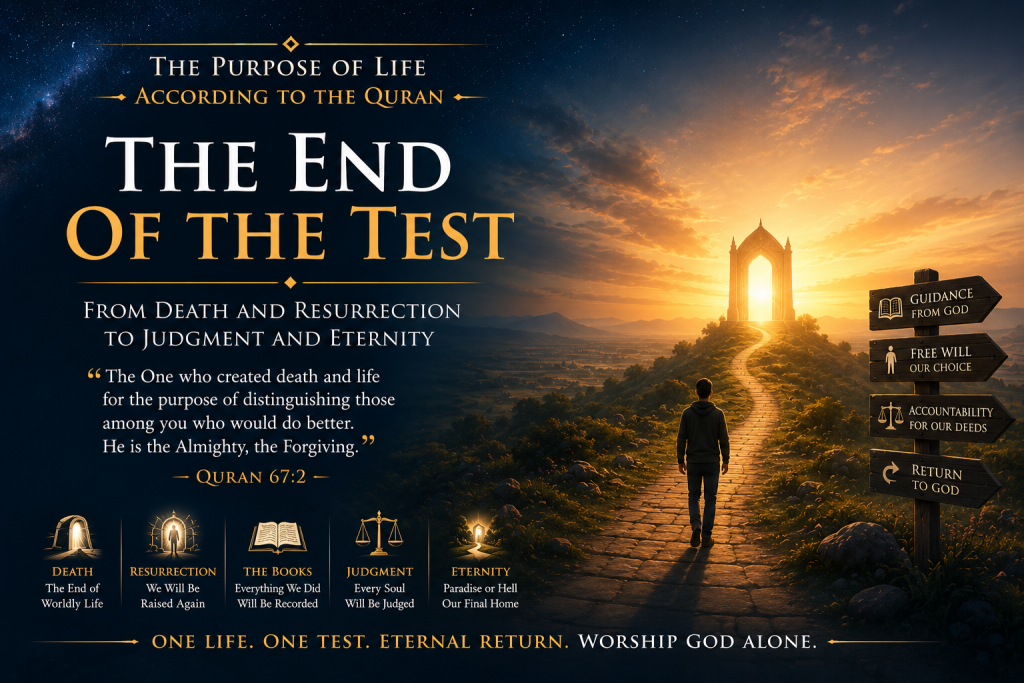
The Purpose of Life According to the Quran: The End of the Test
This is Part 2 of a three-part series
 Part 1 — From the Heavenly Feud to the Earthly Test
Part 2 — The End of the Test
 Reference Guide — Methodology, Timeline, Key Passages & FAQs
Death
Every earthly test has an appointed end.
For every human being, that end is death.
The Quran reminds us that death is not an accident of nature but part of God’s deliberate plan.
“The One who created death and life in order to test you as to which of you works righteousness. He is the Almighty, the Forgiving.” (67:2)
Death therefore marks neither the end of existence nor the failure of life.
It marks the completion of the temporary earthly test.
The Quran repeatedly reminds humanity that earthly life is temporary.
“Everyone will taste death, then to us you will be ultimately returned.” (29:57)
Likewise,
“Every person will taste death, after we put you to the test through adversity and prosperity, then to us you ultimately return.” (21:35)
Death is not the final destination.
It is the transition from the period of testing to the period of accountability.
No person escapes this appointment.
“Wherever you are, death will catch up with you, even if you live in formidable castles.” (4:78)
Neither wealth, power, youth, nor worldly achievement can postpone the moment God has appointed.
The Quran also teaches that death occurs only by God’s permission.
“No one dies except by God’s leave, at a predetermined time.” (3:145)
Life and death therefore remain entirely under God’s control.
When the appointed time arrives, the earthly test ends.
The opportunity to believe, repent, and reform comes to a close.
The Quran describes the regret experienced by those who delayed turning to God.
“When death comes to one of them, he says, ‘My Lord, send me back, I will then work righteousness in everything I left.’ Not true. This is a false claim that he makes. A barrier will separate his soul from this world until resurrection.” (23:99–100)
The request is denied because the period of testing has already ended.
Death fixes the choices each person has freely made during life.
From that moment forward, the individual awaits the resurrection and the Day of Judgment.
The Quran therefore presents death not as something to be feared in itself, but as the inevitable conclusion of the temporary earthly test established by God.
Every life moves toward that appointed meeting with its Creator.
For those who followed God’s guidance, death marks the completion of their trust.
For those who rejected His guidance, it marks the end of every opportunity to change.
Key Insight
From this section, the Quran establishes that:
- God created death as part of His plan for testing humanity. (Q)
- Every soul will inevitably experience death and return to God. (Q)
- Death occurs only by God’s permission at its appointed time. (Q)
- Death ends the period of testing and closes the opportunity for repentance and reform. (Q)
- After death, each person awaits the resurrection and the final judgment. (Q)
Resurrection
Death does not mark the end of human existence.
It marks the end of the earthly test.
The next stage in God’s plan is the resurrection, when every human being will be brought back to life to stand before the Creator.
The Quran repeatedly affirms this certainty.
“Then, later on, you die. Then, on the Day of Resurrection, you will be resurrected…” (23:15–16)
The resurrection is not presented as a new creation but as a re-creation by the same God who created humanity in the first place.
The Quran reminds those who doubt:
“Does the human being not see that we created him from a tiny drop, then he turns into an ardent enemy? He raises a question to us – while forgetting his initial creation – ‘Who can resurrect the bones after they had rotted?’ Say, ‘The One who initiated them in the first place will resurrect them. He is fully aware of every creation.'” (36:77–79)
The God who created life from nothing is fully able to restore it.
The resurrection therefore is neither difficult nor extraordinary for the Creator.
The Quran describes it as effortless.
“The creation and resurrection of all of you is the same as that of one person. God is Hearer, Seer.” (31:28)
When God’s appointed time arrives, the present order of creation comes to an end.
The Trumpet is blown, and every soul is brought forth.
“The horn will be blown, whereupon everyone in the heavens and the earth will be struck unconscious, except those who will be spared by God. Then it will be blown another time, whereupon they will all rise up, looking.” (39:68)
The resurrection is universal.
No generation is forgotten.
No nation is overlooked.
No individual escapes.
Every human being who has ever lived will be restored to life.
The resurrection is also personal.
Each individual returns as the same person who lived the earthly life, carrying the record of every choice made during the test.
The purpose of the resurrection is not merely to restore life.
It is to complete God’s perfect justice.
Those who devoted themselves to God will receive what He promised.
Those who knowingly rejected His guidance will face the consequences of their own choices.
The resurrection therefore transforms the hope of the believer and the warning given to the rejecter into reality.
It is the bridge between the temporary earthly test and God’s eternal judgment.
Key Insight
From this section, the Quran establishes that:
- Every human being will be raised after death. (Q)
- The God who created humanity the first time will recreate humanity with complete ease. (Q)
- The resurrection is universal; no person is omitted from God’s summons. (Q)
- Every individual returns with the record of the life he or she freely lived. (Q)
- The resurrection prepares humanity for God’s final and perfectly just judgment. (Q)
Every Soul Appears Before God
The resurrection brings every human being back to life.
The next event is the personal meeting with God.
The Quran repeatedly emphasizes that every individual will stand before the Creator alone, answering for the life he or she freely chose to live.
“All of them will come before Him on the Day of Resurrection as individuals.” (19:95)
No earthly status accompanies anyone into God’s presence.
No wealth.
No family.
No nation.
No religious group.
No human authority.
Every person stands before God as an individual.
The Quran declares:
“You have come back to us as individuals, just as we created you the first time, and you have left behind what we provided for you…” (6:94)
Nothing acquired during earthly life can alter the reality of that meeting.
The only lasting possession is the record of one’s deeds.
The Quran also describes the scene of complete submission before God’s authority.
“Every single one in the heavens and the earth is a servant of the Most Gracious.” (19:93)
On that Day, every claim of independence disappears.
Every illusion of worldly power vanishes.
Every soul recognizes God’s complete sovereignty.
The Quran further teaches that no one bears the responsibility of another.
“No soul benefits except from its own works, and none bears the burden of another. Ultimately, you return to your Lord, then He informs you regarding all your disputes.” (6:164)
Each person answers only for his or her own choices.
The earthly test has always been personal, and so is the final meeting with God.
The purpose of appearing before God is not to discover the truth.
God already knows every thought, every word, and every deed.
Rather, it is for every individual to witness the perfect justice of God’s judgment.
No one will be able to claim ignorance.
No one will be able to claim unfairness.
Every soul will recognize that God’s judgment is based upon complete knowledge and perfect justice.
Standing before God therefore fulfills the purpose for which the earthly test was established.
The choices made throughout life now become the basis upon which every individual receives his or her eternal destination.
Key Insight
From this section, the Quran establishes that:
- Every human being will personally appear before God after the resurrection. (Q)
- Every individual stands before God alone, without worldly status, possessions, or intermediaries. (Q)
- Each person is accountable only for his or her own choices. (Q)
- God’s perfect knowledge ensures that every judgment is completely just. (Q)
- The personal meeting with God fulfills the purpose of the earthly test by bringing every individual before the Creator for accountability. (Q)
The Evidence
When every soul stands before God, His judgment is not based upon accusation or assumption.
It is based upon complete and irrefutable evidence.
Throughout the earthly test, God has preserved a perfect record of every individual’s life.
The first evidence is the written record.
The Quran states:
“The record will be shown, and you will see the guilty fearful of its contents. They will say, ‘Woe to us. How come this book leaves nothing, small or large, without counting it?’ They will find everything they had done brought forth. Your Lord is never unjust towards anyone.” (18:49)
Nothing is omitted.
Every word.
Every action.
Every choice.
Every deed is preserved with complete accuracy.
The second evidence comes from the recording angels.
During earthly life, they faithfully recorded every word and every deed.
“Oblivious to the fact that there are (invisible) keepers around you. They are honest recorders.” (82:10–11)
The third evidence comes from the individual.
No one can deny the truth.
The Quran describes how people will recognize the reality of what they have done.
“Read your record. Today, you suffice as your own reckoner.” (17:14)
The fourth evidence comes from the human body itself.
“On that day we will seal their mouths; their hands and feet will bear witness to everything they had done.” (36:65)
Likewise,
“The day will come when their own tongues, hands, and feet will bear witness to everything they had done.” (24:24)
Even the skin bears witness.
“They will say to their skins, ‘Why did you bear witness against us?’ They will reply, ‘God made us speak up; He is the One who causes everything to speak.'” (41:21)
The fifth evidence comes from the earth itself.
The place where every deed occurred becomes a witness.
“On that Day it will tell its news. That your Lord has commanded it.” (99:4–5)
Finally, God’s messengers bear witness that His guidance reached humanity.
“Thus, when the day (of judgment) comes, we will call upon a witness from each community, and you (the messenger) will serve as a witness among these people.” (4:41)
The evidence therefore comes from every direction.
The written record.
The recording angels.
The individual.
The body.
The earth.
The messengers.
Above all stands God’s own perfect knowledge, which has encompassed every thought, every intention, and every action from the beginning.
When the evidence has been presented, every excuse disappears.
No one can claim ignorance.
No one can claim that the record is incomplete.
No one can claim injustice.
Every soul recognizes that God’s judgment is founded upon perfect knowledge, complete evidence, and absolute justice.
The earthly test is now complete.
Nothing remains except the final verdict.
Key Insight
From this section, the Quran establishes that:
- God’s judgment is based upon complete and perfect evidence. (Q)
- Every person’s record of deeds is preserved without omission. (Q)
- The recording angels faithfully testify to each individual’s words and actions. (Q)
- A person’s own body and the earth itself bear witness to what occurred during earthly life. (Q)
- God’s messengers testify that His guidance reached humanity. (Q)
- Every excuse disappears before God’s perfect knowledge and justice. (Q)
Satan's Final Failure
14 22From the beginning of the earthly test, Satan sought to divert humanity from God’s guidance.
He adorned falsehood.
He made false promises.
He whispered.
He deceived.
Yet throughout the Quran, one truth remained constant:
Satan could invite, but he could not compel.
After the evidence has been presented and God’s judgment is about to be carried out, Satan finally speaks.
The Quran records his words:
“And the devil will say, after the judgment had been issued, ‘God has promised you the truthful promise, and I promised you, but I broke my promise. I had no power over you; I simply invited you, and you accepted my invitation. Therefore, do not blame me, and blame only yourselves. My complaining cannot help you, nor can your complaining help me. I have disbelieved in your idolizing me. The transgressors have incurred a painful retribution.'” (14:22)
These words expose the complete failure of Satan’s rebellion.
He admits that God’s promise was true.
He admits that his own promises were false.
He admits that he possessed no authority to compel anyone.
His influence depended entirely upon human choice.
Every individual who followed him did so voluntarily.
The earthly test has now revealed its purpose.
Throughout life, every person stood between two invitations.
God invited humanity to worship Him alone and follow His guidance.
Satan invited humanity to reject God’s guidance through deception and false promises.
Each person freely chose which invitation to follow.
Now, at the conclusion of the test, Satan himself confirms that the responsibility for those choices belongs to every individual.
His final speech also exposes the emptiness of every false object of trust.
Neither Satan nor any created being possesses the power to save another from God’s judgment.
Every soul now stands alone before its Creator.
The one who sought to lead others away from God cannot even help himself.
His rebellion has failed.
His deception has been exposed.
His temporary respite has come to an end.
The earthly test is complete, and nothing remains except God’s final judgment.
Key Insight
From this section, the Quran establishes that:
- Satan acknowledges that God’s promise was true and his own promises were false. (Q)
- Satan admits that he had no authority to compel anyone to disobey God. (Q)
- Every individual is responsible for the choices made during the earthly test. (Q)
- Satan’s temporary influence ends with the completion of the test. (Q)
- Satan’s final confession confirms the perfect justice of God’s judgment. (Q)
The Final Judgment
The purpose of the earthly test reaches its completion in God’s final judgment.
Every soul has appeared before its Creator.
The evidence has been presented.
Satan has admitted that he possessed no authority to compel anyone.
Nothing remains except God’s perfectly just verdict.
The Quran declares:
“The scales will be set on that day, equitably. Those whose weights are heavy will be the winners. As for those whose weights are light, they will be the ones who lost their souls, as a consequence of disregarding our revelations, unjustly.” (7:8–9)
God’s judgment is never arbitrary.
Every verdict is based upon complete knowledge, perfect evidence, and absolute justice.
No deed is overlooked.
No sincere act of faith is forgotten.
No injustice, however small, escapes God’s attention.
The Quran assures humanity:
“God does not inflict an atom’s weight of injustice. On the contrary, He multiplies the reward manifold for the righteous work, and grants from Him a great recompense.” (4:40)
Likewise,
“We will establish the scales of justice on the Day of Resurrection. No soul will suffer the least injustice. Even the equivalent of a mustard seed will be accounted for. We are the most efficient reckoners.” (21:47)
God’s judgment encompasses far more than outward actions.
He knows every intention.
Every hidden thought.
Every sincere struggle.
Every act performed solely for His sake.
Nothing escapes His perfect knowledge.
The earthly test has always been personal.
Accordingly, the judgment is also personal.
No one bears another person’s burden.
No one is condemned because of another’s sin.
No one is saved because of another’s righteousness.
Each individual receives the outcome of the life he or she freely chose to live.
The Quran summarizes this principle:
“Whoever does an atom’s weight of good will see it. And whoever does an atom’s weight of evil will see it.” (99:7–8)
The final judgment therefore reveals the perfect harmony between God’s justice and His mercy.
He never wrongs anyone.
He rewards beyond what is deserved.
He forgives whom He wills from among those who turn to Him.
He fulfills every promise He has made.
The purpose of the earthly test is now complete.
Every accountable soul receives the destination that corresponds to the choices freely made throughout life.
Key Insight
From this section, the Quran establishes that:
- God’s final judgment is founded upon complete knowledge, perfect evidence, and absolute justice. (Q)
- Every deed, no matter how small, is taken into account. (Q)
- God never wrongs anyone, even by the weight of an atom. (Q)
- Every individual is judged according to his or her own choices and deeds. (Q)
- The final judgment completes the purpose for which God created death and life as a temporary test. (Q)
Paradise
The earthly test ends with one of two eternal destinations.
For those who believed in God, followed His guidance, and sought His forgiveness, the final destination is Paradise.
From the beginning of the Quran, God promises this reward.
“Give good news to those who believe and lead a righteous life that they will have gardens with flowing streams…” (2:25)
Paradise is not earned solely by human effort.
It is the fulfillment of God’s promise to those who freely chose to live under His guidance and relied upon His mercy.
Throughout earthly life, believers struggled against temptation, resisted Satan’s deception, repented after their mistakes, and continued striving toward God.
The Quran assures them that their efforts are never forgotten.
“As for those who believe and lead a righteous life, their Lord guides them, by virtue of their belief. Rivers will flow beneath them in the gardens of bliss.” (10:9)
Paradise is described as a place of complete peace.
There is no fear.
No grief.
No injustice.
No suffering.
No death.
God says:
“Those who proclaim: ‘Our Lord is God,’ then lead a righteous life, the angels descend upon them: ‘You shall have no fear, nor shall you grieve. Rejoice in the good news that Paradise has been reserved for you.'” (41:30)
The trials of earthly life have come to an end.
The temporary test has been successfully completed.
The Quran also describes the relationship between God and the inhabitants of Paradise.
“And God‘s blessings and approval are even greater. This is the greatest triumph.” (9:72)
Beyond every physical blessing lies the greatest reward of all:
The complete fulfillment of God’s pleasure and acceptance.
Everything that separated humanity from eternal peace has disappeared.
Satan’s deception has ended.
Death has been abolished.
The test has concluded.
The faithful now dwell forever in the home for which they were created.
The Quran beautifully summarizes their gratitude.
“They will say, ‘Praise be to God, who fulfilled His promise to us, and made us inherit the earth, enjoying Paradise as we please.’ What a beautiful recompense for the workers!” (39:74)
Paradise is therefore not simply a reward.
It is the completion of God’s plan.
The temporary earthly test has accomplished its purpose.
Those who freely chose God’s guidance now enjoy eternal life in His peace, justice, mercy, and generosity.
Key Insight
From this section, the Quran establishes that:
- Paradise is the eternal home prepared for those who believe and follow God’s guidance. (Q)
- Entrance into Paradise fulfills God’s promise to the faithful. (Q)
- Paradise is free from fear, grief, suffering, injustice, and death. (Q)
- God’s pleasure with His servants is the greatest reward of Paradise. (Q)
- Paradise represents the successful completion of the temporary earthly test established by God. (Q)
Hell
Just as Paradise is the fulfillment of God’s promise to the faithful, Hell is the fulfillment of His warning to those who knowingly rejected His guidance.
Throughout the earthly test, God repeatedly called humanity to Himself.
He sent messengers.
He revealed scriptures.
He invited people to repent.
He promised forgiveness to those who turned back to Him.
No one enters Hell without first being given the opportunity to choose a different path.
The Quran declares:
“It almost explodes from rage. Whenever a group is thrown therein, its guards would ask them, ‘Did you not receive a warner?’ They would answer, ‘Yes indeed; a warner did come to us, but we disbelieved and said, `God did not reveal anything. You are totally astray.'” (67:8–9)
The judgment is therefore not arbitrary.
It is the consequence of choices freely made during the earthly test.
The greatest tragedy of Hell is not simply its punishment.
It is the permanent loss of what humanity was created to seek.
The Quran describes the fate of those who rejected God:
“Indeed, they will be isolated, on that day, from their Lord.” (83:15)
Throughout life, they turned away from God’s guidance.
Now they are forever separated from His pleasure and the nearness reserved for those who believed and remained steadfast.
The opportunity to repent has ended.
The earthly test is over.
The choices made in time now carry eternal consequences.
The Quran also reminds us that those in Hell recognize the truth too late.
They acknowledge their mistakes.
They wish for another chance.
But the period of testing has already concluded.
“If only you could see them when they face the hellfire! They would say then, ‘Woe to us. Oh, we wish we could go back, and never reject our Lord’s revelations, and join the believers.'” (6:27)
Yet the Quran explains why such a return is not granted.
“As a matter of fact, (they only say this because) their secrets have been exposed. If they go back, they will commit exactly the same crimes. They are liars.” (6:28)
God’s judgment is therefore neither harsh nor unjust.
It is the just conclusion of a test in which every accountable person was given guidance, freedom of choice, and sufficient opportunity to repent.
Hell is the final destination for those who persistently chose to reject God’s guidance.
It is the permanent separation from His pleasure, mercy, and the eternal peace prepared for the righteous.
The same God who invited every human being to Himself now fulfills the warning He gave from the beginning.
His promise of reward is true.
His warning of judgment is equally true.
The purpose of the earthly test has therefore been completely realized.
Every soul has received the outcome of the path it freely chose.
Key Insight
From this section, the Quran establishes that:
- Hell is the eternal destination for those who knowingly reject God’s guidance. (Q)
- No one enters Hell without first receiving God’s guidance through His messengers. (Q)
- Those in Hell recognize the truth when it is too late and wish to return, but the period of testing has ended. (Q)
- Those who rejected God are veiled from their Lord and forever deprived of His pleasure and the peace reserved for the faithful. (Q)
- Hell represents the just completion of the earthly test for those who freely chose to reject God’s guidance. (Q)
Conclusion
The Quran answers one of humanity’s oldest and most profound questions:
Why are we here?
Its answer is both simple and profound.
God created death and life as a temporary test so that every accountable soul could freely choose whether to worship Him, trust His guidance, and prepare for the eternal life to come.
This journey did not begin on earth.
It began before the creation of Adam, when a feud arose among the accountable beings in the High Society.
God, in His perfect wisdom, established the earthly test.
He created humanity.
He granted free will.
He sent guidance through His messengers and scriptures.
He allowed Satan only a temporary opportunity to invite people away from the truth.
Throughout history, every person has faced the same choice:
To respond to God’s guidance or to reject it.
To seek truth or to follow falsehood.
To worship God alone or to devote ultimate loyalty to something else.
No one is compelled.
No one is deprived of guidance.
Every accountable person is given the opportunity to choose.
When earthly life ends, the test is complete.
Every soul returns to God.
Every deed is brought forth.
Every excuse disappears.
God’s judgment is established upon perfect knowledge, complete evidence, and absolute justice.
Those who believed, repented, and remained steadfast receive the fulfillment of God’s promise in Paradise.
Those who knowingly rejected His guidance receive the fulfillment of His warning.
In either case, God’s justice is perfectly manifested.
The Quran therefore presents human life as neither random nor meaningless.
Every moment has purpose.
Every choice has significance.
Every act of faith, every act of kindness, every sincere repentance, and every rejection of truth contributes to the final outcome.
The purpose of life is not merely to exist.
It is to know God through His guidance, to worship Him alone, to live according to His revelations, and to prepare for the Day when every soul will stand before its Creator.
The Quran summarizes this purpose in one remarkable verse:
“The One who created death and life for the purpose of distinguishing those among you who would do better. He is the Almighty, the Forgiving.” (67:2)
The article began with this verse.
It also ends with it.
Between death and life lies the temporary earthly test.
Beyond it lies eternity.
May God guide us to understand His message, to worship Him alone, and to be among those who meet Him with faith, gratitude, and peace.
Key Insight
From this study, the Quran establishes that:
- God created death and life as a temporary test for accountable beings. (Q)
- Human life is part of a much larger divine plan that began before the creation of Adam and continues into eternity. (Q/QS – see Appendix A regarding the reconstruction of the heavenly events.)
- God provided every accountable person with guidance, freedom of choice, and sufficient opportunity to repent. (Q)
- The Day of Judgment perfectly manifests God’s justice, mercy, wisdom, and truth. (Q)
- Paradise and Hell are the eternal outcomes of the choices made during the temporary earthly test. (Q)
- The ultimate purpose of life is to know God through His guidance, worship Him alone, and prepare to return to Him. (Q)