The Purpose of Life According to the Quran: Reference Guide
Methodology, Timeline, Major Passages, Frequently Asked Questions, and Historical Notes
This Reference Guide accompanies the two-part study, The Purpose of Life According to the Quran. Rather than introducing new conclusions, it provides the methodology, chronology, key Quranic passages, frequently asked questions, and historical background that support the main study. Readers are encouraged to use this guide alongside Parts 1 and 2 for deeper study and independent verification.
The Purpose of Life According to the Quran
📖 Part 1 — From the Heavenly Feud to the Earthly Test
📖 Part 2 — The End of the Test
📚 Reference Guide — Methodology, Timeline, Key Passages & FAQs
Reference Guide
Appendix A - Reconstructing the Heavenly Feud: Quranic Methodology and Sources
Why This Appendix?
The Quran presents a complete explanation of humanity’s purpose, but it does not tell that story from beginning to end in a single chapter. Instead, the relevant passages are distributed throughout the Quran, with each passage emphasizing a different aspect of the narrative.
For example, one passage focuses on the creation of Adam, another on Satan’s refusal to submit, another on the earthly test, and still others on death, resurrection, judgment, Paradise, and Hell. These passages are interconnected, yet they appear in different chapters revealed over many years.
This study seeks to reconstruct that unified narrative using the Quran itself.
The Quran Explains Itself
The fundamental assumption throughout this study is that the Quran is its own interpreter.
God repeatedly describes the Quran as:
- fully detailed (6:114)
- an explanation of all things (16:89)
- complete (6:38)
- internally consistent (39:23)
- free from contradiction (4:82)
Rather than relying on external traditions to fill perceived gaps, this study compares Quranic passages with one another until a coherent picture emerges.
This is the same method the Quran encourages when it calls upon believers to reflect upon its verses collectively rather than in isolation.
A Narrative Scattered Across the Quran
Unlike many historical books, the Quran is not arranged chronologically.
Events may be mentioned briefly in one chapter and explained more fully in another.
The story of Adam illustrates this well.
His creation appears in several places, including Suras 2, 7, 15, 17, 18, 20, and 38. Each account contributes details that complement the others without contradiction.
The same is true for the rebellion of Satan, the purpose of earthly life, resurrection, judgment, and eternity.
When these passages are studied together, they form a remarkably coherent narrative extending from before the creation of humanity to the final judgment.
Explicit Statements and Reasoned Reconstruction
Throughout this study, an important distinction has been maintained between what the Quran explicitly states and what can reasonably be reconstructed by combining multiple passages.
For clarity, two categories have been used.
Q — Explicit Quranic Statements
These are facts stated directly by the Quran.
Examples include:
- God created death and life as a test (67:2).
- The angels were commanded to submit before Adam (2:34).
- Satan refused (7:11–12).
- Humanity was sent to earth (2:36).
- Every soul will die (3:185).
- Every soul will be resurrected (22:7).
- Every individual will stand before God (19:95).
These require no reconstruction.
QS — Quranic Synthesis
Other conclusions arise by bringing together multiple explicit statements.
For example:
The Quran never presents a single chapter titled The Purpose of Life.
Instead, that picture emerges by combining passages concerning:
- creation,
- free will,
- Satan,
- guidance,
- earthly life,
- death,
- resurrection,
- judgment,
- eternity.
Each component is explicitly stated.
The chronological sequence is reconstructed by allowing the verses to explain one another.
This synthesis does not introduce new information; it simply organizes information already present in the Quran.
Why a Chronology Is Possible
Although the Quran is not arranged chronologically, many events possess an inherent order.
For example:
God created Adam before humanity lived on earth.
Human beings must live before they die.
Death precedes resurrection.
Resurrection precedes judgment.
Judgment precedes the final destination of Paradise or Hell.
Likewise, Satan’s refusal to submit necessarily occurred before Adam’s earthly life.
These relationships arise naturally from the Quran itself.
The resulting chronology is therefore not imposed upon the text but derived from it.
No External Sources Were Required
This study intentionally avoids dependence on:
- Hadith collections
- Traditional biographies
- Historical narratives
- Jewish or Christian literature
- Philosophical speculation
Such materials often contain valuable historical information, but they are not necessary for understanding the Quran’s own explanation of humanity’s purpose.
The objective has been to allow the Quran to present its own worldview using its own language and internal connections.
Rashad Khalifa’s Contribution
This study owes an intellectual debt to Dr. Rashad Khalifa, particularly for emphasizing the principle that the Quran explains itself and for drawing attention to the importance of reconstructing dispersed Quranic narratives.
His translation has also been used throughout this work.
At the same time, the conclusions presented here are intended to rest upon the Quran itself. Every major claim can be examined directly through the cited verses, allowing readers to verify the evidence independently.
The purpose is not to ask readers to accept a human interpretation, but to encourage them to study the Quran’s own testimony.
A Word About Reconstruction
Every serious study of history, science, or law involves reconstruction.
An archaeologist reconstructs an ancient civilization from scattered artifacts.
A historian reconstructs a sequence of events from surviving documents.
Likewise, this study reconstructs the Quran’s narrative by assembling verses that speak about the same events from different perspectives.
The reconstruction remains accountable to the text.
Whenever a conclusion goes beyond an explicit statement, it should always be tested against the Quran as a whole.
If a reconstruction contradicts even one clear verse, it must be abandoned.
The Goal of This Study
The purpose of this work has never been to produce a new theology or a novel interpretation.
Rather, it seeks to answer one of humanity’s oldest questions:
Why did God create death and life?
The answer emerges not from a single verse but from the Quran’s complete testimony.
Taken together, its passages reveal one continuous narrative:
From God’s sovereign will…
to the creation of Adam…
to humanity’s freedom and responsibility…
to the earthly test…
to death…
to resurrection…
to judgment…
and finally to eternity.
That narrative forms the foundation of The Purpose of Life According to the Quran.
Appendix B - Chronological Timeline of Humanity According to the Quran
Introduction
The Quran does not present the story of humanity in chronological order. Instead, its narrative is distributed throughout many chapters, with different passages emphasizing different aspects of God’s plan.
This timeline reconstructs the sequence by arranging explicit Quranic statements into their natural order. The chronology begins before the creation of Adam and ends with the eternal destinations of Paradise and Hell.
Unless otherwise noted, every event is derived directly from the Quran.
BEFORE HUMANITY
God Alone
Before the creation of the heavens, the earth, angels, jinn, or humanity, God alone existed. He is the First and the Last, independent of all creation.
Representative verses
- 57:3
- 112:1–4
Creation of the Universe
God created the heavens and the earth according to His wisdom and purpose.
Creation itself was not meaningless but established the setting for humanity’s test.
Representative verses
- 21:16
- 44:38–39
- 67:3–4
The Heavenly Realm Exists
Before Adam was created, the heavenly assembly already existed.
The angels were already carrying out God’s commands.
Satan (Iblis) was present among that assembly before his rebellion.
Representative verses
- 2:30
- 7:11
- 15:28–31
- 38:71–74
THE CREATION OF ADAM
God Announces the Creation of Humanity
God informed the angels that He would place a successor (khalifah) on earth.
The angels questioned the wisdom of creating beings capable of corruption and bloodshed.
God answered:
“I know what you do not know.”
Representative verses
- 2:30
Adam Is Created
God fashioned Adam from earthly material before breathing into him from His spirit.
Representative verses
- 15:26–29
- 38:71–72
- 32:7–9
The Command to Submit
After Adam’s creation, God commanded the angels to submit before Adam.
All submitted except Iblis.
Representative verses
- 2:34
- 7:11
- 15:30–31
- 17:61
- 20:116
- 38:73–74
SATAN’S REBELLION
Satan Refuses
Satan refused out of arrogance.
He considered himself superior because he had been created from fire while Adam had been created from clay.
Representative verses
- 7:12
- 38:75–76
Satan Is Condemned
God expelled Satan from His favor because of his arrogance and disobedience.
Representative verses
- 7:13
- 15:34–35
- 38:77–78
Satan Requests Respite
Rather than immediate destruction, Satan requested time until the Day of Resurrection.
God granted that request.
Representative verses
- 7:14–15
- 15:36–38
- 38:79–81
Satan Declares His Mission
Satan vowed to mislead humanity by exploiting human weaknesses while acknowledging that sincere servants devoted to God alone would remain beyond his authority.
Representative verses
- 7:16–18
- 15:39–42
- 17:61–65
- 38:82–83
THE EARTHLY TEST
Adam and His Wife
Adam and his wife entered the Garden and received God’s command concerning the prohibited tree.
Satan deceived them.
Representative verses
- 2:35–36
- 7:19–22
- 20:117–121
Repentance
Adam received words from God, repented, and was forgiven.
The Quran never teaches inherited guilt.
Representative verses
- 2:37
- 20:122
Humanity Sent to Earth
Humanity began its earthly mission.
God promised guidance.
Those who follow His guidance need not fear nor grieve.
Representative verses
- 2:36–39
- 7:24–25
- 20:123
HUMAN LIFE
The Purpose of Life
God created death and life to distinguish those who do better.
Representative verse
- 67:2
Human Freedom
Every person is free to believe or reject God’s guidance.
Representative verses
- 18:29
- 76:3
Revelation
Throughout history God sent messengers and scriptures to guide humanity.
Representative verses
- 2:213
- 16:36
- 35:24
The Continuing Conflict
Throughout earthly life Satan invites while God guides.
Every individual chooses which call to follow.
Representative verses
- 14:22
- 36:60–61
THE END OF EARTHLY LIFE
Death
Every soul experiences death.
Earthly life is temporary.
Representative verses
- 3:185
- 21:35
- 29:57
The Waiting Period
Following death comes a barrier (barzakh) until resurrection.
Representative verse
- 23:99–100
RESURRECTION
The Trumpet
God brings creation back to life.
Representative verses
- 39:68
- 36:51–53
- 22:7
Gathering
Every human being is assembled before God.
No one is absent.
Representative verses
- 18:47
- 19:95
- 78:17–18
THE DAY OF JUDGMENT
Individual Accountability
Every individual appears before God alone.
No family, wealth, or status provides protection.
Representative verses
- 6:94
- 19:95
- 6:164
The Evidence
The records are opened.
The recording angels testify.
Body parts testify.
The earth testifies.
Nothing is overlooked.
Representative verses
- 18:49
- 17:13–14
- 36:65
- 24:24
- 99:4–5
Satan’s Final Admission
Satan openly admits that he merely invited humanity.
Every person bears responsibility for his or her own choices.
Representative verse
- 14:22
Perfect Justice
Every deed receives perfect justice.
Not even an atom’s weight escapes God’s judgment.
Representative verses
- 21:47
- 99:7–8
- 4:40
ETERNITY
Paradise
Those accepted by God receive eternal peace, security, and His pleasure.
Representative verses
- 9:72
- 39:73–74
- 41:30–32
Hell
Those who knowingly rejected God’s guidance experience the consequences of their choices.
Representative verses
- 67:6–11
- 78:21–30
- 83:15
The Eternal Kingdom
The earthly test has ended.
God’s promise has been fulfilled.
Every soul reaches its final destination.
His judgment is perfect, His mercy is complete, and His kingdom endures forever.
Representative verses
- 39:75
- 40:16
- 69:18–37
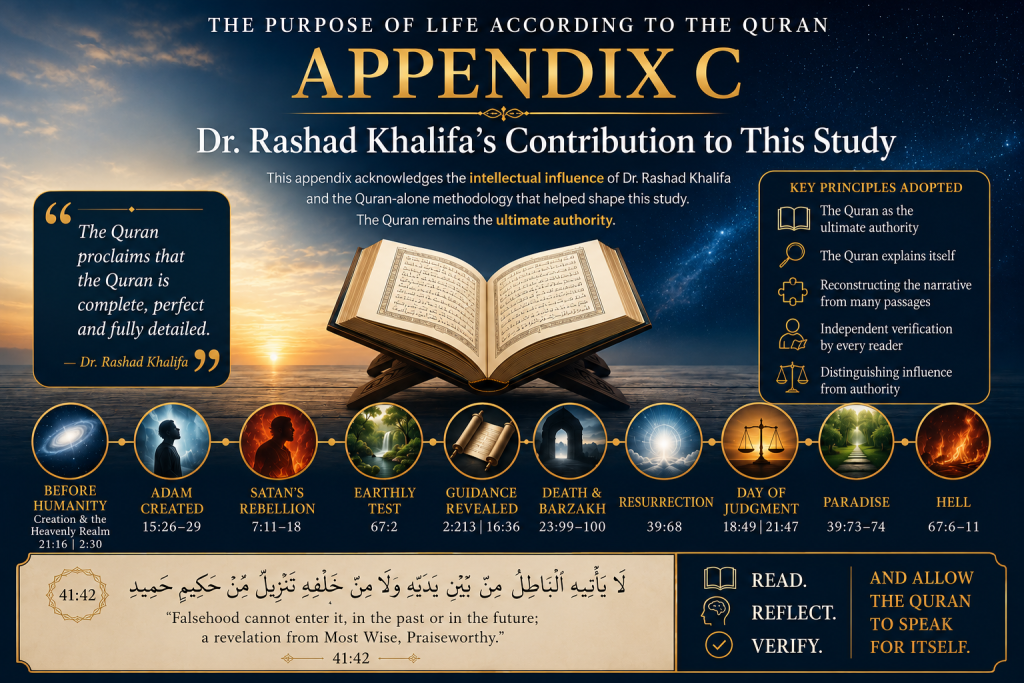
Appendix C - Dr. Rashad Khalifa's Contribution to This Study
Introduction
Throughout this study, the Quran has been treated as the ultimate authority. Every major conclusion has been supported by direct references to the Quran, and readers are encouraged to verify each conclusion for themselves.
Nevertheless, intellectual honesty requires acknowledging an important influence on the development of this work.
Many of the questions explored in The Purpose of Life According to the Quran were first examined in depth by Dr. Rashad Khalifa. His emphasis on allowing the Quran to explain itself encouraged a renewed approach to studying the Quran independent of later religious traditions.
This appendix briefly explains his contribution while maintaining the distinction between the authority of the Quran and the contributions of any individual student of the Quran.
Rashad Khalifa – Messenger of the Covenant
Rashad Khalifa — Messenger of the Covenant
Explore his identification as the Messenger of the Covenant, the mathematical proof, the purpose of life, the Quran-alone message, religious practices, and other information brought to light from within the Quran.
Returning to the Quran
One of Dr. Rashad Khalifa’s central principles was that the Quran is complete, fully detailed, and fully sufficient for religious guidance.
Rather than beginning with later interpretations and reading them into the Quran, he encouraged readers to begin with the Quran itself and allow its verses to explain one another.
This methodological principle became one of the foundations of the present study.
Readers are therefore repeatedly invited to verify every conclusion directly from the cited verses rather than relying upon human authority.
Reconstructing the Narrative
The Quran frequently returns to the same historical events from different perspectives.
Dr. Rashad Khalifa recognized that these passages could be studied collectively to reconstruct a coherent narrative.
Rather than viewing these passages as isolated stories, he demonstrated that they contribute to a unified explanation of God’s relationship with humanity.
The present study follows that same approach.
The chronology presented throughout Parts 1 and 2 was not taken from a single chapter but reconstructed by comparing relevant passages throughout the Quran.
The Heavenly Feud
One of Dr. Rashad Khalifa’s most insightful observations was that the story of humanity begins before Adam’s creation.
The Quran describes God’s announcement to the angels, Satan’s refusal to submit, his request for respite, and his declaration that he would attempt to mislead humanity.
These events establish the context for the earthly test described in 67:2.
Although the Quran never uses the expression “the heavenly feud,” that phrase provides a convenient description for the conflict surrounding Satan’s rebellion before humanity’s earthly existence.
The terminology is human; the underlying events are Quranic.
The Centrality of Quran 67:2
This study is organized around a single verse:
“The One who created death and life for the purpose of distinguishing those among you who would do better.” (67:2)
Dr. Rashad Khalifa consistently emphasized that this verse summarizes the purpose of earthly life.
The present work expands upon that insight by tracing how the Quran develops this purpose from before Adam’s creation to the final judgment.
Rather than treating 67:2 as an isolated statement, the study places it within the broader Quranic narrative.
The Quran as Its Own Commentary
Throughout his work, Dr. Rashad Khalifa emphasized comparing one Quranic passage with another before turning to external explanations.
This study adopts the same principle.
Accordingly, many conclusions arise from reading multiple passages together:
- Adam’s creation.
- Satan’s rebellion.
- Humanity’s descent to earth.
- God’s promise of guidance.
- Human freedom and responsibility.
- Death and resurrection.
- Final judgment.
- Paradise and Hell.
The resulting narrative is not based on a single verse but on the cumulative testimony of the Quran.
The Translation Used
Unless otherwise noted, Quranic quotations throughout this study are taken from Dr. Rashad Khalifa’s English translation.
The translation has been selected because of its clarity, consistency, and its close relationship to the Quran-alone methodology adopted throughout this work.
Readers should remember that every translation represents a human effort to convey the meaning of the Arabic text.
For that reason, references are provided so that readers may compare translations and consult the Arabic whenever possible.
Independent Verification
One of Dr. Rashad Khalifa’s most repeated principles was that readers should not accept religious claims simply because another person made them.
Every claim should be tested against the Quran.
That principle has guided the preparation of this study.
Nothing in these pages should be accepted merely because it appears here or because it was previously proposed by another writer.
Instead, every conclusion should be examined in light of the Quran itself.
If a conclusion agrees with the Quran, it should be accepted because it agrees with the Quran – not because of the individual who presented it.
The Difference Between Influence and Authority
Every researcher benefits from those who have studied before them.
Acknowledging that influence does not transfer authority.
Throughout history, believers have learned from teachers, translators, linguists, historians, and scholars.
Their work may illuminate the Quran, but it never replaces the Quran.
Accordingly, this study distinguishes between:
- the Quran, which is the revealed word of God and the ultimate authority; and
- human contributions, which remain subject to examination, correction, and verification.
This distinction is essential to the Quran’s repeated call to think, reflect, and verify.
Looking Forward
The purpose of this study has never been to promote a personality or a movement.
Its objective has been to encourage readers to return directly to the Quran and to discover its remarkable unity and coherence.
If this work succeeds in helping readers see the Quran as a connected explanation of humanity’s purpose – from God’s announcement of Adam’s creation to the eternal realities of Paradise and Hell – then it has achieved its goal.
Ultimately, every teacher, translator, and student passes away.
The Quran remains.
As God declares:
“Falsehood cannot enter it, in the past or in the future; a revelation from Most Wise, Praiseworthy.” (41:42)
The invitation therefore remains the same for every generation:
Read.
Reflect.
Verify.
And allow the Quran to speak for itself.
Appendix D - Major Quranic Passages by Subject
Introduction
The Quran discusses humanity’s purpose across many chapters rather than in a single continuous narrative. This appendix groups the principal passages by subject, allowing readers to locate the major verses quickly.
The lists below are representative rather than exhaustive. They emphasize the passages most relevant to The Purpose of Life According to the Quran.
1. God
God’s Absolute Oneness
- 112:1–4
- 2:255
- 57:1–6
- 59:22–24
God’s Sovereignty
- 3:26
- 6:73
- 39:62–63
- 40:16
- 67:1
God’s Wisdom and Knowledge
- 2:32
- 6:18
- 31:27
- 35:11
- 67:13–14
2. Creation
Creation of the Universe
- 21:16–18
- 44:38–39
- 67:3–5
- 79:27–33
Creation with Purpose
- 3:191
- 21:16
- 23:115
- 38:27
- 44:38–39
3. Adam and Humanity
Creation of Adam
- 2:30–39
- 15:26–42
- 17:61–65
- 20:115–123
- 38:71–85
Humanity’s Honor
- 17:70
- 32:7–9
- 95:4
4. Satan (Iblis)
Satan’s Refusal
- 2:34
- 7:11–18
- 15:31–42
- 17:61–65
- 18:50
- 20:116
- 38:71–85
Satan’s Mission
- 14:22
- 15:39–42
- 17:61–65
- 36:60–62
Satan’s Limits
- 15:42
- 17:65
- 16:99–100
5. Free Will and Human Responsibility
Freedom of Choice
- 2:256
- 18:29
- 76:3
- 90:10
Individual Responsibility
- 6:164
- 17:15
- 35:18
- 39:7
- 53:38–41
6. Revelation and Guidance
God Guides Humanity
- 2:38
- 10:57
- 16:89
- 17:9
- 39:23
Messengers
- 2:213
- 16:36
- 35:24
- 40:78
The Quran
- 6:114–115
- 12:111
- 16:89
- 39:23
- 41:3
7. The Purpose of Life
Why Were We Created?
- 67:2
- 51:56
- 23:115
- 75:36–40
Earthly Life
- 18:7
- 21:35
- 29:2–3
- 67:2
8. Death
Every Soul Dies
- 3:185
- 21:35
- 29:57
- 39:30
Barzakh
- 23:99–100
9. Resurrection
Resurrection Is Certain
- 22:5–7
- 36:77–83
- 39:68
- 50:41–44
- 75:1–40
Gathering
- 18:47
- 19:95
- 78:17–18
10. The Day of Judgment
Individual Appearance Before God
- 6:94
- 19:95
Books of Deeds
- 17:13–14
- 18:49
- 69:19–37
- 84:7–12
Witnesses
- 24:24
- 36:65
- 41:20–21
- 99:4–5
Justice
- 4:40
- 21:47
- 99:7–8
11. Paradise
Entrance into Paradise
- 9:72
- 13:23–24
- 39:73–74
- 41:30–32
Descriptions
- 47:15
- 55
- 56
- 76
12. Hell
Warning
- 67:6–11
- 74:26–30
- 78:21–30
Regret
- 6:27–28
- 14:22
- 39:56–59
Separation from God’s Favor
- 83:15
13. God’s Mercy
Mercy
- 6:54
- 7:156
- 39:53
- 40:7
- 55
14. The Believer’s Response
Worship God Alone
- 1:5
- 6:162–163
- 39:11–14
- 98:5
Trust in God
- 3:159
- 8:2
- 65:2–3
Patience
- 2:153
- 39:10
- 103
15. The Complete Journey
For readers wishing to follow the entire narrative in sequence:
| Stage | Primary Passages |
|---|---|
| God | 112; 57:1–6 |
| Creation | 21:16–18; 44:38–39 |
| Adam | 2:30–39 |
| Satan | 7:11–18 |
| Earthly Test | 67:2 |
| Guidance | 2:38; 17:9 |
| Human Freedom | 18:29; 76:3 |
| Death | 3:185 |
| Resurrection | 39:68; 75 |
| Judgment | 18:49; 21:47 |
| Paradise | 39:73–74 |
| Hell | 67:6–11 |
Appendix E - Frequently Asked Questions
Introduction
The first two parts of this study present the Quran’s explanation of humanity’s purpose as a unified narrative. As readers reflect upon that narrative, certain questions naturally arise.
This appendix addresses some of the most common questions using the Quran as the primary source. The objective is not to answer every philosophical question but to summarize what the Quran itself teaches.
1. Why did God create humanity?
The Quran gives a direct answer:
“The One who created death and life for the purpose of distinguishing those among you who would do better.” (67:2)
Human life is not an accident, nor is it an end in itself. It is a temporary opportunity to know God through His guidance, worship Him alone, and demonstrate faith through free and conscious choice.
The earthly test prepares every individual for an eternal existence.
2. Why did God create death before life?
Remarkably, the Quran says:
“The One who created death and life…” (67:2)
Death is mentioned before life because earthly life is temporary and gains its meaning from what follows it. Without death, there would be no accountability, no resurrection, and no final judgment.
Death is therefore not the opposite of God’s plan – it is part of God’s plan.
3. Why didn’t God simply create everyone in Paradise?
The Quran consistently presents Paradise as a reward, not a starting point.
Its inhabitants are those who willingly responded to God’s guidance during the earthly test.
Without genuine choice, reward and accountability would lose their meaning.
The earthly test distinguishes those who freely choose faith, gratitude, patience, and righteousness.
4. Why does God allow Satan to exist?
After refusing God’s command, Satan requested respite until the Day of Resurrection.
God granted that request (7:14–15; 15:36–38).
Satan’s continued existence forms part of the earthly test.
The Quran repeatedly emphasizes that Satan possesses no independent authority over humanity. He invites; human beings choose whether to respond (14:22; 17:65).
5. Does Satan force people to sin?
No.
On the Day of Judgment Satan himself declares:
“I simply invited you, and you accepted my invitation.” (14:22)
The Quran consistently teaches that responsibility remains with every individual.
Temptation is real.
Compulsion is not.
6. Why did God create free will?
Love, gratitude, sincerity, patience, and worship have meaning only when they are freely chosen.
The Quran repeatedly places alternatives before humanity:
belief or disbelief,
gratitude or ingratitude,
obedience or rebellion.
Without freedom, the earthly test described in 67:2 would have no purpose.
7. If God already knows everything, why test us?
God’s knowledge does not eliminate human responsibility.
The Quran presents the earthly test as the public manifestation of what each individual freely chooses.
On the Day of Judgment, no one will be able to claim ignorance, injustice, or unequal treatment.
Every person’s own life becomes the evidence.
God’s perfect knowledge is accompanied by perfect justice.
8. Did Adam’s mistake condemn all humanity?
No.
The Quran states that Adam repented.
God accepted his repentance.
Each individual is responsible only for his or her own deeds.
No soul bears the burden of another (6:164; 17:15; 35:18; 53:38).
The Quran therefore rejects inherited guilt.
9. Why does evil exist?
The Quran recognizes both moral evil and suffering.
Human beings possess freedom.
Satan invites toward corruption.
People may reject God’s guidance.
The existence of evil makes possible genuine choices between truth and falsehood, justice and injustice, faith and rejection.
The Quran’s emphasis is not on explaining every instance of suffering but on reminding humanity that earthly life is temporary and that perfect justice belongs to the Hereafter.
10. What is the real purpose of worship?
The Quran never portrays worship as something God needs.
God is free from all needs.
Rather, worship directs human beings toward the One who created them.
It cultivates gratitude, humility, remembrance, trust, and obedience.
To worship God alone is to recognize reality as it truly is.
11. Is earthly success proof of God’s approval?
No.
The Quran repeatedly warns that wealth, power, and worldly success are not reliable measures of divine approval.
Some of history’s greatest rejectors enjoyed immense worldly success.
Likewise, many faithful believers endured hardship.
The true measure is not temporary prosperity but one’s standing before God on the Day of Judgment.
12. What happens immediately after death?
The Quran teaches that every soul experiences death and awaits resurrection.
It refers to a barrier (barzakh) until the Day they are raised (23:99–100).
The focus of the Quran is not on describing this interval in detail but on directing attention toward the certainty of resurrection and accountability.
13. Will everyone stand before God individually?
Yes.
The Quran repeatedly emphasizes personal accountability.
No family relationship, wealth, social status, or religious authority will accompany a person before God.
Every soul comes individually.
Every soul answers individually.
Every soul receives justice individually.
14. Can another person save me?
The Quran consistently teaches that no human being can bear another person’s sins or secure salvation through personal status.
Messengers deliver God’s message.
Parents cannot save children.
Children cannot save parents.
Religious leaders cannot save their followers.
Every individual returns to God personally.
15. Is Hell created because God desires punishment?
The Quran describes God as:
The Most Gracious.
The Most Merciful.
Forgiving.
Patient.
Hell is presented not as an arbitrary act but as the consequence of persistent rejection of God’s guidance despite repeated opportunities to believe and repent.
The Quran repeatedly calls humanity to repentance before judgment arrives.
16. Why is Paradise described so beautifully?
The Quran describes Paradise using language familiar to human beings:
gardens,
rivers,
peace,
security,
joy,
companionship,
and God’s pleasure.
These descriptions encourage hope while reminding believers that God’s reward exceeds human imagination.
The greatest reward is not material comfort but God’s acceptance and pleasure.
17. What is the central message of the entire study?
The Quran’s answer to humanity’s oldest question may be summarized simply.
God created death and life with purpose.
Human beings possess genuine freedom.
God provides guidance.
Satan invites toward misguidance.
Every individual is accountable.
Death is not the end.
Resurrection is certain.
Perfect justice awaits.
Those who willingly worship God alone and follow His guidance attain eternal success.
Final Reflection
The purpose of life is not hidden.
The Quran presents it openly and repeatedly.
Human beings were not created without purpose.
Nor were they abandoned without guidance.
From the creation of Adam to the Day of Judgment, the Quran presents one continuous message:
Life is a trust.
Freedom is a responsibility.
Guidance is a mercy.
Judgment is certain.
Eternity is the destination.
The question is no longer “Why are we here?”
The Quran answers that question.
The remaining question is:
How will each of us respond to God’s guidance during the time we have been given?