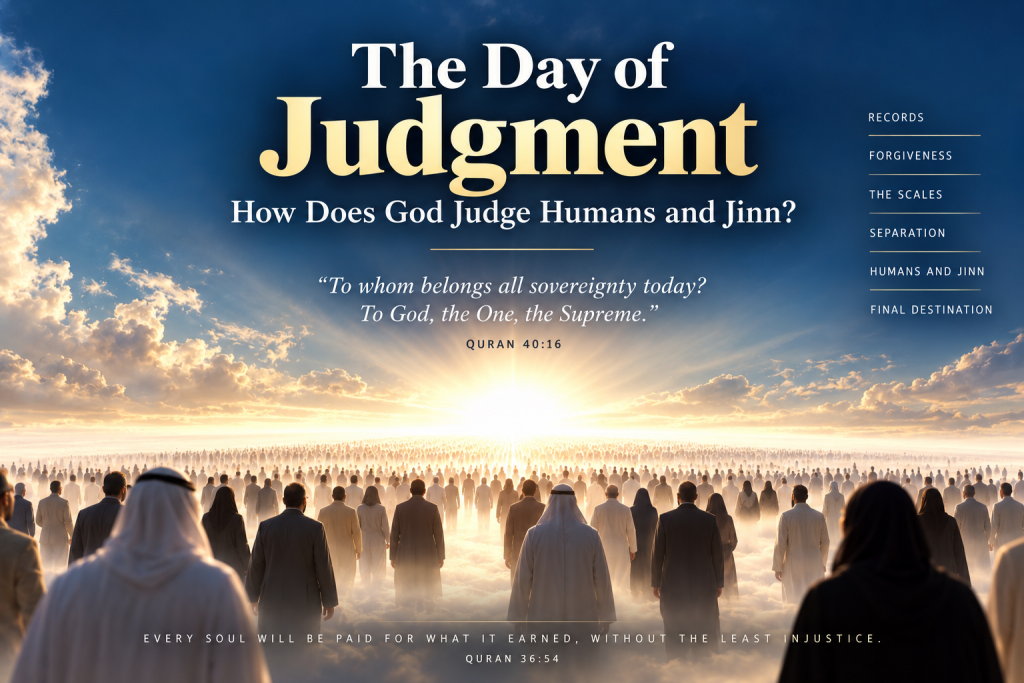
The Day of Judgment — How Does God Judge Humans and Jinn?
Introduction
The resurrection brings every human being and jinn before God. But resurrection itself is not the end of the story.
The Day of Judgment in the Quran describes records being presented, deeds becoming known, witnesses being brought forward where applicable, and scales of justice being established. Yet an important question remains:
How does God actually judge humans and jinn?
Is Judgment simply a comparison of good deeds against bad deeds? What happens to sins that God has already forgiven? Why does the Quran describe an “easy accounting” for some people? What determines the eventual separation of the righteous from the guilty? And what does the Quran tell us about their final destinations?
The Quran provides the principles needed to understand this judgment. It repeatedly emphasizes individual responsibility, repentance, forgiveness, mercy, the weighing of deeds, and perfect justice.
The starting point is fundamental:
God alone is the Judge.
1. God Alone Judges
The Quran leaves no ambiguity concerning who renders the final judgment:
“Those who believe, those who are Jewish, the converts, the Christians, the Zoroastrians, and the idol worshipers, GOD is the One who will judge among them on the Day of Resurrection. GOD witnesses all things.”
Quran 22:17
The verse is striking because it lists different religious communities but does not assign judgment to any of them.
God judges them all.
The same principle appears elsewhere:
“To whom belongs all sovereignty today? To GOD, the One, the Supreme.”
Quran 40:16
And:
“…All decisions, on that day, will belong to GOD.”
Quran 82:19
No prophet, messenger, religious institution, community, saint, or religious leader determines another person’s eternal destiny.
Judgment belongs to God alone.
2. Judgment Is Individual
The Quran repeatedly establishes that every soul is responsible for itself:
“No soul bears the sins of another soul.”
Quran 6:164
The same principle occurs in:
17:15; 35:18; 39:7; 53:38
And:
“All of them will come before Him on the Day of Resurrection as individuals.”
Quran 19:95
Family relationships, religious affiliation, ancestry, and community membership cannot transfer righteousness from one person to another.
Nor can anyone transfer his sins to someone else.
The fundamental unit of Judgment is therefore the individual soul.
3. Judgment Is According to What Each Soul Earned
God says:
“Beware of the day when you are returned to GOD, and every soul is paid for everything it had done, without the least injustice.”
Quran 2:281
Similarly:
“Today, no soul will be wronged in the least. You will be paid precisely for whatever you did.”
Quran 36:54
And:
“GOD created the heavens and the earth for a specific purpose, in order to pay each soul for whatever it earned, without the least injustice.”
Quran 45:22
The judgment therefore concerns what the individual actually earned.
But that raises an important question.
What happens when God has already forgiven some of the person’s sins?
Forgiveness Comes Before the Final Accounting
4. Repentance Changes What Is Brought to Judgment
The Quran does not portray human beings as accumulating an irreversible list of sins throughout life that must all remain against them until Judgment.
Repentance changes the situation.
One of the strongest statements occurs in 25:70:
“Exempted are those who repent, believe, and lead a righteous life. GOD transforms their sins into credits. GOD is Forgiver, Most Merciful.”
The sequence is important:
repent → believe → lead a righteous life → sins transformed into credits
God does not merely say that He ignores those sins.
He transforms them into credits.
Other passages reinforce this principle.
“Those who believe and lead a righteous life, we will surely remit their sins…”
Quran 29:7
And:
“…GOD remits their sinful works, and rewards them generously for their good works.”
Quran 39:35
And:
“It is from these that we accept the righteous works, and overlook their sins.”
Quran 46:16
Therefore, the Judgment cannot be understood merely as adding every good deed to one side and every sin ever committed to the other.
Forgiveness changes what remains against the person.
5. God’s Mercy Is Part of Judgment
This is why the Quranic Judgment cannot be reduced to a mechanical mathematical calculation.
God says:
“My mercy encompasses all things.”
Quran 7:156
And:
“O My servants who exceeded the limits, never despair of GOD’s mercy. For GOD forgives all sins. He is the Forgiver, Most Merciful.”
Quran 39:53
Forgiveness does not mean that God abandons justice.
Rather, forgiveness itself is part of God’s system of justice and mercy.
A person who recognizes wrongdoing, repents, believes, and reforms is not necessarily brought before God carrying the same moral record as someone who persists deliberately in wrongdoing.
This distinction becomes important when we reach the scales.
6. Some Receive an Easy Accounting
The Quran describes some people receiving their records in their right hands:
“As for the one who receives his record with his right hand, he will receive an easy reckoning, and will return to his people joyfully.”
Quran 84:7–9
The expression is:
حِسَابًا يَسِيرًا — ḥisāban yasīrā
“an easy accounting.”
Similarly, the person receiving the record in the right hand says:
“Here is my record; read it. I did believe that I was going to be held accountable.”
Quran 69:19–20
There is no attempt to hide the record.
The person openly presents it.
This is consistent with the possibility that sins already forgiven by God no longer stand as unresolved accusations against that person.
Thus:
accountability does not necessarily mean prosecution.
Everyone is accountable to God, but everyone’s accounting need not be identical.
The Scales of Justice
7. God Establishes the Scales
The Quran says:
“We will establish the scales of justice on the Day of Resurrection. No soul will suffer the least injustice…”
Quran 21:47
The emphasis is not merely upon scales.
They are:
الْمَوَازِينَ الْقِسْطَ — al-mawāzīn al-qisṭ
the scales of justice/equity.
Their purpose is explicitly stated:
No soul will be wronged.
The Quran also says:
“The scales will be set on that day, equitably…”
Quran 7:8
The scales therefore represent the perfect justice by which the person’s standing before God is determined.
8. Heavy and Light Weights
The Quran then describes two outcomes:
“Those whose weights are heavy will be the winners.”
Quran 7:8
“As for those whose weights are light, they will be the ones who lost their souls…”
Quran 7:9
The same distinction appears in 23:102–103:
“Those whose weights are heavy are the winners.”
“Those whose weights are light are the ones who lose their souls…”
This is one of the Quran’s clearest descriptions of the actual determination of Judgment.
There is a weighing.
There is a distinction between heavy and light.
And that distinction has consequences.
9. What Is Being Weighed?
The Quran does not provide a physical description of the scales.
Nor does it give us a mathematical formula assigning numerical values to individual deeds.
What it does repeatedly tell us is that God judges according to what each soul earned.
Even the smallest deeds matter:
“Whoever does an atom’s weight of good will see it. And whoever does an atom’s weight of evil will see it.”
Quran 99:7–8
But this must be read together with God’s forgiveness.
If God has remitted, overlooked, or even transformed a person’s sins, those sins cannot simply be treated as though God’s forgiveness never occurred.
Thus the Quranic picture is broader than:
good deeds – bad deeds = final result
It includes:
faith + deeds + repentance + forgiveness + mercy + perfect justice.
God alone knows the complete weight of every soul’s life.
Humans and Jinn
10. Both Humans and Jinn Face Judgment
The Quran does not limit Judgment to human beings.
God addresses both humans and jinn:
“O you jinns and humans, did you not receive messengers from among you, who narrated to you My revelations, and warned you about the meeting of this day?”
Quran 6:130
Both communities are accountable because both received warning and both were capable of responding to God’s guidance.
Surah 55 repeatedly addresses both:
“Which of your Lord’s marvels can you deny?”
Then, concerning Judgment:
“On that day, no human, nor a jinn, will be asked about his sins.”
Quran 55:39
And immediately:
“The guilty will be recognized by their looks…”
Quran 55:41
Thus humans and jinn both stand within the Quran’s Judgment framework.
11. The Guilty Can Be Recognized Without Interrogation
55:39–41 provides an important insight into how Judgment operates.
The guilty do not necessarily need to confess their sins before God can determine their condition.
They are recognized.
This supports the conclusion developed in the companion study on Resurrection:
questioning is not necessary because God needs information.
God already knows.
Records, testimony, questioning, and bodily witnesses manifest the truth and justice of His judgment; they do not supply missing information to God.
The Separation
12. Humanity Is Separated
Once Judgment is rendered, separation follows.
The Quran says:
“On that day, they will be separated.”
Quran 30:14
And:
“O you guilty ones, you must get aside today.”
Quran 36:59
The people who lived together on earth are no longer treated simply as one human community.
Their response to God during earthly life has produced different outcomes.
13. The Quran Describes Three Categories
Surah 56 provides a particularly important description:
“You will be stratified into three kinds.”
Quran 56:7
It then describes:
the people of the right
the people of the left
and:
the foremost
The Quran therefore gives us more than a simplistic statement that humanity is merely divided into two indistinguishable groups.
Within those ultimately redeemed, the Quran describes distinctions.
This becomes important when examining the different levels or categories of Paradise.
Everyone Encounters Hell
14. A Difficult but Important Passage — 19:71–72
One of the most important passages for understanding the actual Judgment says:
“Every single one of you must see it; this is an irrevocable decision of your Lord.”
Quran 19:71
The following verse continues:
“Then we rescue the righteous, and leave the transgressors in it, humiliated.”
Quran 19:72
The sequence is important:
everyone encounters it → God rescues the righteous → the transgressors remain
Whatever precise meaning we assign to the manner of this encounter, the Quran itself establishes the contrast.
The righteous are rescued.
The transgressors are left.
This is therefore an important transition between Judgment and final destination.
15. Salvation Is Ultimately Rescue by God
The wording of 19:72 is significant:
ثُمَّ نُنَجِّي الَّذِينَ اتَّقَوا
“Then We rescue those who were righteous/conscious of God…”
The righteous do not independently escape.
God rescues them.
This is consistent with the broader Quranic picture.
Human beings are responsible for belief, repentance, and righteous conduct, but salvation remains dependent upon God’s judgment and mercy.
The Final Destinations
16. The Quran Presents Two Ultimate Destinations
At the broadest level, the Quran repeatedly contrasts:
Paradise
and
Hell
For example:
“Those who believe and lead a righteous life… they have deserved Paradise…”
while those who persist in rejection and wrongdoing face the opposite destination.
The Quran frequently places the two outcomes alongside one another.
But within Paradise, the Quran also describes distinctions.
Are There Different Levels of Paradise?
17. Surah 55 Describes Two Gardens
Surah 55 says:
“For those who reverence the majesty of their Lord, two gardens.”
Quran 55:46
The following verses describe these gardens.
Then, after that description, the Quran says:
“Below them are two gardens.”
Quran 55:62
Thus the text itself presents:
two gardens
followed by:
two additional gardens below them.
This is one of the principal Quranic passages behind Rashad Khalifa’s distinction between what he called the High Heaven and Lower Heaven in Appendix 5. Appendix 5 further interprets the paired gardens as corresponding respectively to humans and jinn.
The first part of that conclusion has a clear textual basis:
the Quran itself describes one pair of gardens and then another pair below them.
The further identification of exactly who occupies each individual garden requires additional interpretation.
That distinction should be preserved.
18. The Foremost and the People of the Right
Surah 56 may provide another Quranic basis for different levels among the saved.
The Quran distinguishes:
the foremost (al-sābiqūn)
from:
the people of the right (aṣḥāb al-yamīn)
The foremost are described as:
“the closest [to God].”
Quran 56:11
This indicates that not everyone who succeeds at Judgment necessarily occupies precisely the same rank.
The Quran elsewhere says:
“They all attain ranks at GOD, in accordance with their works.”
Quran 3:163
Thus differences in rank are Quranically established even without imposing a detailed geographical model upon Paradise.
Hell and Those Who Remain
19. The Guilty Face the Consequence of Their Own Choice
The Quran repeatedly connects the final outcome with what people themselves earned.
God does not wrong them.
They wrong themselves.
This is why 39:69 is so fundamental:
“…Everyone will then be judged equitably, without the least injustice.”
The Quran’s description of Hell should therefore never be separated from its repeated insistence upon:
warning → choice → accountability → justice.
No one reaches the final outcome because God lacked mercy.
God repeatedly offered repentance and forgiveness during earthly life.
20. The Opportunity for Repentance Belongs to This Life
This gives 25:70 even greater significance.
During earthly life, the sinner can:
repent → believe → reform
and God can transform sins into credits.
But Resurrection is the unveiling of reality.
The earthly test has ended.
This is why the Quran repeatedly urges people to repent before the Day arrives.
The purpose of understanding Judgment is therefore not simply to know what will happen later.
It is to change what we do now.
What Can We Conclude From the Quran Alone?
The Quran gives us a coherent framework for Judgment:
Every human and jinn is accountable to God.
Every soul bears its own responsibility.
God knows everything each person has done.
Repentance can result in sins being forgiven, remitted, overlooked, or transformed into credits.
Some therefore receive an easy accounting.
God establishes the scales of justice.
Those whose weights are heavy succeed; those whose weights are light lose themselves.
Humans and jinn are judged.
People are separated.
The Quran describes the foremost, the people of the right, and the people of the left.
Everyone encounters Hell, after which God rescues the righteous and leaves the transgressors.
The Quran describes different gardens and different ranks among those who succeed.
And throughout the process one principle never changes:
No soul will suffer the least injustice.
Rashad Khalifa’s Appendices 5 and 11
Rashad Khalifa brought together many of these verses into a broader description of Heaven, Hell, Resurrection, and the final classification of humans and jinn.
Appendix 5 particularly develops the distinction between High Heaven and Lower Heaven, drawing substantially upon the two sets of gardens described in Surah 55. Appendix 11 places these conclusions within a broader chronology of Resurrection.
These appendices can be valuable in drawing attention to Quranic connections that might otherwise be overlooked.
But the authority remains the Quran.
As with any human explanation, the proper question is not simply:
“What did Rashad Khalifa say?”
but:
“What does the Quran establish?”
This distinction is consistent with the broader approach of IslamUnraveled: Rashad’s contributions are examined through their Quranic evidence rather than treated as substitutes for God’s revelation.
Where the Quran explicitly establishes something – such as the scales, the three categories, the two sets of gardens, or the rescue of the righteous – we can state it confidently.
Where a more detailed arrangement is reconstructed from several verses, it should be presented as a Quran-based conclusion, rather than wording directly stated in a single verse.
Judgment Is the Completion of the Earthly Test
The Day of Judgment is ultimately connected with the reason we are here.
God created death and life:
“…to distinguish those among you who would do better.”
Quran 67:2
Earthly life provides the opportunity to choose, believe, repent, worship God alone, and lead a righteous life.
Judgment reveals the result of those choices.
For the repentant believer, God’s mercy can erase what would otherwise stand against the person.
For those who persist in rejection and wrongdoing, the record remains.
The scales are perfectly just.
The separation is God’s.
And the final decision belongs to Him alone.
“Is GOD not the most wise of all judges?”
Quran 95:8
Related Studies
Appendix 5 — Heaven and Hell
Rashad Khalifa’s presentation of the final destinations and the distinction he draws between levels of Heaven.
Appendix 11 — The Day of Resurrection
Rashad Khalifa’s broader reconstruction of Resurrection and the events that follow.
The Day of Resurrection — Events Described in the Quran
The Purpose of Life According to the Quran: The End of the Test