Introduction
Books introducing Islam for beginners is not the Quran and often presented as:
- simple,
- accessible,
- and faithful summaries of the religion.
Many are written with sincere intentions to help non-Muslims and new readers understand Islam more clearly.
Yet a fundamental question is rarely asked:
Are these books actually introducing readers to the Quran itself?
Or are they introducing readers to:
- centuries of inherited religious tradition,
- post-Quranic jurisprudence,
- Hadith literature,
- scholar-centered authority,
- and sectarian orthodoxy?
This distinction is critically important.
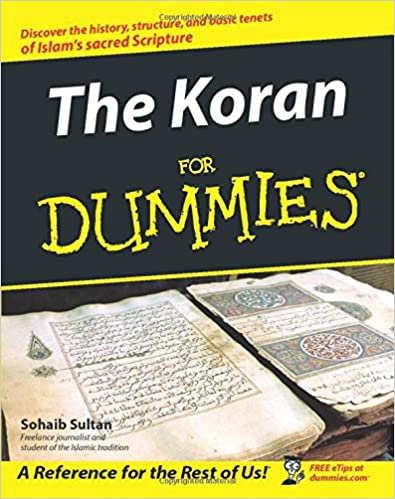
One example is The Koran For Dummies by Sohaib Sultan. Like many introductory Islam books, it presents not merely the Quran, but an entire inherited religious framework built from:
- Hadith,
- Sunnah,
- Tafsir,
- jurisprudence,
- and later scholarly tradition.
The issue is not the sincerity of the author.
The deeper issue is:
What actually constitutes Islam according to the Quran itself?
The Quran repeatedly describes itself as:
- complete,
- fully detailed,
- sufficient,
- and the sole source of religious law.
Yet many introductory Islam books quickly move beyond the Quran and treat later religious tradition as equally authoritative.
The result is that readers often encounter:
traditional Islam,
rather than:
the Quran itself.
The Quran’s Own Claim About Itself
The Quran repeatedly makes extraordinary claims regarding its own authority and completeness.
“Shall I seek other than GOD as a source of law, when He has revealed to you this book fully detailed?” (6:114)
“The Word of your Lord is complete, in truth and justice. Nothing shall abrogate His words.” (6:115)
“This Quran could not possibly be authored by other than GOD… and provides a fully detailed scripture.” (10:37)
The Quran repeatedly presents itself as:
- fully detailed,
- complete,
- sufficient,
- and internally coherent.
It also repeatedly identifies itself as:
Hadith.
“GOD has revealed herein the best Hadith…” (39:23)
And asks repeatedly:
“Which Hadith other than GOD and His revelations do they uphold?” (45:6)
“Which Hadith, other than this, do they believe in?” (77:50)
The implication is difficult to avoid:
the Quran consistently directs believers back toward:
revelation itself,
not toward centuries of accumulated religious narration.
The Shift From Quran to Tradition
A striking feature of many introductory Islam books is how quickly they move away from the Quran itself.
Instead of grounding religion directly in revelation, the discussion rapidly shifts toward:
- Hadith,
- prophetic narrations,
- scholarly interpretation,
- legal schools,
- and inherited orthodoxy.
Sohaib Sultan openly states that understanding the Quran requires:
- sayings attributed to Muhammad,
- companions,
- and famous scholars.
The problem is not merely the use of historical material.
The problem is theological.
Once words attributed to:
- scholars,
- jurists,
- narrators,
- or religious authorities
become necessary to “complete” the Quran, the Quran’s own repeated claims of completeness become undermined.
Who Explains the Quran?
The Quran repeatedly states that:
God explains the Quran.
“Then it is we who will explain it.” (75:19)
The Quran contains numerous verses stating that:
- God explains His revelations,
- clarifies the signs,
- and teaches the scripture.
It even explicitly states:
“The Most Gracious. Teacher of the Quran.” (55:1–2)
Yet many traditional frameworks teach that:
- scholars,
- jurists,
- Hadith,
- or prophetic reports
are necessary to explain the Quran properly.
This creates a fundamental shift in religious authority.
The Quran consistently places ultimate explanatory authority with:
The Problem of Sunnah and Hadith
One of the most important issues concerns the meaning of:
Sunnah.
Traditional Islam defines Sunnah as:
- the practices,
- sayings,
- and traditions attributed to Prophet Muhammad.
Yet in the Quran itself, the Arabic word:
sunnah
consistently refers to:
God’s system or method.
Examples include:
- 17:77
- 33:62
- 48:23
The Quran never uses the phrase:
“Sunnah of Muhammad.”
This distinction becomes highly significant because much of traditional Islam depends upon elevating extra-Quranic reports into binding religious authority.
The Hadith collections themselves were compiled:
- more than two centuries after the Quranic revelation,
- amid political conflict,
- sectarian rivalry,
- and theological development.
Yet introductory Islam books frequently present these later narrations as though they were inseparable from the Quran itself.
When Scholars Replace Revelation
The Quran repeatedly warns against elevating religious leaders into authorities beside God.
“They have set up their religious leaders and scholars as lords instead of GOD…” (9:31)
Ironically, many traditional religious systems do exactly this:
- scholars define lawful and unlawful,
- jurists create binding legislation,
- and inherited interpretations override direct Quranic wording.
Once human beings gain authority to:
- legislate religion,
- define doctrine,
- or complete revelation,
religious authority gradually shifts away from:
God alone.
The Quran repeatedly insists:
“Legislation belongs to GOD alone.” (12:40)
Examples of Extra-Quranic Religion
Many doctrines commonly presented in introductory Islam books rely overwhelmingly upon:
- Hadith,
- juristic interpretation,
- or inherited tradition
rather than explicit Quranic teaching.
Examples include:
- stoning for adultery,
- death penalty for apostasy,
- cutting off hands for theft,
- mandatory hijab formulations,
- the return of Jesus,
- detailed ablution rituals,
- and rigid political Sharia systems.
The Quran itself often presents very different formulations.
For example:
- the Quran prescribes flogging for adultery, not stoning (24:2),
- the Quran speaks of marking the thief’s hand rather than amputating it (5:38),
- the Quran never commands a political Islamic state,
- and the Quran repeatedly emphasizes freedom of belief.
Yet introductory Islam literature often presents later traditional interpretations as though they were the Quran itself.
The Quran and Freedom of Religion
The Quran repeatedly affirms freedom of conscience.
“There shall be no compulsion in religion.” (2:256)
“The truth is from your Lord; whoever wills may believe, and whoever wills may disbelieve.” (18:29)
“Had your Lord willed, all the people on earth would have believed. Are you going to force the people to become believers?” (10:99)
The Quran consistently presents faith as:
- voluntary,
- moral,
- and rooted in sincerity.
Yet many traditional systems transform religion into:
- institutional authority,
- legal enforcement,
- and ideological conformity.
The Quran’s emphasis remains fundamentally different.
Rituals vs Religious Law
A common objection raised against the Quran-alone perspective asks:
“If the Quran is complete, where are the details of ritual prayer?”
This objection confuses:
- ritual practice,
with: - religious legislation.
The Quran repeatedly claims completeness regarding:
guidance,
law,
doctrine,
and:
religious authority.
The Quran does not necessarily detail every ritual motion or customary practice.
For example, the Quran commands ablution in four simple steps:
“Wash your faces, wash your arms to the elbows, wipe your heads, and wash your feet to the ankles.” (5:6)
Yet traditional systems expanded this into elaborate ritual sequences through later jurisprudence.
The distinction between:
- ritual continuity,
and: - religious law
is critically important.
The Quran and Human Religious Systems
A major historical reality is that organized religious systems developed:
- generations after revelation,
- through scholars,
- jurists,
- empires,
- and sectarian institutions.
This occurred in:
- Judaism,
- Christianity,
- and Islam alike.
The Quran repeatedly warns against:
- inherited religion,
- conjecture,
- and human religious authority.
“They follow nothing but conjecture and personal opinion.” (53:23)
Yet much introductory Islam literature presents later orthodoxy as though it emerged directly and unchanged from the Quran itself.
The Quran Alone
The Quran repeatedly calls believers back to:
- God alone,
- revelation alone,
- and direct accountability before the Creator.
“When your Lord ALONE is mentioned in the Quran, they run away in aversion.” (17:46)
And:
“When GOD ALONE is mentioned, the hearts of those who do not believe in the Hereafter shrink with aversion…” (39:45)
These verses remain deeply relevant.
The real question is not whether:
- scholars,
- traditions,
- or historical systems
exist.
The real question is:
what possesses ultimate religious authority?
The Quran’s answer is consistent and unmistakable:
God alone.
Conclusion
Many introductory Islam books sincerely attempt to help readers understand the religion.
Yet too often they introduce readers not primarily to:
the Quran,
but to:
centuries of accumulated religious tradition.
The result is that:
- Hadith,
- jurisprudence,
- scholar authority,
- and inherited orthodoxy
gradually overshadow the Quran’s own repeated claims: - completeness,
- sufficiency,
- and direct accessibility.
The Quran repeatedly calls believers back toward:
- revelation itself,
- personal accountability,
- and submission to God alone.
The central question therefore remains:
Should Islam ultimately be understood through:
- the Quran itself,
or through: - religious systems constructed centuries later?
Continue Your Study
These related studies examine different ways the Quran can become secondary to inherited tradition, simplified religious teaching, academic assumptions, or political ideology – and why religious claims should ultimately be tested against the Quran itself.
The Quran Hijacked Twice – By Critics and Traditionalists
Examine how critics of Islam and traditional Muslim authorities can arrive from opposite directions yet rely on the same post-Quranic traditions, leaving the Quran itself secondary.
When the Quran Becomes Secondary
Examine how additional religious sources, authorities, and inherited assumptions can gradually move the Quran from the center of religious guidance to a secondary position.
Modern Scholarship and the Quranic Proof
Consider both the contributions and methodological limits of modern Quranic scholarship, and whether an internally embedded Quranic proof can address questions that historical-critical methods do not consider.
When Religion Becomes Ideology – A Quranic Critique of Sayyid Qutb’s Milestones
Examine how religion can be transformed into a political ideology, and evaluate the influential ideas of Sayyid Qutb’s Milestones against the Quran itself.