Introduction: Time Is Not a Human Construct
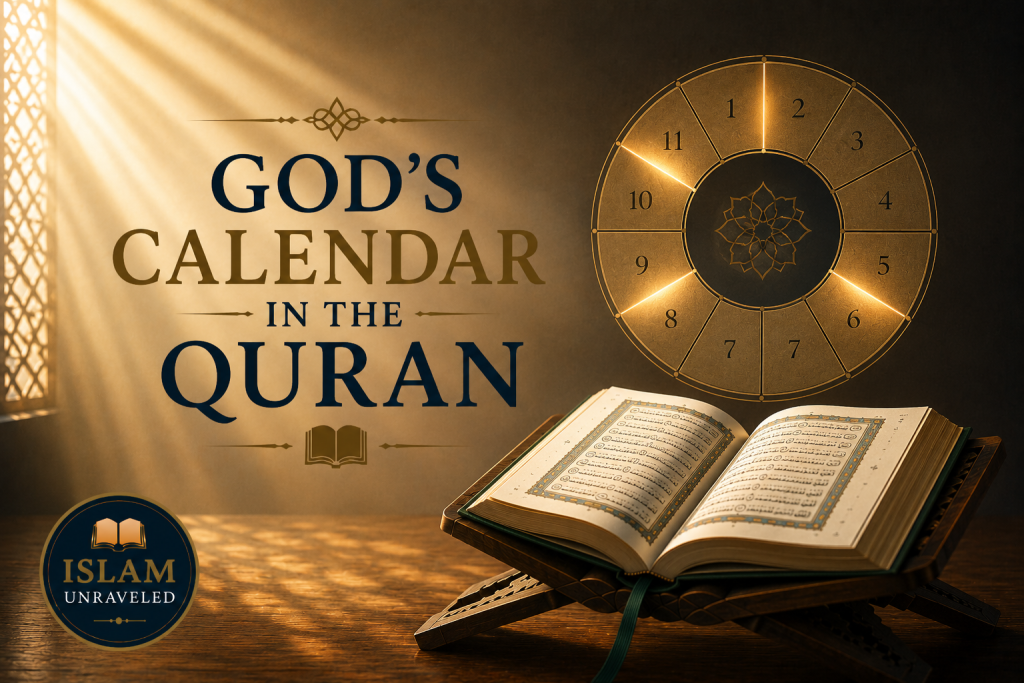
Time, in God’s calendar in the Quran, is not a cultural invention. It is a divine system established by God from the beginning of creation.
“The count of months, as far as GOD is concerned, is twelve. This has been GOD’s law since the day He created the heavens and the earth…” (9:36)
This statement is definitive. It establishes that:
- the structure of time is fixed by God
- the calendar is not subject to human redesign
- deviation from this system is a departure from divine order
The Divine System: Twelve Lunar Months
The Quran defines a simple and universal system:
- twelve months
- based on the lunar cycle
- established from creation
This system is:
- observable
- consistent
- independent of human calculation
Unlike solar or hybrid systems, the lunar calendar naturally rotates through all seasons. This ensures that religious practices are not tied to a fixed climate or geography.
The Four Sacred Months
Within the twelve months, the Quran designates:
“…four of them are sacred. This is the perfect religion…” (9:36)
The Quran does not name these months explicitly. It does, however, provide a critical clue:
“The pilgrimage is to be observed in the specified months…” (2:197)
This indicates that:
- Hajj is not confined to a single day
- it occurs within a span of months
- the sacred period is tied to this broader context
A consecutive sequence of sacred months that includes Hajj aligns naturally with the Quranic wording and avoids reliance on external traditions.
Human Alteration: The Case of the Jewish Calendar
Historically, the Jewish calendar was originally lunar. Over time, it was modified into a lunisolar system by introducing an extra month to align with the solar year.
This adjustment ensured that:
- religious events remained tied to specific seasons
However, this represents a fundamental shift:
- from a naturally rotating lunar system
- to a controlled, calculated structure
The Quran presents time as a fixed divine system. Introducing adjustments to maintain seasonal alignment reflects a human preference imposed onto what God established.
The Islamic Calendar: Divine Structure and Cultural Elements
The Islamic calendar preserves the lunar structure described in the Quran. However, an important distinction must be made:
- the twelve months are divinely established
- the names of the months are pre-Islamic and cultural
Names such as:
- Ramadan (scorching heat)
- Rabiʿ (spring)
reflect the seasonal conditions at the time they were named. Yet today, these months move through all seasons.
This demonstrates a key point:
The meaning of the names is not part of the divine system.
The structure of the calendar is.
The Rotation of Time: A Deliberate Design
Because the Quran’s calendar is purely lunar:
- months are not fixed to seasons
- religious practices occur across all climates over time
This creates:
- balance
- universality
- equality across regions
Fixing religious observances to seasons, as in a lunisolar system, disrupts this balance and introduces artificial constraints.
Reconsidering the Sacred Months
Traditional identifications of the sacred months rely on historical reports and inherited interpretations.
However, a Quran-based approach requires:
- internal consistency
- reliance on the text itself
- avoidance of external assumptions
A consecutive sequence of sacred months that includes the Hajj period:
- aligns with 2:197
- maintains continuity
- reflects a coherent sacred interval
This approach remains within the Quran’s framework and avoids dependence on later sources.
A Broader Principle: Divine Simplicity vs Human Complexity
The contrast is clear.
God’s system:
- simple
- observable
- consistent
- universal
Human systems:
- adjusted
- calculated
- modified to fit preferences
What begins as practical adjustment often becomes:
- institutionalized
- unquestioned
- mistaken for divine intent
Conclusion
The Quran presents time as part of God’s perfect design:
- twelve lunar months
- four sacred months
- a system established from creation
Human alteration of this system, whether through calculation, adjustment, or inherited tradition, introduces complexity into what was originally simple.
The Quran does not call for managing time.
It calls for recognizing and following the system already established.
Time in the Quran is not a cultural construct.
It is a divine order.