Introduction
One of the remarkable patterns in the Quran is its repeated emphasis on the humanity of the messengers including Jesus in the Quran. The Quran rejects the deification of prophets and consistently portrays them as servants of God who were inspired, guided, corrected, and tested.
The Quran declares:
“Say, ‘I am no more than a human like you, being inspired that your god is one god…’” (18:110)
And:
“The messengers before you were no more than men whom We inspired…” (16:43)
The Quran therefore does not present prophets as divine beings immune from human limitation. In fact, many prophets are shown experiencing moments of weakness, haste, fear, misjudgment, or divine correction. Yet when examining the case of Jesus, a striking distinction appears: the Quran does not record a personal mistake or divine rebuke concerning him.
This raises an important question:
Does the Quran mention an error or mistake for every prophet and messenger?
The answer, based on the Quran alone, appears to be no.
The Quran Records Human Weaknesses of Many Messengers
The Quran openly mentions moments involving numerous prophets that demonstrate their humanity.
Adam
Adam disobeyed the command concerning the tree:
“Adam disobeyed his Lord, and thus went astray.” (20:121)
Yet God redeemed him afterward.
Noah
Noah pleaded concerning his son after the flood despite prior warning:
“My Lord, my son is a member of my family…” (11:45)
God corrected him:
“Do not ask Me about matters you do not know…” (11:46)
Noah then repented.
Abraham
Abraham prayed for his father before it became clear that his father remained an enemy of God:
“Abraham’s plea for forgiveness for his father was only because of a promise he had made to him…” (9:114)
When the truth became clear, Abraham dissociated himself.
Moses
Moses unintentionally killed a man:
“He struck him and killed him…” (28:15)
Moses immediately admitted his wrongdoing:
“My Lord, I have wronged my soul, so forgive me.” (28:16)
David
David realized he had been tested in judgment after hearing the case of the two disputants:
“David realized that We had tested him. He then asked forgiveness from his Lord…” (38:24)
The Quran does not elaborate extensively, but the passage clearly presents a moment of realization and repentance.
Solomon
The Quran describes Solomon becoming occupied with magnificent horses until sunset:
“I enjoyed the material things more than worshiping my Lord, until the sun was gone.” (38:32)
Interpretations vary regarding the exact nature of the event, but the surrounding verses present it as a test followed by repentance and renewed devotion.
Jonah
Jonah left angrily before divine permission:
“The one with the fish…” (21:87)
Inside the darkness he confessed:
“I have committed a gross sin.” (21:87)
Muhammad
The Quran also contains direct divine corrections addressed to Muhammad.
Examples include:
The Blind Man
“He frowned and turned away when the blind man came to him.” (80:1–2)
Permission to the Hypocrites
“God has pardoned you: why did you give them permission…” (9:43)
Forbidding What God Made Lawful
“O prophet, why do you prohibit what God has made lawful for you?” (66:1)
These passages powerfully demonstrate that the Quran does not portray Muhammad as beyond correction.
Joseph
Joseph told the freed servant:
“Mention me at your lord.” (12:42)
The verse then states that Satan caused the servant to forget, resulting in Joseph remaining in prison for additional years.
The Quran does not explicitly call this a sin, but many understand the passage as illustrating a moment of reliance upon worldly means rather than solely upon God.
Jesus in the Quran
When the Quran speaks about Jesus, however, a noticeably different pattern emerges.
The Quran repeatedly states:
“We supported him with the Holy Spirit.” (2:87)
And again:
“We gave Jesus, son of Mary, the clear proofs and supported him with the Holy Spirit.” (2:253)
Also:
“Recall that I supported you with the Holy Spirit…” (5:110)
Unlike other prophets, the Quran never narrates:
- a mistake by Jesus,
- a divine rebuke directed at Jesus,
- a repentance of Jesus,
- or a correction of Jesus’ conduct.
Instead, the Quran consistently defends him from false accusations and emphasizes his purity and righteousness.
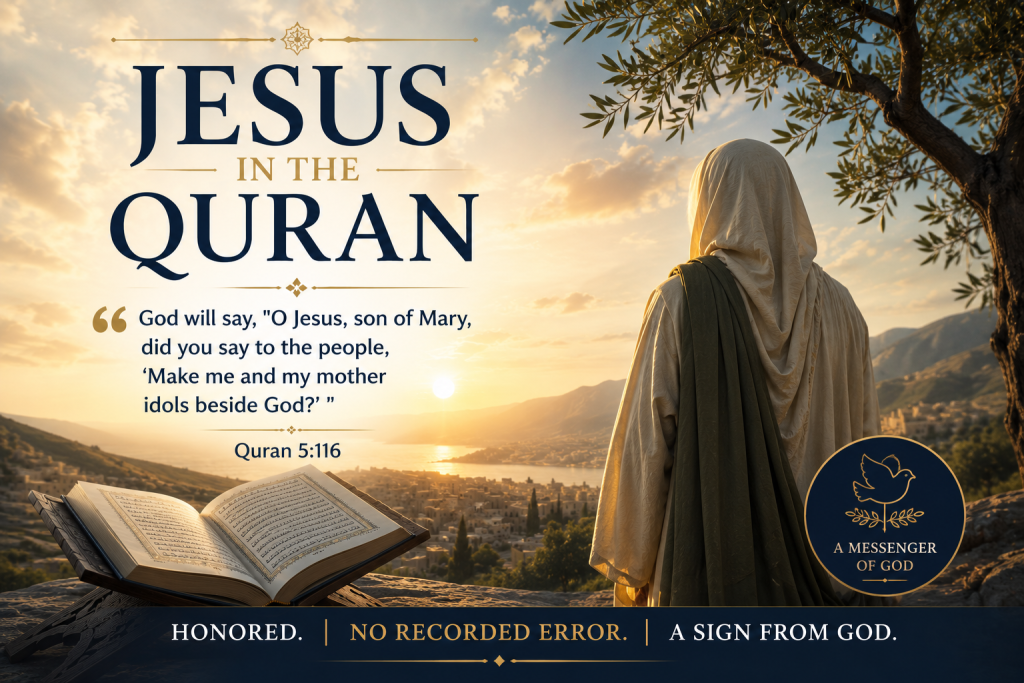
The Question in 5:116
Some point to 5:116 as a possible rebuke:
“Did you say to the people, ‘Take me and my mother as gods beside God?’”
But the passage itself shows that Jesus denies making such a claim:
“I only told them what You commanded me…” (5:117)
The correction in this passage is directed toward later followers who elevated Jesus and Mary, not toward Jesus himself.
Does Every Messenger Have a Recorded Error?
The Quran mentions many prophets about whom little detail is given. Several are praised without any recorded lapse or correction.
Examples include:
- Idris
- Ishmael
- Isaac
- Jacob
- Hud
- Salih
- Shuʿayb
- Yahya
- Zakariya
- Dhul-Kifl
Regarding Yahya, the Quran says:
“We granted him wisdom while still a child, and tenderness from Us and purity…” (19:12–13)
No mistake is mentioned.
Likewise concerning Idris:
“He was truthful, a prophet.” (19:56)
No error narrative appears.
Thus, the Quranic pattern is not that every prophet must have a recorded mistake. Rather, the Quran selectively records incidents that reinforce theological lessons.
Why Does the Quran Mention These Human Moments?
The Quran’s purpose appears clear.
It repeatedly removes the possibility of elevating prophets into divine or semi-divine beings.
The prophets:
- receive revelation,
- guide humanity,
- and are honored by God,
but they remain human servants.
The Quran warns:
“The Messiah, son of Mary, was no more than a messenger…” (5:75)
And:
“It is not for any human being whom God gave the scripture, authority, and prophethood to then say to the people, ‘Worship me instead of God.’” (3:79)
The inclusion of human moments among prophets reinforces this principle.
Jesus: A Unique Yet Human Messenger
Jesus is clearly distinguished in the Quran in several ways:
- virgin birth,
- miracles by God’s permission,
- direct support by the Holy Spirit,
- speaking in infancy,
- and absence of any recorded personal mistake.
Yet despite these distinctions, the Quran still firmly rejects divinizing him.
Jesus himself says:
“I am a servant of God.” (19:30)
Thus, from the Quran alone, Jesus stands as a uniquely supported and protected messenger, but still entirely a servant of God and never divine.
Jesus as “A Word from God” and Speaking in the Cradle
Another notable distinction concerning Jesus in the Quran is the language used to describe him in relation to divine revelation and divine support.
The Quran states:
“The angels said, ‘O Mary, God gives you good news of a Word from Him whose name is the Messiah, Jesus son of Mary…’” (3:45)
And:
“The Messiah, Jesus son of Mary, was a messenger of God and His Word that He delivered to Mary, and a Spirit from Him…” (4:171)
These verses have generated much discussion. However, within the Quran itself, the expression “His Word” does not indicate divinity. Rather, it points to Jesus being brought into existence directly through God’s command.
The Quran repeatedly explains creation through the divine command “Be”:
“When He decrees a matter, He only says to it, ‘Be,’ and it is.” (3:47)
The immediate context of Jesus’ birth confirms this understanding. After mentioning Jesus as “a Word from Him,” the Quran explains that God creates as He wills without normal biological process:
“The likeness of Jesus with God is the same as Adam. He created him from dust, then said to him, ‘Be,’ and he was.” (3:59)
Thus, the Quran itself interprets Jesus being “a Word from God” as referring to the special manner of his creation by divine command, not as sharing in divinity.
At the same time, the Quran portrays Jesus as uniquely aligned with revelation from the very beginning of his life.
When Mary brought the infant Jesus to her people and they accused her, the infant Jesus spoke:
“I am a servant of God. He has given me the scripture and made me a prophet.” (19:30)
This event is extraordinary among the prophets mentioned in the Quran. Jesus speaks miraculously in infancy, immediately declaring:
- servitude to God,
- receipt of scripture,
- and prophethood.
One may reasonably observe from the Quranic narrative that Jesus’ speech is portrayed as being under divine guidance from the very beginning of his earthly life. Combined with the repeated statements that he was supported by the Holy Spirit (2:87, 2:253, 5:110), the Quran presents Jesus as uniquely protected and guided in his mission.
However, even these exceptional qualities remain within the Quran’s strict framework of monotheism. The Quran never presents Jesus as divine, independent, or worthy of worship. Rather, all miraculous aspects of Jesus’ life are consistently attributed to God’s power and permission.
The balance of the Quran is therefore precise:
- Jesus is uniquely honored,
- uniquely supported,
- and uniquely described,
- yet always remains a servant and messenger of God.
Final Reflection
The Quran does not establish a rule that every prophet must have a recorded mistake. Rather, it presents selected human moments from many prophets to emphasize their humanity and dependence upon God.
Jesus stands out because the Quran records no personal lapse or divine correction concerning him, while repeatedly emphasizing that he was strengthened by the Holy Spirit throughout his mission.
At the same time, the Quran carefully balances this distinction by continually affirming that Jesus was:
- a messenger,
- a servant,
- and a worshiper of God,
never an object of worship himself.