Introduction
Throughout history, individuals have claimed divine authority, revelation, or special religious status. The Quranic criteria for God’s messengers repeatedly warns humanity about false religious leadership, fabricated teachings, and speaking in the name of God without authorization.
At the same time, the Quran clearly affirms that God sends messengers to humanity.
This creates an essential question:
How does the Quran distinguish between a genuine messenger and a false claimant?
The issue became particularly significant in modern times after renewed attention was drawn to Quran 3:81 and the distinction between a prophet and a messenger. Once this distinction became widely discussed, messenger claims multiplied dramatically.
The Quran therefore must remain the criterion.
The Distinction Between Prophet and Messenger
One of the most important Quranic distinctions appears in 3:81:
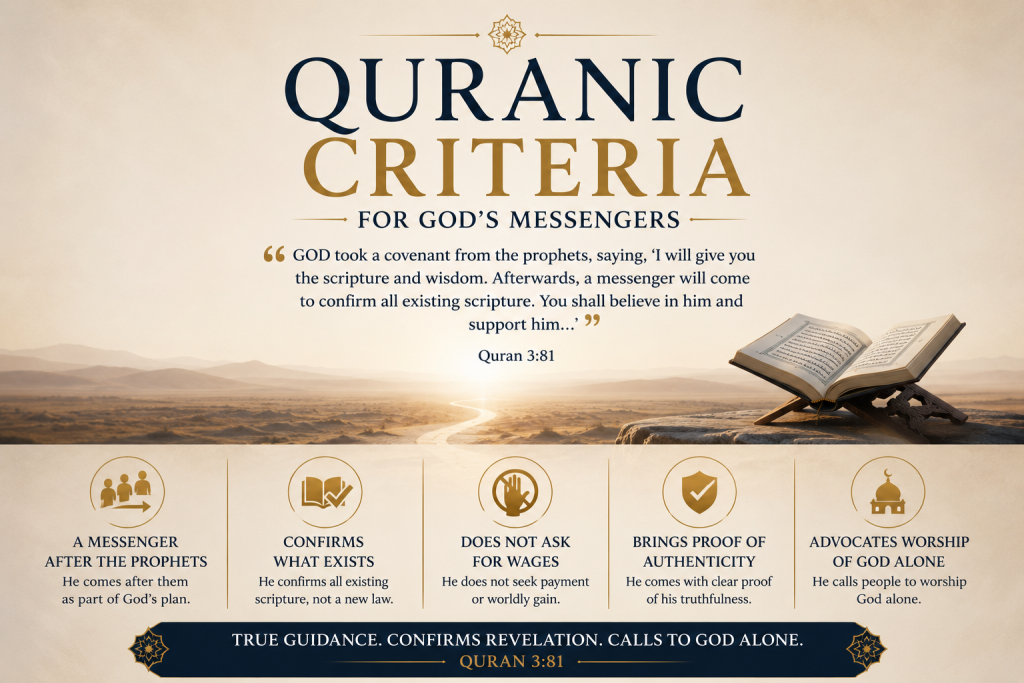
“GOD took a covenant from the prophets, saying, ‘I will give you the scripture and wisdom. Afterwards, a messenger will come to confirm all existing scripture. You shall believe in him and support him…’” (3:81)
This verse is highly significant because it distinguishes between:
- prophets
- and a messenger who comes confirming scripture already present with them
If prophet and messenger were identical categories, the distinction within the verse would become unnecessary.
The Quran therefore establishes:
- all prophets are messengers
- but not all messengers are prophets
This distinction is critical because Muhammad is explicitly described as:
“…the messenger of GOD and the final prophet.” (33:40)
The Quran states that Muhammad is the final prophet. It does not state that he is the final messenger.
The Historical Pattern Before and After 1988
For centuries, many false claimants declared themselves prophets:
- Joseph Smith
- Baháʼu’lláh
- Mirza Ghulam Ahmad
All such claims directly conflicted with 33:40 because they failed to recognize the Quranic distinction between prophet and messenger.
However, after Rashad Khalifa publicly emphasized the distinction between prophet and messenger based on 3:81, the pattern changed dramatically.
The first modern messenger claimants appeared while Rashad Khalifa was still alive. After his death in 1990, the number of claimants steadily increased. Over time, messenger claims became increasingly common, with numerous individuals around the world—both men and women—claiming divine messengership.
This historical shift is itself noteworthy.
Before the distinction became widely discussed, false claimants overwhelmingly claimed prophethood. After the distinction became known, claimants shifted almost entirely toward “messenger” status.
The phenomenon continues to this day.
The Existence of False Claimants Does Not Invalidate the Quranic Category
The multiplication of messenger claimants does not invalidate the Quranic category of “messenger.” Rather, it demonstrates why the Quranic criteria are essential safeguards against self-appointed religious authority.
The Quran repeatedly warns against:
- fabricated religion
- false authority
- speaking in God’s name without proof
“Who is more evil than one who fabricates lies about GOD…?” (6:21)
A Messenger Is Not Self-Appointed
The Quran consistently presents messengership as a divine appointment:
“GOD knows best whom to appoint as His messenger.” (6:124)
“GOD chooses from the angels messengers, as well as from the people.” (22:75)
A messenger therefore cannot establish authority merely through:
- personal conviction
- dreams
- charisma
- followers
- emotional experiences
The authority must come from God.
Messengers Confirm Existing Revelation
A central Quranic criterion is confirmation of revelation.
3:81 explicitly describes a messenger who:
“…will come to confirm all existing scripture…”
Likewise:
“This too is a blessed scripture that confirms the previous scriptures…” (6:92)
A genuine messenger does not:
- contradict the Quran
- replace the Quran
- introduce a new religion
Rather, the messenger:
- confirms revelation
- restores forgotten truth
- calls people back to God alone
Messengers Bring Proof from God
The Quran repeatedly associates divine messengership with signs and proof.
“Their messengers went to them with clear proofs…” (57:25)
This point becomes critically important regarding modern claimants.
The Proof in 74:30–31
One of the central Quranic manifestations associated with Rashad Khalifa was the unveiling of the significance of:
“Over it is nineteen.” (74:30)
For centuries, the meaning of this verse remained unknown and widely misunderstood. The discovery associated with it was presented not merely as a numerical observation, but as embedded Quranic information connected to:
- the Quran’s structure
- the distinction between prophet and messenger
- and the covenant of 3:81
Similarly, the distinction between prophet and messenger in 3:81 was not widely recognized before this period.
This is an important observation.
The claimed proof involved uncovering information embedded within the Quran itself that had not previously been understood.
The Problem of Imitation Claims
Most later messenger claimants do not present genuinely new Quranic manifestations or previously unknown embedded Quranic information.
Instead, many simply:
- repeat the number 19
- imitate previously known arguments
- reinterpret existing discoveries around themselves
This is a critical distinction.
A genuine divine confirmation would reasonably involve uncovering Quranic information not previously recognized—just as the significance of 74:30–31 and 3:81 was not broadly understood beforehand.
Merely repeating already-known claims is not equivalent to bringing proof from God.
Messengers Call to God Alone
The central message of all messengers is identical:
“We sent a messenger to every community, saying, ‘You shall worship GOD, and avoid false gods.’” (16:36)
A genuine messenger consistently calls people toward:
- worship of God alone
- rejection of shirk
- rejection of human religious authority beside God
Messengers Do Not Seek Personal Glorification
The Quran repeatedly portrays God’s messengers as:
- humble
- devoted
- unconcerned with worldly gain
“I do not ask you for any wage.” (42:23)
A genuine messenger does not build:
- personality worship
- priesthood
- cultic devotion
- religious hierarchy around himself
The focus remains on:
- God
- revelation
- truth
The Quran Warns Against Religious Delusion
The Quran repeatedly warns that religious corruption often comes from within religious communities themselves.
“The devils of the humans and the jinn inspire in each other fancy words, in order to deceive.” (6:112)
“Woe to those who write the scripture with their own hands, then say, ‘This is from GOD.’” (2:79)
Claiming divine authority is among the most serious claims a human being can make.
The Burden of Claiming Messengership
Messengership is not:
- mystical status
- spiritual branding
- personal enlightenment
- social media influence
It is an immense Quranic claim carrying enormous responsibility.
Such a claim requires:
- Quranic consistency
- confirmation of revelation
- proof from God
- devotion to God alone
- absence of contradiction with the Quran
Without these, a claim remains only a claim.
Conclusion
The Quran does not leave believers unprotected against false religious authority.
It provides criteria.
The clarification of the distinction between prophet and messenger brought renewed attention to an important Quranic truth. But it also produced a wave of messenger claimants.
The existence of numerous claimants does not invalidate the Quranic category of “messenger.” Rather, it demonstrates why the Quranic criteria are indispensable.
A genuine messenger cannot merely assert authority. The claim must stand within the Quran’s own framework of:
- confirmation
- proof
- consistency with revelation
- devotion to God alone
Without these, religious claims become indistinguishable from personal assertion.
The Quran repeatedly calls believers not to follow personalities blindly, but to examine all claims through the criterion of God’s revelation itself.