Introduction – The Human Instinct to Blame
When things go wrong, human beings instinctively search for causes. Yet the Quran repeatedly shows that people often do not search for truth first—they search for someone to blame.
Instead of:
- reflection
- repentance
- accountability
people frequently resort to:
- excuses
- projection
- denial
- blame-shifting
The Quran presents this tendency as deeply rooted in human psychology. From Satan himself, to religious leaders, to ordinary individuals, the Quran repeatedly exposes the human urge to transfer responsibility elsewhere.
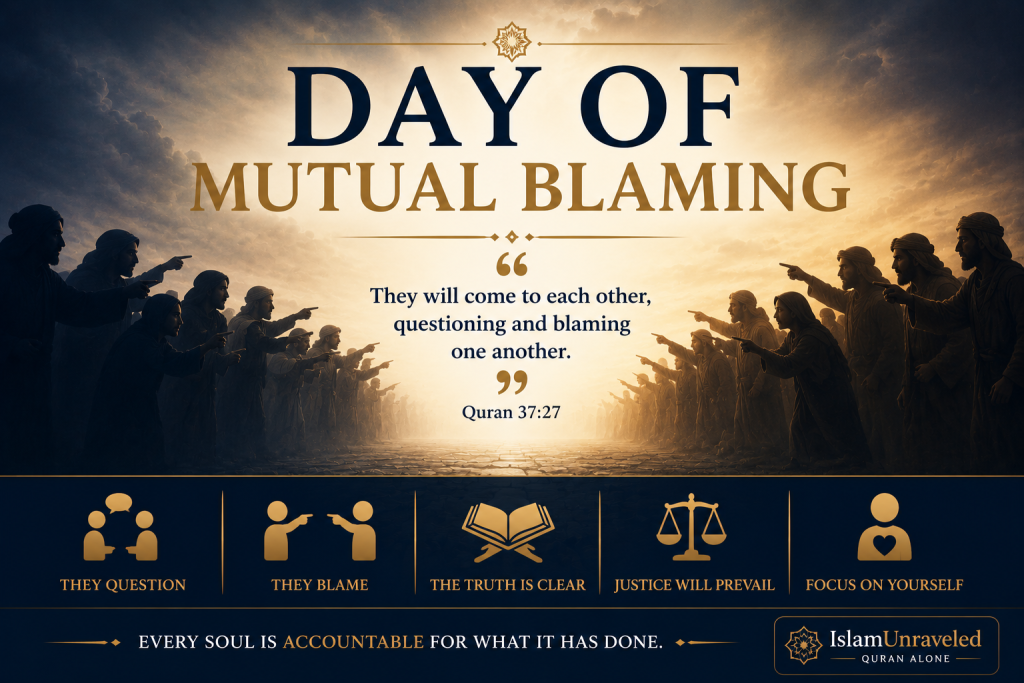
This reaches its climax on the Day of Judgment – a Day the Quran describes as a time of mutual blaming.
The Day of Mutual Blaming
Surah 64 is called Al-Taghabun:
“The Day of Mutual Blaming.”
The word carries meanings of:
- mutual loss
- mutual recrimination
- blaming one another after truth becomes fully clear
On that Day:
- excuses collapse
- hidden motives are exposed
- self-deception disappears
The Quran repeatedly describes scenes in which:
- followers blame leaders
- leaders blame followers
- humans blame Satan
- Satan rejects responsibility for them
The Day of Judgment becomes the final exposure of humanity’s refusal to accept accountability.
The Blaming Soul (75:2)
The Quran even swears by what it calls:
“The blaming soul.” (75:2)
The nafs al-lawwamah is the self-reproaching or blaming soul.
This verse contains profound psychological insight.
The Quran recognizes that human beings possess:
- conscience
- guilt
- inner conflict
- self-awareness
Yet this same soul can move in two very different directions.
One path leads toward:
- honest self-reflection
- repentance
- growth
The other leads toward:
- projection
- denial
- endless blaming of others
The Quran consistently encourages the first and warns against the second.
Humans Claim Credit but Externalize Failure
One of the Quran’s recurring observations is that people readily take ownership of success while distancing themselves from failure.
“When something good happens to them, they say, ‘This is from GOD,’ but when something bad afflicts them, they blame you…” (4:78)
This pattern appears constantly throughout human history:
- political systems blame opponents
- communities blame outsiders
- religious groups blame sects
- individuals blame family, society, or circumstances
The ego protects itself by externalizing responsibility.
The Quran repeatedly dismantles this illusion.
Satan — The Archetype of Blame
The first great act of blame in the Quran comes from Satan himself.
After refusing God’s command, Satan says:
“Since You have willed that I go astray, I will skulk for them on Your straight path.” (7:16)
Rather than accepting responsibility, Satan blames God for his rebellion.
This becomes one of the defining characteristics of evil in the Quran:
- refusal of accountability
- preservation of ego at all costs
Yet the Quran later presents a remarkable scene on the Day of Judgment:
“The devil will say, after the judgment has been issued, ‘GOD has promised you the truthful promise, and I promised you, but I broke my promise. I had no power over you; I simply invited you, and you accepted my invitation. Therefore, do not blame me; blame only yourselves.’” (14:22)
This verse destroys one of humanity’s oldest excuses.
Satan:
- whispers
- invites
- tempts
But he does not force.
The Quran consistently preserves human agency and accountability.
Followers and Leaders Blaming Each Other
The Quran repeatedly portrays scenes where followers blame leaders for their misguidance.
“Our Lord, we obeyed our leaders and elders, but they misled us from the path.” (33:67)
But the Quran does not excuse blind following.
Elsewhere, leaders blame followers in return:
“Those who were arrogant will say to those who were weak, ‘Did we repel you from the guidance after it came to you? No—you yourselves were guilty.’” (34:32)
The Quran rejects the idea that surrendering conscience removes accountability.
No leader can carry another soul’s moral responsibility before God.
The Owners of the Garden — Collective Failure and Mutual Blame
Surah 68 presents a striking example of collective blame.
A group of men planned to harvest their garden selfishly while depriving the needy. God destroyed the garden overnight.
When they saw the destruction:
“They turned to each other, blaming one another.” (68:30)
This scene captures a deeply human reaction.
Instead of immediately confronting:
- greed
- arrogance
- spiritual failure
people often create emotional noise through mutual blame.
Blame becomes a mechanism to avoid:
- shame
- grief
- self-recognition
Jonah — The Opposite Response
The Quran presents Jonah as the opposite model.
Rather than blaming:
- circumstances
- enemies
- destiny
Jonah acknowledged responsibility:
“There is no god except You. Be You glorified. I have committed a gross sin.” (21:87)
This moment is profound.
The path out of darkness began not with blame, but with accountability.
The Quran presents self-recognition as liberating.
Blame as Surrender of Agency
Blaming others often feels empowering.
But the Quranic reality is the opposite.
Persistent blame frequently becomes surrender:
- surrender of agency
- surrender of growth
- surrender of responsibility
The person trapped in blame remains spiritually stagnant because transformation requires ownership.
This is why the Quran repeatedly redirects human beings inward:
- examine yourselves
- reflect
- repent
- reform
The Quranic Principle of Individual Accountability
The Quran repeatedly emphasizes that every soul stands before God individually.
“No soul bears the sins of another soul.” (6:164)
“Every human being is responsible for his own destiny.” (17:13)
“The human being attains only what he strives for.” (53:39)
This principle destroys:
- victim theology
- inherited guilt
- excuse-based spirituality
The Quran acknowledges:
- oppression
- manipulation
- temptation
- social pressure
Yet it never removes personal accountability.
Religious Blame and Sectarianism
The Quran also exposes blame within religion itself.
Communities frequently:
- idolize leaders
- surrender thought
- inherit traditions blindly
Then later blame:
- scholars
- sects
- history
- Satan
The Quran consistently calls believers back to:
- reflection
- reason
- personal responsibility before God
No sect, scholar, movement, or leader can ultimately stand between a soul and its accountability.
The Collapse of Excuses
The Day of Mutual Blaming is not merely a future event.
It already manifests:
- in families
- in politics
- in religion
- in communities
- in relationships
- and within the human soul itself
The Quran repeatedly teaches that spiritual maturity begins when blame ends.
Not because others are always innocent.
But because accountability is the only path to transformation.
Related Articles in This Series
The themes explored in this article connect to broader Quranic discussions on accountability, free will, ego, conscience, leadership, repentance, and human psychology. The following companion articles explore these subjects in greater depth:
- Satan Never Forced Anyone — Free Will in the Quran
A Quranic study of Satan, temptation, accountability, and why the Quran rejects the idea that human beings are forced into corruption. - The Blaming Soul (75:2) — Psychology in the Quran
An exploration of conscience, guilt, ego, denial, and the Quran’s profound understanding of the human soul. - Followers, Leaders, and Blind Obedience
A Quranic study of religious authority, sectarianism, manipulation, and personal accountability before God. - Jonah and the Path of Self-Accountability
How Jonah’s repentance reveals the Quranic path from blame and ego toward humility, accountability, and spiritual transformation. - Retribution in the Quran
- The Blaming Soul
Conclusion
The Quran presents blame-shifting as one of the deepest manifestations of the human ego.
From Satan blaming God, to followers blaming leaders, to communities blaming each other, the Quran repeatedly exposes humanity’s tendency to avoid responsibility.
Yet the Quran also presents another path:
- reflection
- repentance
- self-recognition
- accountability before God
This is the path of spiritual growth.
The Day of Mutual Blaming will ultimately expose every excuse. On that Day, no soul will escape responsibility by pointing at another.
The Quran therefore calls human beings to confront themselves now—before excuses collapse and truth becomes undeniable.
Related Discussion (Video)
This article was inspired in part by themes discussed in the following video: