Introduction
Long before modern psychology explored:
- guilt
- denial
- projection
- self-awareness
- internal conflict
the Quran addressed the inner struggles of the human soul with remarkable depth.
One of the most profound psychological expressions in the Quran appears in a brief but powerful verse:
“And I swear by the blaming soul.” (75:2)
The Quran here draws attention to what it calls:
النفس اللوامة
The blaming soul
The self-reproaching soul
This verse opens a window into the Quran’s understanding of human psychology, conscience, moral conflict, and spiritual accountability.
The Human Soul in the Quran
The Quran describes the human self (nafs) in different spiritual conditions.
Among them are:
- the peaceful soul (nafs al-mutma’innah) — 89:27
- the evil-commanding soul (nafs al-ammarah) — 12:53
- the blaming soul (nafs al-lawwamah) — 75:2
These are not necessarily separate entities. Rather, they reflect different states and tendencies within the human being.
The “blaming soul” occupies a unique position because it represents:
- self-awareness
- moral discomfort
- internal accountability
It is the soul that recognizes contradiction between:
- truth and behavior
- conscience and desire
- belief and action
Why Does God Swear by the Blaming Soul?
In the Quran, when God swears by something, it signifies importance.
The verse:
“And I swear by the blaming soul.” (75:2)
immediately follows:
“I swear by the Day of Resurrection.” (75:1)
This pairing is deeply meaningful.
The Day of Judgment represents:
- ultimate external accountability
The blaming soul represents:
- internal accountability already placed within the human being
Before the final judgment arrives, human beings already possess an inner mechanism capable of:
- recognizing wrongdoing
- experiencing guilt
- sensing moral failure
The Quran therefore presents conscience itself as a sign.
The Blaming Soul and Conscience
The blaming soul is not merely self-hatred or negativity.
It is the human capacity to:
- reflect
- question oneself
- recognize error
- feel moral tension
Without this inner faculty, repentance would be impossible.
The Quran repeatedly encourages self-examination:
“O you who believe, you shall reverence GOD. Let every soul examine what it has sent forth for tomorrow.” (59:18)
The blaming soul becomes spiritually valuable because it interrupts:
- arrogance
- self-righteousness
- moral numbness
The Difference Between Accountability and Despair
The Quran’s psychology is remarkably balanced.
The blaming soul is not meant to trap a person in:
- hopelessness
- obsessive guilt
- paralysis
Rather, it is meant to awaken transformation.
This is why the Quran simultaneously condemns despair:
“Never despair of GOD’s mercy.” (39:53)
Healthy self-reproach leads toward:
- repentance
- growth
- humility
- reform
Unhealthy self-destruction leads toward:
- hopelessness
- emotional collapse
- surrender to sin
The Quran consistently encourages accountability without despair.
Projection — The Refusal to Blame Oneself
One of the deepest psychological insights in the Quran is that human beings often avoid self-accountability by projecting blame outward.
Instead of confronting themselves, they blame:
- society
- leaders
- Satan
- family
- circumstances
- fate
The Quran repeatedly exposes this tendency.
Satan — The First to Refuse Accountability
The first major act of blame in the Quran comes from Satan himself.
After rebelling against God’s command, Satan says:
“Since You have willed that I go astray…” (7:16)
Rather than acknowledging arrogance and pride, Satan blames God.
This establishes a profound Quranic principle:
One of the defining traits of spiritual corruption is refusal of self-accountability.
The Blaming Soul vs The Ego
The Quran repeatedly contrasts humility with arrogance.
The ego seeks:
- self-preservation
- self-justification
- external blame
The blaming soul disrupts this illusion.
It forces the human being to confront uncomfortable truths.
This is why many people resist honest self-reflection:
- because it threatens ego identity
The Quran repeatedly warns against people who:
- justify themselves endlessly
- refuse correction
- become spiritually hardened
Joseph — A Profound Psychological Statement
One of the deepest psychological verses in the Quran appears in Joseph’s statement:
“The self is an advocate of vice, except for those who attain mercy from my Lord.” (12:53)
The Quran recognizes:
- inner temptation
- moral weakness
- psychological conflict
Yet it also recognizes the possibility of:
- awareness
- restraint
- transformation
The blaming soul becomes the battlefield between:
- conscience
- desire
Jonah — The Path of Honest Self-Recognition
The Quran presents Jonah as one of the clearest examples of healthy self-accountability.
Inside the darkness of the fish, Jonah declares:
“There is no god except You. Be You glorified. I have committed a gross sin.” (21:87)
Jonah does not:
- rationalize
- shift blame
- justify himself
Instead, he:
- acknowledges reality
- turns toward God
- accepts responsibility
The Quran presents this honesty as the path to liberation.
Modern Culture and the Collapse of Accountability
Modern culture increasingly encourages externalization:
- blame systems
- blame society
- blame upbringing
- blame environment
- blame others endlessly
The Quran does acknowledge:
- oppression
- injustice
- manipulation
- social pressure
But it never abolishes individual responsibility.
This balance is crucial.
The Quran rejects:
- total victimhood
and also rejects: - merciless harshness
Every soul remains morally accountable before God.
The Spiritual Danger of Losing the Blaming Soul
One of the greatest spiritual dangers is moral numbness.
When the blaming soul weakens:
- conscience fades
- sin normalizes
- arrogance increases
- repentance disappears
The Quran describes people who:
- no longer reflect
- no longer feel moral disturbance
- no longer examine themselves
Such people become spiritually hardened.
The Quranic Path — Self-Examination Before Judgment
The Quran repeatedly calls believers toward:
- introspection
- humility
- repentance
- self-awareness
Before the final Day of Judgment arrives, human beings are already given an internal witness:
- conscience
- the blaming soul
The purpose is not self-condemnation for its own sake.
The purpose is transformation.
Part of a Quranic Reflection Series
This article is part of a broader Quranic series exploring accountability, blame, free will, repentance, conscience, leadership, and the human soul through the Quran alone.
Main article:
The Day of Mutual Blaming — A Quranic Study of Accountability and Human Nature
Related articles in this series:
- Satan Never Forced Anyone — Free Will in the Quran
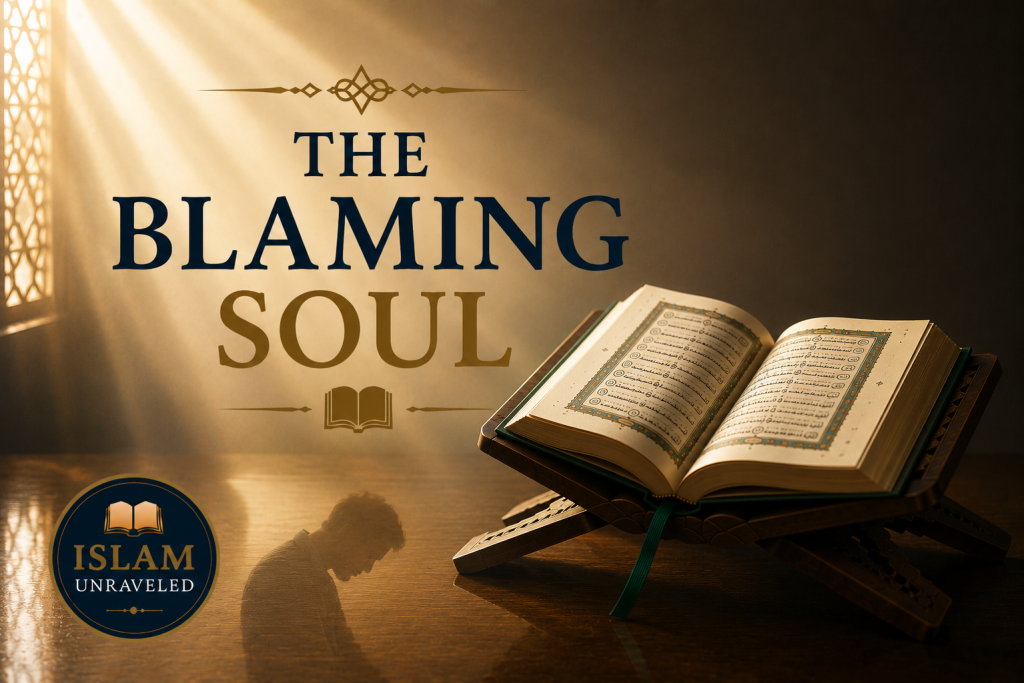
- The Blaming Soul (75:2) — Psychology in the Quran
- Followers, Leaders, and Blind Obedience
- Jonah and the Path of Self-Accountability
Conclusion
The Quran’s discussion of the blaming soul reveals extraordinary psychological depth.
Human beings are not presented as morally simple creatures. The Quran recognizes:
- internal conflict
- guilt
- ego
- denial
- self-deception
- conscience
- repentance
The blaming soul stands between:
- corruption and reform
- arrogance and humility
- destruction and salvation
It is the inner voice that resists spiritual numbness.
The Quran therefore presents self-accountability not as weakness, but as one of the essential signs of spiritual life itself.
Related Discussion (Video)
This article was inspired in part by themes discussed in the following video: