Introduction
The Quran presents many stories of human failure, weakness, and error. Yet among them, the story of Jonah and self accountability stands out because of what he does not do.
He does not:
- blame others
- blame society
- blame circumstances
- blame Satan
- blame destiny
Instead, Jonah turns inward.
In one of the most profound moments in the Quran, trapped in darkness and isolation, Jonah acknowledges responsibility before God.
His story becomes a powerful Quranic lesson about:
- accountability
- humility
- repentance
- and spiritual transformation
Jonah Leaves in Anger
The Quran briefly describes Jonah’s departure:
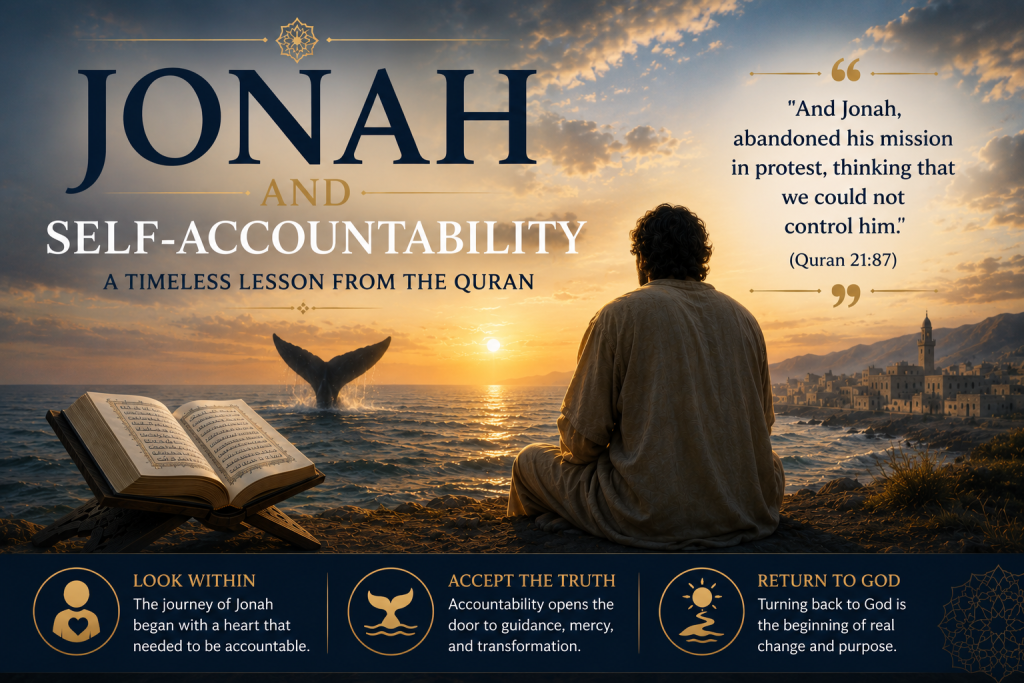
“And Jonah abandoned his mission in protest…” (21:87)
Another verse says:
“Jonah was one of the messengers. He ran to the loaded ship.” (37:139–140)
The Quran does not dwell on excessive detail. Instead, it focuses on the spiritual meaning of what follows.
Jonah:
- became emotionally overwhelmed
- reacted impulsively
- departed prematurely
The Quran presents him not as evil, but as human.
This is deeply important.
The Quran does not portray God’s servants as emotionless beings untouched by frustration, disappointment, or exhaustion.
The Darkness
Jonah eventually finds himself:
- cast into the sea
- swallowed by the fish
- isolated in darkness
The Quran describes the moment with remarkable intensity:
“Then he implored from inside the darknesses…” (21:87)
Notice the plural:
darknesses
The darkness was not merely physical.
It included:
- emotional darkness
- spiritual distress
- inner collapse
- confrontation with the self
The Quran repeatedly portrays isolation and crisis as moments where illusions disappear.
The Turning Point
What makes Jonah extraordinary is not that he made a mistake.
What makes him extraordinary is what he says next.
“There is no god except You. Be You glorified. I have committed a gross sin.” (21:87)
This is one of the purest expressions of self-accountability in the Quran.
Jonah does not:
- rationalize
- justify himself
- blame his people
- accuse God
- project responsibility elsewhere
Instead:
- he glorifies God
- acknowledges truth
- accepts responsibility
The Opposite of Satan
The Quran deliberately contrasts spiritual responses.
When Satan sinned, he blamed God:
“Since You have willed that I go astray…” (7:16)
When Jonah failed, he blamed himself:
“I have committed a gross sin.”
This difference reveals one of the Quran’s deepest spiritual principles.
The path of corruption begins with:
- ego
- self-justification
- blame-shifting
The path of redemption begins with:
- humility
- honesty
- self-recognition
The Psychology of Self-Accountability
Human beings naturally resist self-blame.
The ego prefers:
- excuses
- externalization
- emotional protection
This is why people often say:
- “They made me do it.”
- “It was society.”
- “It was my upbringing.”
- “It was Satan.”
- “It was circumstances.”
The Quran repeatedly dismantles this mentality.
Jonah’s story demonstrates that transformation begins when a person stops fleeing from truth internally.
The Power of Honest Recognition
The Quran presents self-recognition as spiritually liberating.
Immediately after Jonah’s prayer, the Quran states:
“We responded to him, and saved him from the crisis. We thus save the believers.” (21:88)
This is remarkable.
God does not merely save Jonah.
The Quran universalizes the principle:
“We thus save the believers.”
The lesson extends beyond Jonah himself.
The path of salvation involves:
- recognition
- repentance
- accountability
- return to God
Why Accountability Leads to Freedom
Many people assume accountability is emotionally painful while blame feels relieving.
But the Quran presents the opposite reality.
Blame traps the human being because it:
- preserves ego
- prevents growth
- blocks transformation
Accountability, though difficult initially, restores:
- agency
- sincerity
- spiritual movement
Jonah becomes free precisely when he stops defending himself.
The Quran Does Not Demand Perfection
One of the Quran’s most profound lessons is that spiritual greatness does not require perfection.
Human beings:
- struggle
- fail
- weaken
- become emotional
The crucial distinction is not between:
- perfect people
and - imperfect people
The distinction is between:
- those who recognize truth
and - those who endlessly defend the ego
Modern Culture and the Avoidance of Responsibility
Modern culture often encourages:
- self-justification
- perpetual victimhood
- external blame
The Quran acknowledges genuine oppression and injustice. Yet it consistently calls human beings back toward:
- self-reflection
- repentance
- moral responsibility
This balance is essential.
The Quran neither:
- destroys human dignity through hopeless guilt
nor - removes responsibility through endless excuses
The Prayer of Jonah — A Universal Formula
Jonah’s prayer is among the most powerful prayers in the Quran because it contains three essential elements:
1. Recognition of God
“There is no god except You…”
2. Glorification of God
“Be You glorified…”
3. Honest self-recognition
“I have committed a gross sin.”
The prayer contains:
- no ego defense
- no self-righteousness
- no blame projection
It is pure sincerity before God.
The Path of Spiritual Maturity
The Quran repeatedly teaches that spiritual maturity begins when:
- excuses end
- reflection begins
- the soul confronts itself honestly
This is why the Quran swears by:
“the blaming soul” (75:2)
The conscience exists to awaken the human being before final judgment arrives.
Jonah responded correctly to that inner awakening.
The Final Reality
Every human being eventually faces moments similar to Jonah’s:
- failure
- regret
- collapse of ego
- confrontation with truth
The Quran presents two possible responses:
The satanic response:
- denial
- blame
- arrogance
The prophetic response:
- humility
- accountability
- return to God
Jonah chose the second path.
Part of a Quranic Reflection Series
This article is part of a broader Quranic series exploring accountability, blame, free will, repentance, conscience, leadership, and the human soul through the Quran alone.
Main article:
The Day of Mutual Blaming — A Quranic Study of Accountability and Human Nature
Related articles in this series:
- Satan Never Forced Anyone — Free Will in the Quran
- The Blaming Soul (75:2) — Psychology in the Quran
- Followers, Leaders, and Blind Obedience
- Jonah and the Path of Self-Accountability
Conclusion
The story of Jonah is not fundamentally about a fish.
It is about the human soul.
It is about what happens when:
- illusion collapses
- ego weakens
- and a human being finally speaks honestly before God
Jonah’s greatness lies not in never struggling, but in refusing to hide from truth once confronted with it.
The Quran presents self-accountability not as humiliation, but as liberation.
The soul begins healing the moment it stops blaming everything else.
Related Discussion (Video)
This article was inspired in part by themes discussed in the following video: