Does Scripture Necessarily Mean a Written Book?
When we hear the word “scripture,” we normally think of a written book—a physical text consisting of pages that can be read, copied, and preserved.
But what is scripture in the Quran?
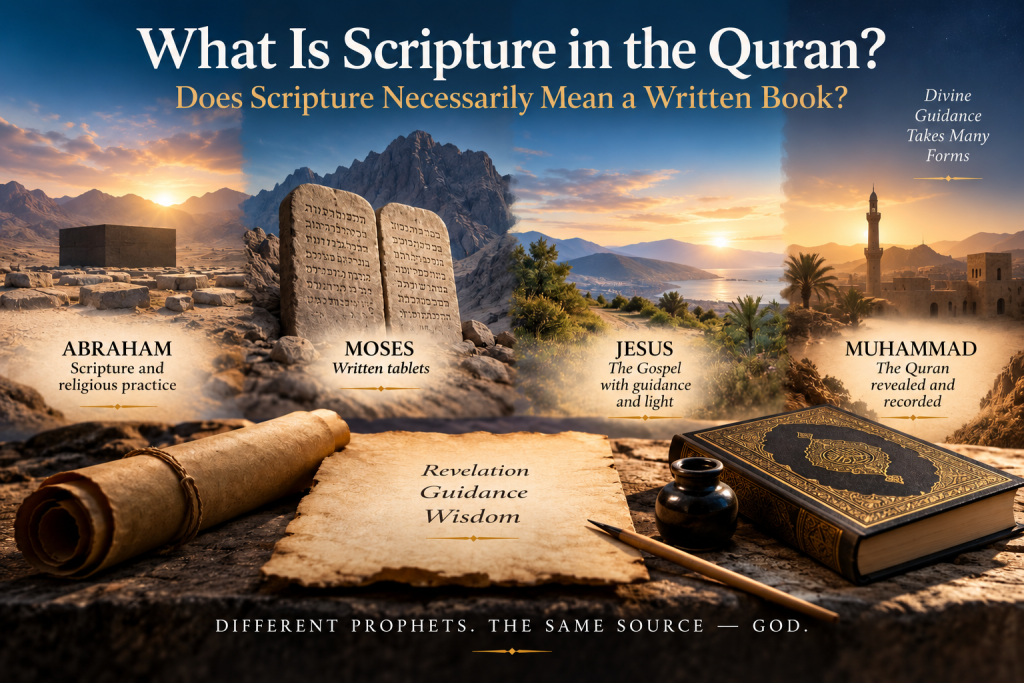
This question becomes particularly important when considering the revelations associated with Abraham, Moses, Jesus, and Muhammad. The Quran associates scripture with God’s prophets, but it does not describe every scripture as being delivered or preserved in the same physical manner.
Moses provides the clearest example of revelation explicitly written on physical tablets. The Quran’s revelation to Muhammad occurs in a setting where reading, the pen, writing, and dictation are mentioned. By contrast, although the Quran refers to the scriptures of Abraham and says that Jesus was given the Gospel, it does not tell us that either Abraham or Jesus received a physically written book.
This suggests an important distinction:
Divine scripture is defined primarily by its source—revelation and guidance from God—not necessarily by the physical medium through which it is delivered or preserved.
Scripture and the Prophets
An important starting point is 3:81:
“GOD took a covenant from the prophets, saying, ‘I will give you the scripture and wisdom. Afterwards, a messenger will come to confirm all existing scriptures. You shall believe in him and support him.’ He said, ‘Do you agree with this, and pledge to fulfill this covenant?’ They said, ‘We agree.’ He said, ‘You have thus borne witness, and I bear witness along with you.’”
— Quran 3:81
For the purpose of this discussion, the important part is God’s statement to the prophets:
“I will give you the scripture and wisdom.”
The verse establishes a relationship between prophethood and scripture.
The Quran does not separately identify by name the scripture associated with every prophet. That does not mean that scripture was not given to them. Verse 3:81 provides the general statement, while the Quran gives us additional information concerning particular prophets and particular revelations where relevant.
The question then becomes: What does receiving scripture actually mean? Must it mean receiving a physically written book?
The examples provided by the Quran suggest otherwise.
Abraham Had Scripture
The Quran explicitly refers to scripture associated with Abraham:
“This is recorded in the earlier teachings. The teachings of Abraham and Moses.”
— Quran 87:18–19
The Arabic expression in 87:19 is:
صُحُفِ إِبْرَاهِيمَ وَمُوسَىٰ
ṣuḥufi Ibrāhīma wa-Mūsā
The word ṣuḥuf can carry the sense of pages, sheets, writings, or scriptures.
Abraham is mentioned similarly in 53:36–37:
“Was he not informed of the teachings in the scripture of Moses? And of Abraham who fulfilled?”
The important point is therefore not whether Abraham had scripture. The Quran tells us that he did.
What the Quran does not tell us is that Abraham received a physical written document.
There is no Quranic account of Abraham receiving written tablets, carrying a manuscript, or writing a book containing his revelation.
That absence becomes particularly significant when Abraham’s religious role is considered.
Abraham and the Transmission of Religious Practice
Much of what the Quran tells us about Abraham concerns divine instruction and religious practices.
Abraham and Ismail raised the foundations of the Sacred House:
“As Abraham raised the foundations of the shrine, together with Ismail…”
— Quran 2:127
They prayed:
“Our Lord, make us submitters to You, and from our descendants let there be a community of submitters to You. Teach us the rites of our religion…”
— Quran 2:128
Abraham was also instructed concerning the Sacred House and Hajj:
“We appointed Abraham to establish the Shrine…”
— Quran 22:26
He was then told:
“And proclaim that the people shall observe Hajj pilgrimage…”
— Quran 22:27
Much later, Muhammad was instructed:
“Then we inspired you to follow the religion of Abraham, the monotheist…”
— Quran 16:123
These passages illustrate something important about the transmission of religious guidance.
A religious practice can be taught, demonstrated, practiced, and passed from one generation to another. It does not necessarily require a surviving written instruction manual.
The Quran tells us that Abraham had scripture. It also describes God teaching Abraham religious practices that continued after him. But it does not describe Abraham receiving his scripture as a physical written book.
We should therefore be careful not to add that assumption to the Quran.
Moses: An Explicitly Written Revelation
Moses provides a striking contrast.
In his case, the Quran specifically tells us that revelation was written:
“We wrote for him on the tablets all kinds of enlightenments and details of everything…”
— Quran 7:145
The Quran then describes Moses physically handling those tablets.
When Moses returned to his people:
“…He threw down the tablets…”
— Quran 7:150
Later:
“When Moses’ anger subsided, he picked up the tablets…”
— Quran 7:154
The sequence is concrete:
God wrote → on tablets → Moses possessed the tablets → Moses threw them down → Moses picked them up.
Here the physical form of the revelation is explicitly described.
This establishes an important point for our inquiry:
When the Quran intends to tell us that revelation was physically written, it is capable of saying so explicitly.
We should therefore distinguish what the Quran actually says from what we may automatically imagine when we encounter the English words “scripture” or “book.”
Jesus Was Given the Gospel
Jesus presents another important example.
The Quran states:
“…We sent Jesus, the son of Mary, confirming the previous scripture, the Torah. We gave him the Gospel, containing guidance and light…”
— Quran 5:46
The divine origin of the Gospel is explicit:
God gave Jesus the Gospel.
The Gospel contained guidance and light and confirmed the Torah.
But compare the description with that of Moses.
The Quran does not say that God wrote the Gospel for Jesus.
It does not describe Jesus receiving tablets or written pages.
It does not say that Jesus wrote down the Gospel.
It does not describe Jesus carrying a physical Gospel manuscript.
This places the Gospel given to Jesus closer to the case of Abraham than to the explicitly written tablets of Moses.
Abraham had scripture, but the Quran does not describe its physical written form.
Jesus was given the Gospel, but the Quran does not describe a physical written Gospel being delivered to him.
This does not make either revelation less of a scripture.
Instead, it suggests that physical writing is not what makes revelation scripture.
The Gospel Given to Jesus and the Later Written Gospels
This distinction is especially important because the word “Gospel” today commonly brings to mind the written books known as Matthew, Mark, Luke, and John.
But the Quran’s description is different.
The Quran speaks of:
the Gospel that God gave to Jesus.
The Gospel described in 5:46 was given to Jesus and contained guidance and light.
The later written Gospels are accounts concerning Jesus. They should therefore not automatically be assumed to be identical to the Gospel that the Quran says God gave directly to Jesus.
Whatever historical questions may surround the composition and preservation of the later Gospels are separate from the Quranic point being made here.
For our purposes, the Quranic statement is sufficient:
Jesus received the Gospel from God, but the Quran does not tell us that the Gospel given to Jesus was a physical written book.
This makes the case of Jesus particularly useful for understanding what scripture can mean in the Quran.
Muhammad and the Quran
With Muhammad and the Quran, the circumstances are again different.
The Quran describes itself as revelation received from God:
“You are receiving the Quran from a Most Wise, Omniscient.”
— Quran 27:6
And:
“We have revealed to you this Quran…”
— Quran 76:23
But unlike the accounts of Abraham and Jesus, the Quran’s own environment contains references to reading, the pen, and writing.
One of the most significant occurs at the beginning of Sura 96:
“Read, and your Lord, Most Exalted. Teaches by means of the pen. He teaches the human what he never knew.”
— Quran 96:3–5
The connection is noteworthy:
Read → teaching → pen → knowledge.
The Quran does not present the written word as something foreign to divine instruction. On the contrary, God identifies Himself as the One who “teaches by means of the pen.”
This verse does not directly state that Muhammad personally wrote the Quran. But it is relevant to the question of whether writing was part of the setting in which the Quran was revealed and transmitted.
“You Did Not Write With Your Hand”
Another important passage is 29:48:
“You did not read the previous scriptures, nor did you write them with your hand. In that case, the rejectors would have had reason to harbor doubts”
— Quran 29:48
This verse is sometimes treated as though it simply states that Muhammad could neither read nor write.
But the verse is more specific.
The Arabic includes:
مِن قَبْلِهِ — min qablihi
— “before this.”
The statement concerns what Muhammad had not been doing before the Quran. He had not been reading a previous scripture and writing it with his right hand.
The verse therefore does not simply say:
“You cannot read or write.”
Its purpose is connected to the source of the Quran. Muhammad had not previously been reading and copying earlier scriptures from which opponents could reasonably claim that the Quran had been constructed.
The distinction matters when considering whether the Quran itself could subsequently be committed to writing.
Writing and Dictation
Verse 25:5 provides another interesting piece of evidence.
Muhammad’s opponents alleged:
“They also said, ‘Tales from the past that he wrote down; they were dictated to him day and night.’”
— Quran 25:5
Their accusation concerning the source of the Quran was false. But the form of the accusation is noteworthy.
They accused Muhammad of writing down material being dictated to him.
The Quran responds:
“Say, ‘This was revealed by the One who knows the Secret in the heavens and the earth…’”
— Quran 25:6
The response addresses the source of the Quran. It does not respond by saying that Muhammad was incapable of writing.
Again, this verse by itself does not establish every detail of how the Quran was physically recorded. But together with 96:3–5 and 29:48, it demonstrates that reading, writing, the pen, and dictation are all relevant within the Quranic environment.
What, Then, Does the Quran Mean by Scripture?
The examples can now be compared.
Abraham
The Quran explicitly identifies scripture associated with Abraham. It also describes religious practices taught to and transmitted through him. But it does not describe Abraham receiving a physical written document.
Moses
The Quran explicitly says God wrote upon tablets. Moses physically possessed those tablets, threw them down, and later picked them up.
This is the clearest Quranic example of scripture in an explicitly physical written form.
Jesus
God gave Jesus the Gospel, containing guidance and light. Yet the Quran does not describe God writing a Gospel for Jesus, Jesus writing it himself, or Jesus possessing a physical Gospel manuscript.
Muhammad
The Quran was revealed to Muhammad in a setting where the Quran itself speaks of reading, the pen, writing, and dictation. These passages are consistent with written preservation, even though they should not individually be made to say more than they actually state.
The physical circumstances therefore differ.
But one element remains constant:
The revelation originates with God.
That appears to be the more fundamental characteristic of scripture.
A revelation does not become divine scripture because it has been written on stone, parchment, paper, or another physical medium. Rather, it is scripture because God gives or reveals it as divine guidance.
The physical medium concerns how that revelation may be recorded, preserved, or transmitted.
Its status as scripture concerns its source—God.
Scripture Does Not Necessarily Mean a Physical Book
Our modern use of the word “book” can therefore create an assumption that the Quran itself does not require.
When the Quran speaks of scripture, it does not necessarily mean that a prophet was handed something resembling the books familiar to us today.
The Quran gives us different examples.
With Abraham, scripture is identified without its physical form being described.
With Jesus, the Gospel is given without a written Gospel manuscript being described.
With Moses, God explicitly writes upon physical tablets.
With Muhammad, the Quran is revealed within an environment in which reading, the pen, writing, and dictation are explicitly mentioned.
These differences are important because they separate two questions that are often treated as though they were identical:
Was something divine scripture?
and
In what physical form was that scripture originally recorded or transmitted?
They are not necessarily the same question.
Conclusion
When the Quran speaks of scripture, we should allow the Quran itself to define the concept rather than automatically imposing our modern image of a physical book.
God associates the prophets with scripture and wisdom in 3:81. The Quran explicitly refers to the scripture of Abraham, yet it does not describe Abraham receiving a physical manuscript. Instead, much of the guidance associated with Abraham involves religious practices taught, observed, and transmitted.
Similarly, God gave Jesus the Gospel containing guidance and light, but the Quran does not tell us that Jesus received a physically written Gospel or wrote one himself. This Quranic Gospel should therefore not automatically be equated with the later written accounts about Jesus simply because those writings subsequently became known as Gospels.
Moses provides the clearest contrast. In his case, the Quran explicitly tells us that God wrote upon tablets, and those tablets were physical objects possessed by Moses.
The Quran’s revelation to Muhammad presents another setting. The Quran speaks of reading, the pen, writing, and dictation, providing evidence consistent with its being committed to writing while maintaining that its source was God.
Taken together, these examples point to a broader Quranic understanding:
Scripture is fundamentally divine revelation and guidance originating with God. Whether that revelation was initially transmitted orally, taught through practice, written upon tablets, or committed to writing in another manner is a separate question from what makes it scripture.
The Quran therefore does not require us to assume that every scripture given to a prophet originally existed as a physical written book.
Abraham had scripture. Jesus was given the Gospel. Moses received written tablets. Muhammad received the Quran. The physical form may differ; the defining source of scripture remains the same—God.
Continue Your Study
To explore the prophets, scriptures, and Quranic principles discussed in this article, continue with these studies:
Abraham in the Quran
Explore Abraham’s life, his submission to God, the religious practices established through him, and why the Quran commands believers to follow the religion of Abraham.
Religious Duties Inherited from Abraham
Examine how religious practices established through Abraham were inherited and already known rather than introduced for the first time with the Quran.
Moses in the Quran
Explore how the Quran presents Moses as God’s messenger, recipient of revelation, and a prophet.
Jesus in the Quran
Explore how the Quran presents Jesus as God’s messenger, supported by the Holy Spirit and devoted to God alone.
Muhammad in the Quran
Study Muhammad’s Quranic role as a human messenger, recipient of revelation, and final prophet.
Was Prophet Muhammad Literate?
A closer examination of the Quranic evidence concerning Muhammad’s ability to read and write, directly relevant to 29:48 and the recording of the Quran.
The Quran — Browse All Surahs
Read the Quran directly and examine the passages discussed in this study in their complete context.