Introduction
Few Quranic expressions have been as widely misunderstood—and misused—as:
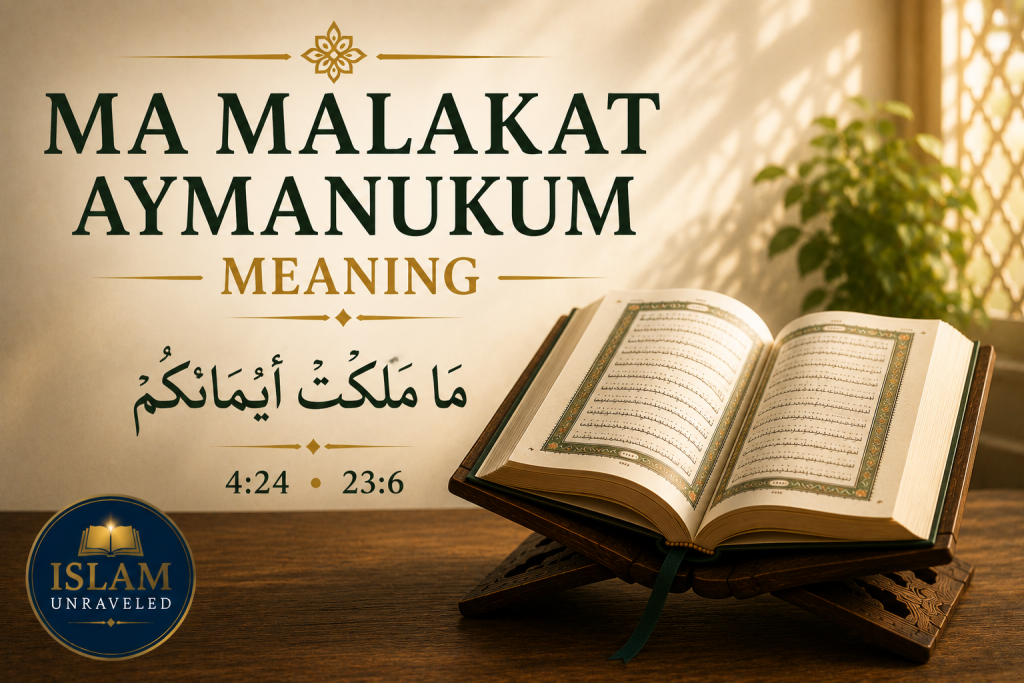
“Ma Malakat Aymanukum”
Often translated literally as “what your right hands possess,” this phrase has been used by some to justify practices that stand in direct contradiction to the Quran’s principles—most notably, the claim that it permits sexual relations outside marriage.
A careful, Quran-based reading shows the opposite.
The Quran consistently presents those under one’s care—referred to as Ma Malakat Aymanukum (MMA)—as individuals with rights, dignity, and protection, not as objects of exploitation. The misuse of this term stems from reading external assumptions into the text, rather than allowing the Quran to define its own framework.
What Does “Ma Malakat Aymanukum” Mean?
The phrase refers broadly to:
People under one’s responsibility or care
This includes individuals who:
- Depend on others for:
- security
- livelihood
- protection
Importantly:
- MMA are not limited to women
- They include:
- men and women
- young and old
- servants, dependents, and others under care
Thus, the term describes a relationship of responsibility, not ownership in a literal or exploitative sense.
The Quran’s Core Principle: Dignity and Protection
The Quran consistently commands just and compassionate treatment:
“You shall worship GOD alone… and treat the parents kindly, and the relatives, and the orphans, and the poor, and the neighbor… and those under your care (MMA)…” (4:36)
This verse places MMA alongside:
- parents
- relatives
- vulnerable members of society
This alone establishes:
- MMA are to be treated with dignity and respect, not exploitation
Sexual Relations: Strictly Within Marriage
A critical clarification comes from:
“They guard their chastity—except with their spouses…” (23:5–6, 70:29–30)
These verses are often misinterpreted.
However, the Quran’s consistent framework is clear:
Sexual relations are only legitimate within marriage
There is no verse that explicitly permits:
- sexual access to MMA outside a lawful marriage
Any such interpretation contradicts:
- the Quran’s emphasis on chastity
- its requirement of lawful unions
MMA and Marriage: Protection, Not Exploitation
The Quran explicitly regulates relationships involving MMA through marriage:
“…you may marry them with the permission of their guardians and give them their due dowries…” (4:25)
This verse establishes:
- MMA (including those in dependent situations)
- must be treated as:
- honorable individuals
- eligible for lawful marriage
If MMA were already considered sexual partners, marriage would not be required.
Privacy and Boundaries: Not Sexual Access
Another key verse:
“O you who believe, those under your care (MMA)… should ask your permission at three times…” (24:58)
This clearly distinguishes:
- MMA → require permission for private spaces
- spouses → have intimate access
This is decisive:
- MMA are not sexual partners
- They are separate from marital relationships
The Case of Servants and Dependents
The Quran includes servants within MMA:
- 24:31
- 33:55
- 4:36
It applies the same moral framework:
- modesty
- respect
- boundaries
Notably:
- The Quran mentions male servants as well
This exposes a major inconsistency in traditional interpretations:
- If MMA were sexual partners, this would apply equally to:
- men and women
But the Quran never suggests such a concept.
Slavery Context: Reform and Protection
In contexts where slavery existed:
- The Quran consistently promotes:
- freeing slaves
- improving their condition
It never establishes:
- sexual entitlement
Instead:
- it requires:
- marriage
- consent
- dignity
Special Circumstances: War and Migration
The Quran also addresses situations involving women who:
- leave disbelieving husbands
- join the believers
“…test them… and give them their due dowries…” (60:10)
Even in these complex cases:
The Quran requires:
- lawful marriage
- financial rights
- consent
Not exploitation.
The Root Problem: Reading Into the Quran
The misuse of “Ma Malakat Aymanukum” stems from:
- importing external traditions
- overriding clear Quranic principles
This leads to:
- contradictions within the text
- violations of:
- justice
- dignity
- moral consistency
A Consistent Quranic Framework
When all relevant verses are considered together, the Quran presents a unified system:
- MMA = people under care
- They have:
- rights
- dignity
- protection
- Sexual relations:
- strictly within marriage
- No exceptions are made based on:
- status
- dependency
Conclusion
The Quran’s message on Ma Malakat Aymanukum is clear and consistent.
- It does not grant privilege—it imposes responsibility
- It does not allow exploitation—it demands justice
The phrase has been misused to justify practices that the Quran itself does not support.
When read on its own terms, the Quran restores the correct understanding:
Those under your care are part of your moral responsibility—not objects of desire
And all intimate relations are governed by one principle:
Lawful, honorable marriage