Introduction: Moving Beyond Labels
Marriage in the Quran in religious discourse is often framed in terms of identity—Muslim, Christian, or Jew. The Quran does not anchor its guidance in labels alone. It establishes a deeper and more decisive criterion: whether a person associates partners with God (shirk).
This principle reshapes how marriage is to be understood in the Quran.
The Foundational Rule
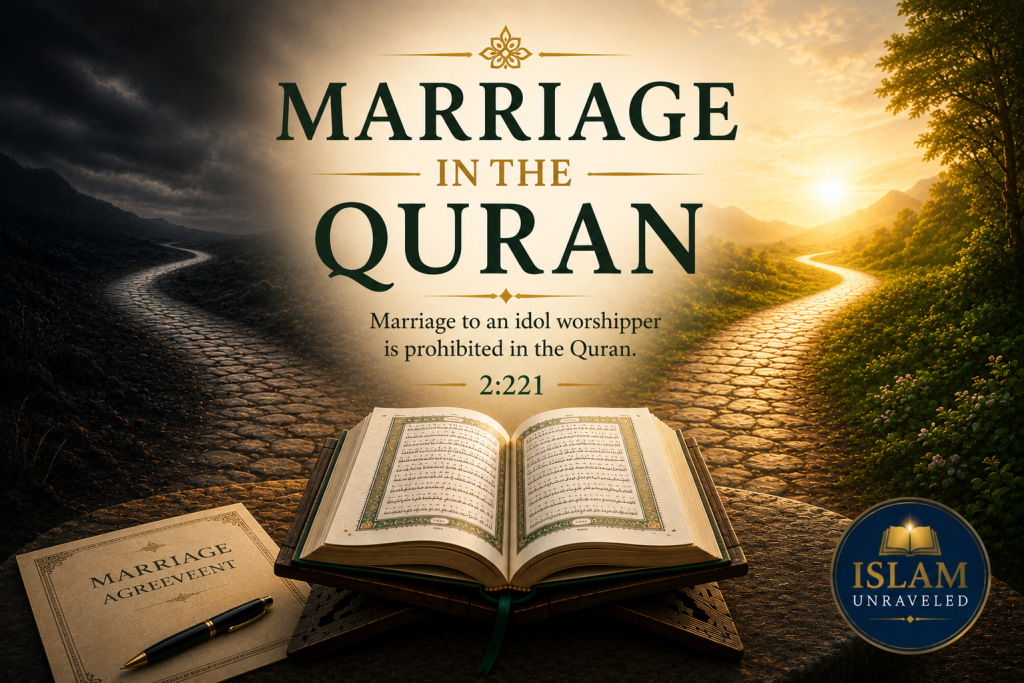
“Do not marry idolaters (mushrikeen) until they believe…” (2:221)
This is the core rule. Marriage is prohibited where there is shirk. The boundary is theological and foundational, not cultural.
What Is Shirk?
The Quran defines shirk as:
- associating partners with God
- invoking others alongside Him
- attributing divine authority or power to others
“GOD does not forgive idolatry (shirk), but He forgives lesser offenses…” (4:48)
“They worship besides GOD what neither harms them nor benefits them…” (10:18)
Shirk is the decisive violation of monotheism.
Labels Do Not Guarantee Monotheism
A critical Quranic principle is often overlooked: religious labels do not guarantee belief in God alone.
A person may identify as Muslim, Christian, or Jew and still:
- associate others with God
- elevate human authority alongside divine revelation
- rely on intermediaries in ways that compromise monotheism
Marriage, therefore, cannot be determined by label. It must be determined by belief and practice.
The Exception: People of the Scripture
“…you may marry the chaste women among the believers, and the chaste women among the People of the Scripture…” (5:5)
This verse establishes a qualified allowance.
Conditions in the verse:
- chastity
- lawful marriage with due dowry
- commitment to the marriage contract
This allowance operates within the Quran’s broader framework. It does not override the prohibition of shirk.
Reconciling 2:221 and 5:5
At first glance, one verse prohibits while the other permits. The distinction is precise:
- 2:221 prohibits mushrikun (idolaters)
- 5:5 permits marriage with People of the Scripture (with conditions)
Not all People of the Scripture are mushrikun.
The decisive criterion is this:
- Presence of shirk – marriage prohibited
- Absence of shirk – marriage may be permissible
Kufr and Shirk: A Necessary Distinction
The Quran differentiates between:
Kufr (disbelief):
Rejection or distortion of truth.
Shirk (idolatry):
Associating partners with God.
“They have disbelieved (kafara) who say that GOD is the Messiah…” (5:72)
All shirk is kufr. Not all kufr is shirk.
The prohibition in marriage is tied specifically to shirk, not to every form of kufr.
The Standard: The Religion of Abraham
“…follow the religion of Abraham…” (16:123)
“Who would turn away from the religion of Abraham except one who fools himself?” (2:130)
Abraham represents pure monotheism—the rejection of all forms of association. The Quran’s framework for marriage aligns with this standard.
Modern Implication: Where the Real Issue Lies
Contemporary discussions often focus on labels and affiliations. The Quran redirects the focus.
The real issue is not what someone is called.
The real issue is whether they associate partners with God.
This raises a necessary question: Is belief anchored in God alone, or are other authorities, figures, or systems elevated alongside Him?
The Quran consistently calls for exclusive devotion, direct reliance on God, and the rejection of intermediaries.
A Sharpened Reflection
A person may carry a religious label, perform rituals, and belong to a tradition, yet compromise monotheism.
A person may also differ in affiliation, yet maintain sincere belief in God without association.
This is why the Quran’s standard is belief, not label.
Conclusion
The Quran defines marriage with clarity:
- It does not rely on identity labels
- It does not defer to cultural boundaries
It establishes one decisive principle.
Marriage is prohibited where there is shirk.
Everything else, identity, background, and affiliation, is secondary to this requirement.
Marriage in the Quran is not about what you are called. It is about whether you associate partners with God.
Continue Your Study
Explore related studies on women, marriage, family, and individual rights in the Quran.
Women in the Quran
Begin with the broader Quranic framework for the dignity, equality, rights, responsibilities, and protection of women.
Marriage in the Quran: Women
Explore marriage specifically from the perspective of women’s dignity, rights, financial independence, and protection.
Dowry in the Quran
Examine the dowry as a right belonging to the woman and the Quranic principles governing it.
Divorce in the Quran
Study the Quran’s regulated process for separation, including reconciliation, financial protection, waiting periods, and dignified treatment. Your current article already emphasizes these protections.
Polygamy in the Quran
Examine the context and conditions of polygamy, particularly its connection with justice, responsibility, orphans, and protection of women.
Abortion in the Quran
Examine abortion through the Quranic principles of creation, the sanctity of life, divine knowledge, and individual accountability.