Introduction
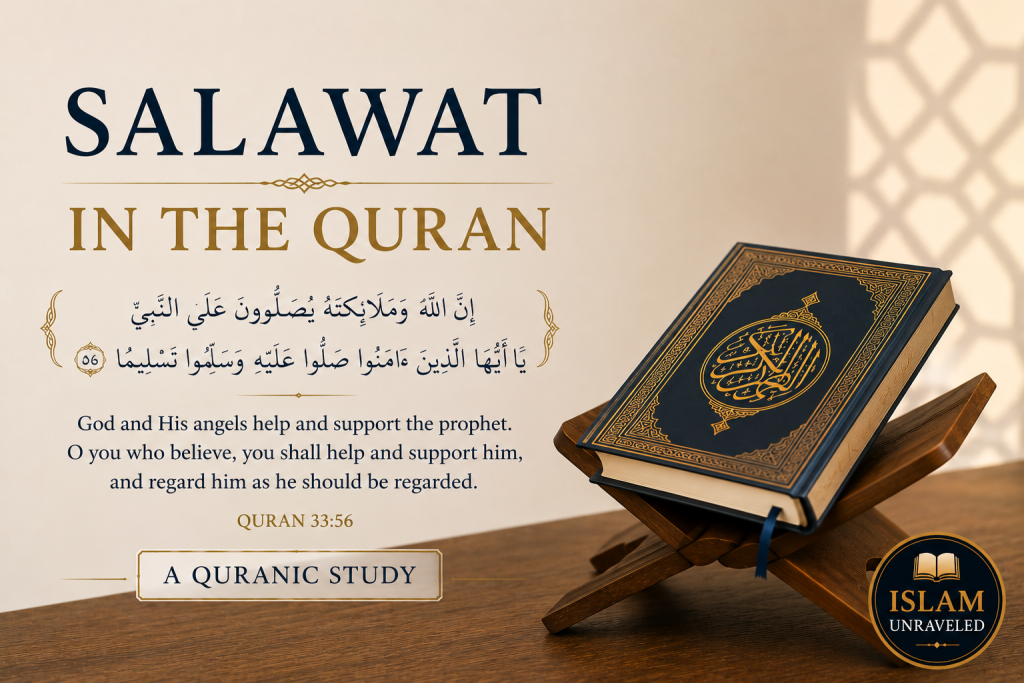
Verse 33:56 about ‘Salawat’ in the Quran is among the most frequently cited verses in discussions about the Prophet Muhammad. It is commonly used to support the practice of repeatedly invoking blessings upon the Prophet as a devotional act.
“GOD and His angels help and support the prophet. O you who believe, you shall help and support him, and regard him as he should be regarded.” (33:56)
The central question is not whether the Prophet is to be respected. The Quran clearly establishes that he is. The question is whether this verse mandates a ritualized, ongoing devotional practice directed toward the Prophet, or whether it refers to something contextual and functional.
A careful reading of the Quran as a whole provides the answer.
The Meaning of “Salat” in the Quran
The word translated in 33:56 as “help and support” is derived from the root used in salat. This term appears throughout the Quran with related but context-dependent meanings, including:
- connection or contact
- support or encouragement
- formal ritual prayer
For example:
- God and His angels “support” the believers: “He is the One who helps you, together with His angels…” (33:43)
- The Prophet is commanded to perform “salat” upon the believers: “…encourage them; your encouragement reassures them.” (9:103)
In both cases, the meaning is clearly not ritual prayer in the formal sense, but support, reassurance, and connection.
At the same time, the Quran also uses salat in a specific, well-defined sense as a religious duty:
“You shall observe the Contact Prayers (Salat) to commemorate Me.” (20:14)
Here, salat refers to the structured act of worship directed to God alone. This demonstrates that the term carries multiple meanings, and its correct interpretation must be derived from context.
The Immediate Context of Surah 33
Verses immediately preceding 33:56 provide essential context:
“O you who believe, you shall remember GOD frequently. You shall glorify Him day and night. He is the One who helps you, together with His angels…” (33:41–43)
In these verses:
- remembrance is directed exclusively to God
- the same root (used in 33:56) describes God’s support for believers
This establishes a consistent pattern: the term does not inherently imply ritual invocation or devotional repetition.
The Role of the Prophet as “Nabi”
The Quran uses the title “Nabi” (Prophet) in contexts that are clearly situational and time-bound.
Examples include:
- “Do not raise your voices above the voice of the prophet…” (49:2)
- instructions regarding conduct in his presence (33:53)
These commands:
- applied to those living with him
- required direct interaction
- are not transferable beyond his lifetime
Within this framework, 33:56 aligns naturally as a directive to:
- support the Prophet
- respect his authority
- cooperate with him in his mission
All of which require his presence.
The Prophet’s Function Toward Believers
The Quran defines the Prophet’s role in practical terms:
“Take from their money a charity to purify them and sanctify them, and support them…” (9:103)
Here, the Prophet performs “salat” upon the believers—meaning:
- encouragement
- reassurance
- active engagement
This reinforces the understanding that “salat” in 33:56 refers to functional support and connection, not ritualized praise.
The Theological Boundary: Worship Belongs to God Alone
The Quran consistently establishes that all acts of worship and devotion are directed to God alone.
“When GOD alone is mentioned, the hearts of those who do not believe in the Hereafter shrink with aversion…” (39:45)
“Say, ‘I have no power to benefit myself or harm myself…’” (7:188)
“You will surely die, just as they will die.” (39:30)
These verses clarify:
- the Prophet is fully human
- he possesses no independent divine power
- he is not an object of worship
The Death of the Prophet and Its Implication
The Quran explicitly states:
“You (Muhammad) will surely die…” (39:30)
With the Prophet’s death:
- direct interaction ended
- functional support (as in 33:56) ceased to be applicable in its original form
This further supports the understanding that the verse addressed a living relationship, not a perpetual ritual.
Re-evaluating 33:56
When read in its full context:
- linguistically (meaning of “salat”)
- structurally (placement within Surah 33)
- historically (lifetime of the Prophet)
- theologically (worship directed to God alone)
the meaning becomes clear.
33:56 instructs believers to:
- support the Prophet in his mission
- respect and honor him appropriately
- maintain alignment with his leadership
It does not establish a ritual of repeated invocation directed toward him.
The Risk of Misapplication
When the verse is detached from its context and transformed into a ritual:
- the function of the verse is altered
- devotional focus is redirected
- practices emerge that are not grounded in the Quran’s framework
This shift is subtle but significant.
The Criterion
The Quran provides a clear test:
“When GOD alone is mentioned…” (39:45)
This verse identifies a defining distinction:
- whether devotion remains directed to God alone
- or whether others are introduced into that space
Conclusion
A contextual reading of 33:56 demonstrates that it is:
- a situational directive
- tied to the lifetime of the Prophet
- centered on support and respect
It is not:
- a command for ritual invocation
- a basis for devotional repetition directed toward the Prophet
The Quran consistently establishes that:
- salat (ritual prayer) is for God alone (20:14)
- remembrance is directed to God alone (33:41–43)
- no human shares in divine authority or worship
To transform 33:56 into a devotional practice directed toward the Prophet is to move beyond its Quranic meaning and introduce a form of religious expression that the Quran itself does not establish.
The Quran’s framework is precise: devotion belongs to God alone, and no interpretation should redirect it elsewhere.