Introduction
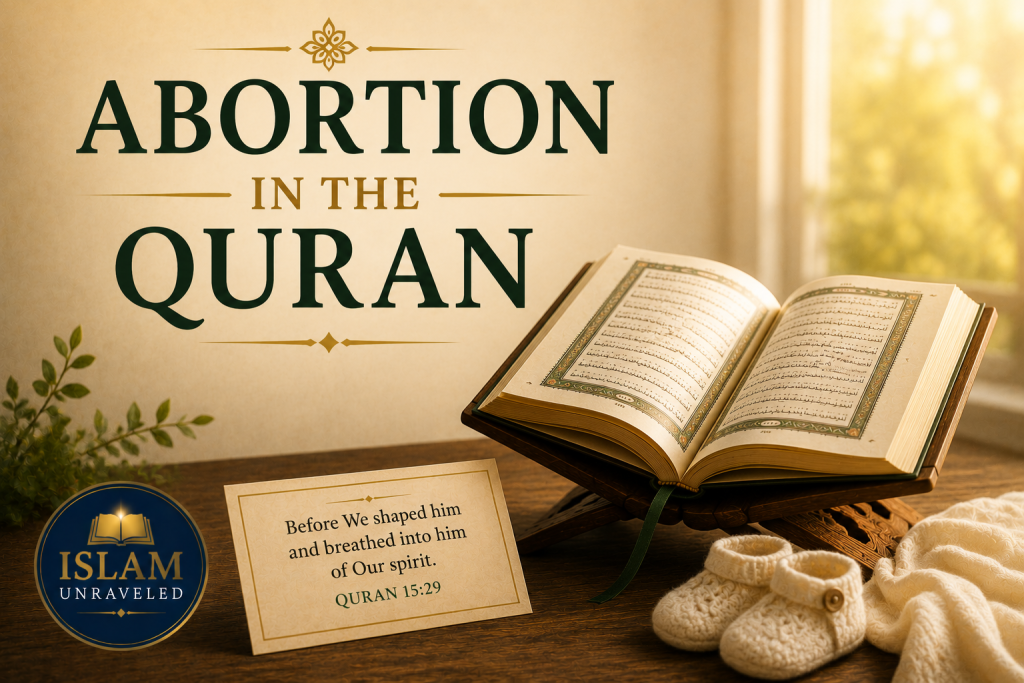
Abortion is among the most emotionally difficult and morally sensitive issues in modern society. Discussions surrounding it are often shaped by politics, ideology, culture, or emotion. The Quran, however, approaches human life from a fundamentally different perspective—one rooted in creation, accountability, mercy, and the sanctity of life.
Abortion in the Quran is not discussed using modern legal or political terminology. Yet it establishes foundational principles regarding:
- the creation of human life
- the development of the unborn
- the sanctity of innocent life
- the prohibition against killing children
- God’s authority over life and death
When these principles are examined collectively, the Quran presents a serious and morally weighty view of unborn life.
God as the Creator of Life
The Quran repeatedly describes human creation in the womb as a deliberate and divinely guided process.
“We created the human from an extract of clay. Subsequently, we reproduced him from a tiny drop, inside a well protected repository. Then we developed the drop into a hanging embryo, then developed the embryo into a bite-size morsel…” (23:12–14)
Another passage states:
“O people, if you have any doubt regarding resurrection, we created you from dust, then from a tiny drop, then from a hanging embryo…” (22:5)
The Quran treats embryonic development neither casually nor mechanically. The unborn child is described as part of a purposeful creative process directed by God Himself.
The Sanctity of Human Life
One of the Quran’s central moral principles is the sanctity of innocent life.
“You shall not kill any person—GOD has made life sacred—except in the course of justice.” (6:151)
“Anyone who kills any person who had not committed murder or horrendous crimes, it shall be as if he killed all the people.” (5:32)
Life is not portrayed as belonging ultimately to human beings. It belongs to God:
“He is the One who controls life and death…” (67:2)
This principle forms the moral foundation of the Quran’s perspective.
Children in the Quran: Fear, Poverty, and Killing
The Quran repeatedly condemns the killing of children because of fear, economics, or social pressure.
“You shall not kill your children because of fear of poverty. We provide for them, as well as for you.” (6:151)
“Do not kill your children for fear of want. We provide for them and for you. Killing them is a gross offense.” (17:31)
Historically, these verses addressed infanticide and the killing of children after birth. Yet the moral principle extends beyond historical form. The Quran consistently rejects:
- economic fear
- social pressure
- material hardship
as justification for taking innocent life.
Another powerful image appears in Surah 81:
“The girl who was buried alive is asked: For what crime was she killed?” (81:8–9)
The Quran places moral focus not on social justification, but on the innocence of the life being taken.
The Womb and Divine Knowledge
The Quran repeatedly emphasizes God’s intimate knowledge of life within the womb.
“GOD knows what every female carries, and what the wombs release, or add. Everything with Him is precisely measured.” (13:8)
“He knows you best since He initiated you from the earth, and while you were embryos in your mothers’ bellies.” (53:32)
The unborn are not treated as morally insignificant or invisible. They exist within:
- divine knowledge
- divine creation
- divine measurement
Does the Quran Establish a “Permissible Window” for Abortion?
Many later religious discussions introduced theories such as:
- 40-day stages
- 120-day “ensoulment”
- graduated moral status during pregnancy
However, these frameworks arise primarily from Hadith literature and later jurisprudence—not from the Quran itself.
The Quran never establishes:
- a specific gestational cutoff
- a staged permission structure
- a point before which unborn life lacks moral significance
Instead, the Quran consistently treats life in the womb as part of God’s active creation.
The Moral Weight of Pregnancy
The Quran repeatedly describes pregnancy as a serious and burdensome responsibility.
“His mother bore him arduously, gave birth to him arduously…” (46:15)
This recognition is important. The Quran does not trivialize pregnancy, childbirth, or the suffering associated with them.
The issue therefore cannot be reduced to slogans or simplistic formulas.
Difficult and Exceptional Circumstances
Real-life situations can involve severe moral and medical complexity, including:
- danger to the mother’s life
- severe medical complications
- traumatic circumstances
The Quran establishes principles, but human beings may confront situations involving competing harms and painful realities.
Even in such cases, however, the Quranic framework approaches life with gravity and caution—not casual disposal.
The Modern Reduction of Human Life
Modern societies increasingly evaluate life through:
- convenience
- economics
- social pressure
- personal autonomy alone
The Quran repeatedly challenges this mentality.
“We provide for them, as well as for you.” (6:151)
Fear of provision, status, hardship, or future uncertainty is consistently rejected as a basis for destroying life.
Life Belongs to God
The Quran repeatedly reminds humanity:
“We control life and death…” (15:23)
Human beings are not absolute owners of life. They are trustees living within God’s creation.
This principle applies not only to life after birth, but to life developing within the womb.
The Broader Spiritual Principle
The Quran’s moral direction is clear:
- life is sacred
- creation belongs to God
- the unborn are known to God
- fear and material hardship do not justify killing
The Quran does not present unborn life as disposable, negotiable, or morally insignificant.
Conclusion
The Quran does not approach abortion through modern political categories. It approaches the subject through broader divine principles concerning:
- creation
- sanctity of life
- accountability
- mercy
- trust in God
When all relevant verses are considered together, the Quran consistently moves in one direction:
Human life—even in the womb—is treated with seriousness, dignity, and sanctity.
The Quran leaves no support for casual or convenience-based destruction of unborn life. Rather, it repeatedly calls human beings to humility before the One who creates life, sustains life, and ultimately controls life and death.
Final Reflection
The Quran’s perspective is not centered on ideology, politics, or social trends.
It is centered on a simple but profound principle:
Life belongs to God.
Continue Your Study
Explore related studies on women, marriage, family, and individual rights in the Quran.
Women in the Quran
Begin with the broader Quranic framework for the dignity, equality, rights, responsibilities, and protection of women.
Marriage in the Quran
Examine the Quranic foundations of marriage, mutual responsibility, commitment, and the rights of both spouses.
Marriage in the Quran: Women
Explore marriage specifically from the perspective of women’s dignity, rights, financial independence, and protection.
Dowry in the Quran
Examine the dowry as a right belonging to the woman and the Quranic principles governing it.
Divorce in the Quran
Study the Quran’s regulated process for separation, including reconciliation, financial protection, waiting periods, and dignified treatment. Your current article already emphasizes these protections.
Polygamy in the Quran
Examine the context and conditions of polygamy, particularly its connection with justice, responsibility, orphans, and protection of women.