Introduction
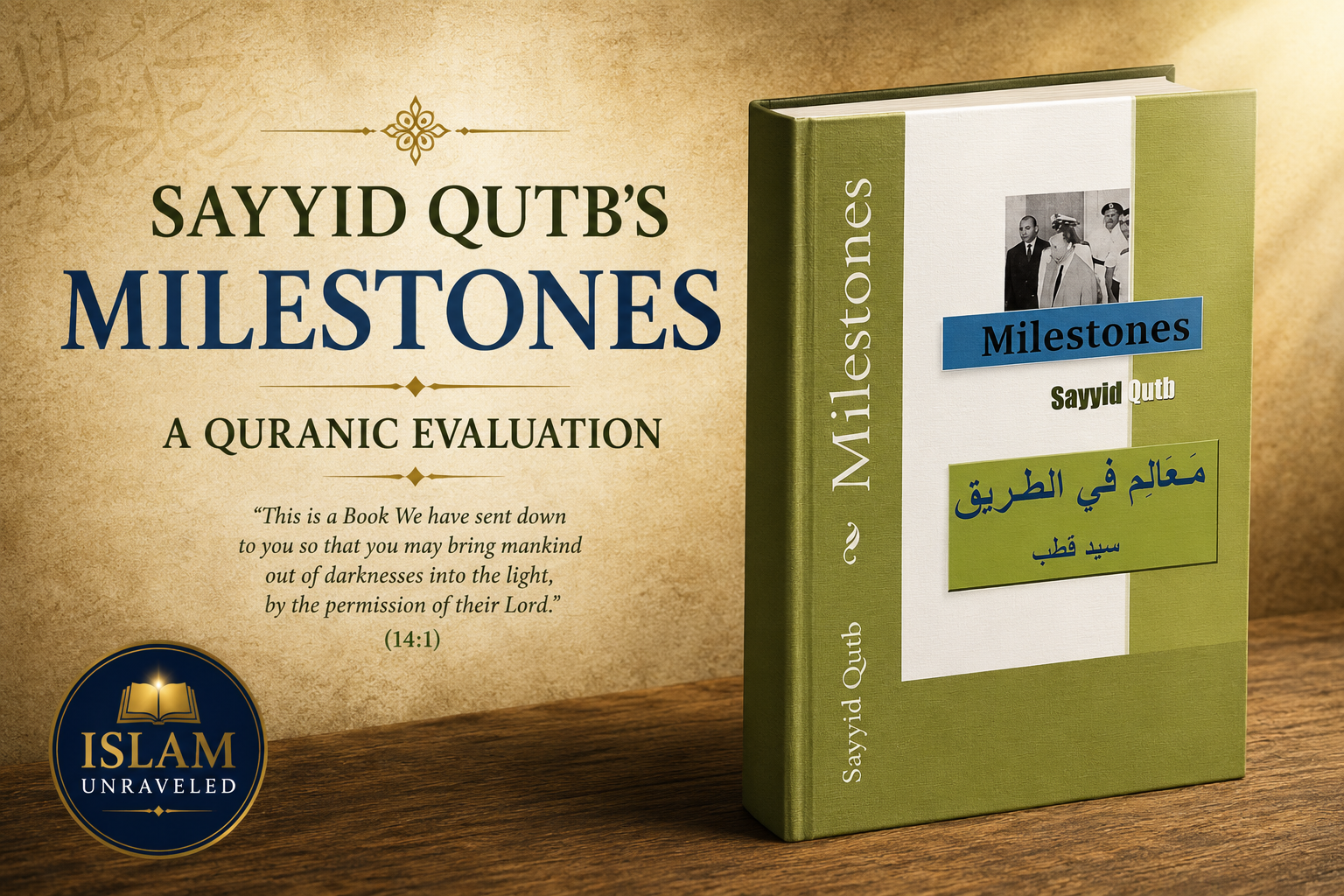
Few modern Muslim writers have influenced contemporary political Islam more than Sayyid Qutb’s Milestones. His 1964 book Milestones (Ma‘alim fi al-Tariq) became one of the foundational texts for modern Islamist movements and later profoundly influenced revolutionary Islamic ideology across the Muslim world.
Qutb argued that modern societies — including societies identifying as Muslim — had reverted to:
Jahiliyyah
(the state of ignorance associated with pre-Quranic Arabia).
According to Qutb, humanity could only escape this condition through the establishment of an Islamic order governed by divine law (Sharia).
The influence of these ideas extended far beyond Egypt. Together with the writings of Abul A’la Maududi, Qutb helped shape the intellectual foundations of:
- modern Islamism,
- political Islam,
- revolutionary Islamic movements,
- and eventually extremist ideological currents.
Yet from the perspective of the Quran itself, the central problem with Qutb’s framework is not merely political.
It is theological.
At its core, Milestones depends upon religious authority structures that the Quran repeatedly warns against:
- extra-Quranic religious law,
- inherited jurisprudence,
- scholar-centered authority,
- and human legislation in the name of God.
The issue therefore is not simply whether an “Islamic state” should exist.
The deeper issue is:
What is the legitimate source of religious authority according to the Quran?
Islam — Submission or Ideology?
One of the first problems appears in the very use of the word:
Islam.
The Quran consistently uses the word Islam descriptively:
- submission to God,
- surrender to God alone,
- devotion to the Creator.
It is not primarily presented as:
- a political ideology,
- civilizational project,
- or state system.
Abraham himself is described as:
“Neither Jewish nor Christian; he was a monotheist, submitting to God.” (3:67)
The Quran repeatedly emphasizes:
- faith,
- righteousness,
- justice,
- humility,
- and worship of God alone.
By contrast, modern Islamist thought gradually transformed Islam into:
- a political program,
- a legal ideology,
- and ultimately a state-centered religious system.
This transformation fundamentally alters the Quran’s emphasis.
The Quran primarily transforms:
the human being.
Political Islam primarily seeks to transform:
the state.
The distinction is profound.
The Quran Alone vs Ideological Religion
One of the defining features of Qutb’s thought is that the Quran itself is never treated as the sole and complete source of religious law.
Like traditional Islamic scholarship generally, Qutb’s framework depends heavily upon:
- Hadith,
- classical jurisprudence,
- inherited legal systems,
- and later scholarly authority.
Yet the Quran repeatedly presents itself as:
- complete,
- fully detailed,
- and sufficient for religious guidance.
“Shall I seek other than GOD as a source of law, when He has revealed to you this book fully detailed?” (6:114)
The Quran repeatedly warns against following religious sources beside revelation:
“These are GOD’s revelations that We recite to you truthfully. In which Hadith other than GOD and His revelations do they believe?” (45:6)
“Which Hadith, other than this, do they uphold?” (77:50)
The Quran even explicitly identifies itself as:
the best Hadith.
“GOD has revealed herein the best Hadith…” (39:23)
Yet in Qutb’s framework — as in traditional Islam generally — the actual religious system depends overwhelmingly upon:
- Hadith literature,
- juristic interpretation,
- and inherited legal tradition.
The Quran becomes honored rhetorically while functionally subordinated in practice.
The Problem of Sharia
Central to Qutb’s vision is the implementation of:
Sharia.
However, historical Sharia was not revealed as a complete legal system during Muhammad’s lifetime.
Rather, the major schools of Sunni jurisprudence emerged:
- generations later,
- after civil wars,
- political fragmentation,
- sectarian disputes,
- and dynastic consolidation.
The classical legal schools were constructed primarily during the second and third Islamic centuries through:
- juristic reasoning,
- Hadith collection,
- consensus claims,
- and legal analogy.
The result was not one unified divine law, but multiple competing legal systems.
Even within Sunni Islam alone:
- Hanafi,
- Maliki,
- Shafi‘i,
- and Hanbali
schools frequently disagreed on major issues.
Thus, “Sharia” as historically practiced became:
scholar-produced religious law.
Yet the Quran repeatedly warns against elevating religious authorities beside God.
The Quran and Religious Authority
The Quran explicitly criticizes previous religious communities for turning scholars and clergy into religious authorities beside God:
“They have set up their religious leaders and scholars as lords instead of GOD…” (9:31)
Traditional Islam commonly interprets this verse through a famous Hadith stating that:
- obeying scholars in religious legislation constitutes worship of them.
Ironically, this interpretation exposes the very problem the Quran is condemning.
Once human beings gain authority to:
- legislate religion,
- define lawful and unlawful,
- or override revelation,
religious authority shifts away from God alone.
The Quran repeatedly insists:
“Legislation belongs to GOD alone.” (12:40)
Yet political Islam depends fundamentally upon:
- juristic authority,
- scholar authority,
- and extra-Quranic legislation.
The contradiction is difficult to ignore.
Jahiliyyah Reconsidered
Qutb dramatically expanded the Quranic concept of:
Jahiliyyah.
In the Quran, Jahiliyyah refers primarily to:
- ignorance,
- tribalism,
- idolatry,
- moral corruption,
- and rejection of divine guidance.
Qutb extended the concept to encompass:
- secular society,
- modern political systems,
- nationalism,
- and governments not implementing Islamic law.
This transformation became foundational for later Islamist revolutionary ideology.
Yet the Quran itself does not present:
- state structure,
- political form,
- or legal codification
as the primary measure of submission to God.
Rather, the Quran repeatedly emphasizes:
- belief,
- righteousness,
- justice,
- charity,
- humility,
- and freedom of conscience.
Political Islam and Coercion
The Quran repeatedly rejects religious coercion.
“There shall be no compulsion in religion.” (2:256)
“The truth is from your Lord; whoever wills may believe, and whoever wills may disbelieve.” (18:29)
“Had your Lord willed, all the people on earth would have believed. Are you going to force the people to become believers?” (10:99)
The Prophet himself is repeatedly instructed that his role is:
- delivery of the message,
not: - coercive enforcement.
“You are not a controller over them.” (88:22)
Yet modern political Islam frequently transforms religion into:
- ideological governance,
- legal enforcement,
- and state power.
The Quran’s emphasis, however, remains fundamentally moral and spiritual rather than coercively political.
The Historical Construction of Religious Orthodoxy
A major historical issue often overlooked in Islamist discourse is that much of traditional Islamic orthodoxy developed:
- centuries after the Quran,
- under imperial states,
- during political consolidation,
- and amid intense sectarian conflict.
History itself was gradually rewritten retrospectively.
Later legal and theological systems were projected backward onto the earliest Muslim community as though they existed fully formed from the beginning.
The Quran warns repeatedly against:
- conjecture,
- inherited assumptions,
- and religious guesswork.
“They uphold nothing but conjecture and personal opinion.” (53:28)
The same phenomenon occurred historically in other religious traditions:
- the Talmud emerged centuries after Mosaic revelation,
- Christian orthodoxy developed through post-Jesus councils,
- and Islamic jurisprudence crystallized long after Muhammad.
The Quran repeatedly redirects believers back toward:
revelation itself.
The Quran and Human Freedom
One of the most striking differences between the Quran and ideological religion concerns:
human freedom.
The Quran repeatedly affirms:
- moral accountability,
- individual responsibility,
- and freedom of belief.
Faith cannot be reduced to:
- political conformity,
- ideological allegiance,
- or state enforcement.
The Quran consistently addresses:
- conscience,
- intention,
- sincerity,
- and the human heart.
Political Islam, by contrast, often prioritizes:
- external conformity,
- institutional control,
- and ideological structure.
The Quran’s primary project is transformation of:
the human soul,
not:
domination of political systems.
The Central Quranic Issue
Ultimately, the central issue is not:
- Sayyid Qutb personally,
- nor one particular movement.
The deeper issue is:
authority.
Who possesses the right to define religion?
The Quran repeatedly answers:
God alone.
Once religious authority becomes transferred to:
- scholars,
- jurists,
- sectarian tradition,
- or political ideology,
religion itself becomes vulnerable to distortion.
The Quran repeatedly warns against:
- associating partners with God,
- including in religious authority itself.
Conclusion
Milestones became one of the foundational texts of modern political Islam because it transformed religion into:
- ideology,
- legal system,
- and revolutionary program.
Yet from the perspective of the Quran itself, the central problem lies deeper than politics.
The Quran repeatedly presents:
- revelation as complete,
- legislation as belonging to God alone,
- and religion as submission to the Creator directly.
By contrast, political Islam depends heavily upon:
- Hadith,
- juristic systems,
- inherited legal structures,
- and scholar-centered religious authority.
The result is that religion gradually becomes mediated through human institutions rather than grounded directly in revelation itself.
The Quran repeatedly calls believers back to:
- God alone,
- revelation alone,
- and personal moral accountability before the Creator.
The central question therefore remains:
Does religion belong ultimately to:
- God and His revelation,
or - to ideological systems constructed by human authority?
Continue Your Study
These related studies examine different ways the Quran can become secondary to inherited tradition, simplified religious teaching, academic assumptions, or political ideology – and why religious claims should ultimately be tested against the Quran itself.
The Quran Hijacked Twice – By Critics and Traditionalists
Examine how critics of Islam and traditional Muslim authorities can arrive from opposite directions yet rely on the same post-Quranic traditions, leaving the Quran itself secondary.
When “Islam for Beginners” Is Not the Quran
Explore how introductory presentations of Islam can begin with inherited beliefs and practices rather than allowing newcomers to encounter the Quran and evaluate its message directly.
When the Quran Becomes Secondary
Examine how additional religious sources, authorities, and inherited assumptions can gradually move the Quran from the center of religious guidance to a secondary position.
Modern Scholarship and the Quranic Proof
Consider both the contributions and methodological limits of modern Quranic scholarship, and whether an internally embedded Quranic proof can address questions that historical-critical methods do not consider.