Quran Idolatry and Sectarian Religion
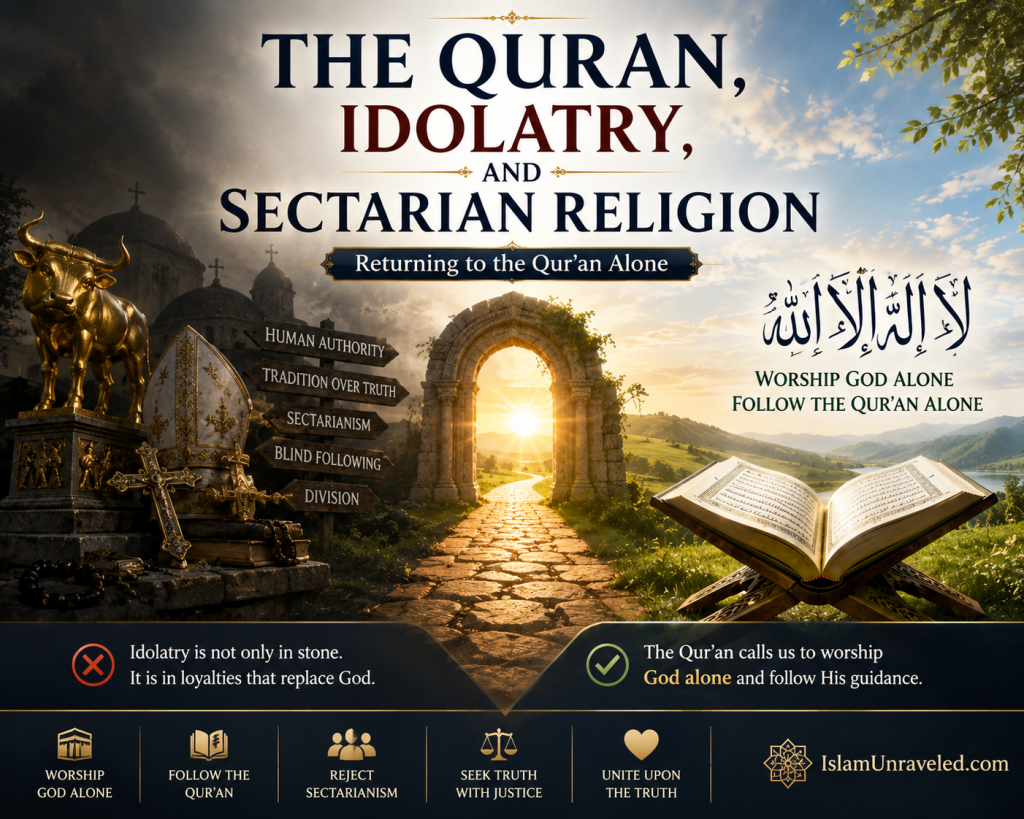
Introduction
Many people assume that the Quran’s primary struggle was against pagan idol worship.
The familiar narrative is simple:
Ancient Arabs worshipped statues. Muhammad destroyed the idols. Monotheism replaced paganism.
Yet a careful reading of the Quran reveals a more profound story.
The Quran repeatedly describes people who already believed in God, acknowledged Him as Creator, called upon Him during times of distress, and traced their religious heritage to Abraham.
If so, what exactly was the problem?
This series explores a possibility often overlooked in modern discussions:
The Quran’s central concern was not merely the worship of physical idols but the corruption of monotheism itself.
Again and again, the Quran warns against association (shirk), inherited traditions, religious authority beside God, and the gradual transformation of divine guidance into sectarian religion.
The articles below examine these themes through the Quran’s own testimony.
1. Who Were the Mushrikeen in the Quran?
Most people assume the mushrikeen were simply pagan idol worshippers.
Yet the Quran describes them as people who believed in God and acknowledged Him as Creator.
This article examines who the mushrikeen were and why the Quran condemned them despite their belief in God.
2. The Forgotten Meaning of Idolatry
When people hear the word idolatry, they often think of statues and images.
The Quran’s concept of shirk is much broader.
This article explores how idolatry can involve religious authority, legislation, inherited traditions, and devotion directed toward anything besides God.
3. Did the Quran Confront Pagans or Corrupted Monotheists?
The traditional narrative portrays Arabia as overwhelmingly pagan.
Yet the Quran repeatedly depicts Muhammad’s opponents as people familiar with God, Abraham, pilgrimage, and the sacred sanctuary.
This article investigates whether the Quran’s primary struggle was against paganism or against the corruption of monotheism.
Read: Did the Quran Confront Pagans or Corrupted Monotheists?
4. From Believers to Sectarian Islam
The Quran repeatedly speaks of believers, submitters, and monotheists.
It does not identify God’s community through later sectarian labels.
This article explores how religious communities evolve and how the Quran warns against division into competing sects.
5. The Kaaba Before Muhammad: What Does the Quran Actually Say?
The Quran presents the Kaaba as an ancient sanctuary established by Abraham and Ishmael.
But what does the Quran actually reveal about the Kaaba before Muhammad?
This article examines the sanctuary’s Abrahamic foundations and the Quran’s surprising emphasis on monotheism rather than idols.
Read: The Kaaba Before Muhammad: What Does the Quran Actually Say?
6. How Did the Traditional Story of Pagan Arabia Arise?
The familiar picture of pagan Arabia is deeply rooted in Islamic tradition.
Yet the Quran itself often emphasizes association, religious corruption, and inherited traditions.
This article explores how the traditional narrative developed and compares it with the Quran’s own emphasis.
7. The Idols of Noah and the Idols of Arabia: What Does the Quran Say?
The Quran mentions five names in Noah’s story and three names in Surah 53.
Many later traditions connect these groups.
But does the Quran itself make that connection?
This article examines what the Quran actually says—and does not say—about ancient idols.
Read: The Idols of Noah and the Idols of Arabia: What Does the Quran Say?
A Recurring Pattern in the Quran
One theme runs through all seven articles.
The Quran repeatedly describes a recurring historical cycle:
- God sends revelation.
- A believing community emerges.
- Traditions accumulate.
- Religious authorities arise.
- Corruption enters.
- God calls people back to pure monotheism.
This pattern appears in the stories of:
- Noah,
- Abraham,
- Moses,
- Jesus,
- and Muhammad.
The details change.
The pattern remains remarkably consistent.
The Central Question
The series ultimately asks a simple question:
Was the Quran’s primary battle against stone idols?
Or was it against something deeper—the tendency of human beings to elevate traditions, authorities, intermediaries, and institutions alongside God?
The Quran repeatedly points toward the latter.
Its concern is not merely what people worship.
Its concern is whether devotion, authority, and religious law belong to God alone.
Conclusion
The Quran’s message is timeless because the danger it identifies is timeless.
Physical idols may disappear.
The temptation to associate partners with God remains.
Whether through inherited traditions, religious authority, sectarian identity, or devotion directed elsewhere, the challenge faced by every generation is the same:
Will we devote our religion to God alone?
The Quran’s answer remains as clear today as it was in the time of Abraham, Moses, Jesus, and Muhammad.
Worship God alone.
Follow God’s revelation.
Avoid associating anything alongside Him.