One of the most frequently cited Quranic commands is:
“Obey God and obey the messenger.”
Many assume this means obedience to the messenger is unconditional. Yet a careful reading of the Quran reveals a very different picture.
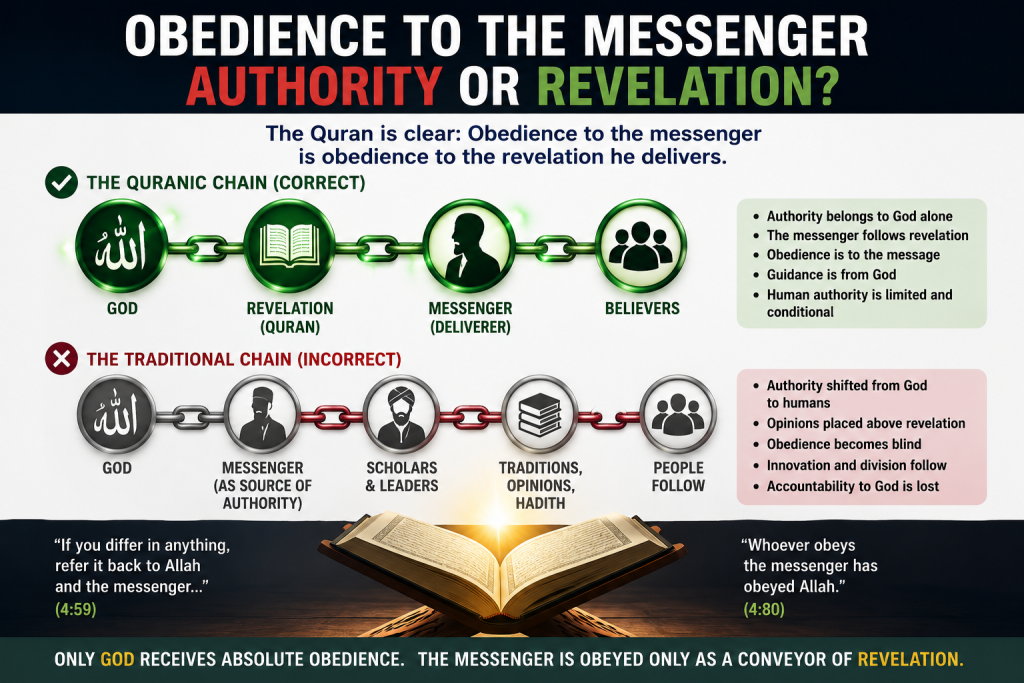
The Quran never grants absolute obedience to any human being. Absolute obedience belongs to God alone. A messenger is obeyed only because he delivers God’s revelation. The moment we separate the messenger from the message, we risk elevating a human being to a position that belongs only to God.
ONLY GOD RECEIVES ABSOLUTE OBEDIENCE
Throughout the Quran, God is the ultimate authority.
“You shall obey God and the messenger…” (3:32)
The messenger is never presented as an independent source of authority. His authority derives entirely from the revelation he conveys.
This distinction is crucial.
The Quran repeatedly directs believers back to God and His revelations, not to the personal opinions or judgments of any human being.
WHY IS THE MESSENGER OBEYED?
The Quran itself answers this question:
“Whoever obeys the messenger has obeyed Allah.” (4:80)
This verse is often quoted to support unrestricted obedience to a messenger. Yet the verse actually explains why the messenger is obeyed.
The messenger is obeyed because he faithfully delivers God’s message.
The obedience is not to the man himself but to the revelation he brings.
If a messenger follows revelation, then obedience to the messenger is obedience to revelation.
The authority remains God’s authority.
THE QURAN SHOWS THAT MESSENGERS ARE HUMAN
One of the Quran’s remarkable features is its honesty regarding the human nature of God’s messengers.
The Quran does not portray them as flawless beings incapable of error.
Muhammad is corrected on several occasions.
The Blind Man
“He frowned and turned away when the blind man came to him.” (80:1-2)
God directly corrects the Prophet’s behavior.
Permission Granted
“God has pardoned you; why did you give them permission?” (9:43)
Again, the Prophet’s judgment is questioned.
Prohibiting What God Made Lawful
“O Prophet, why do you prohibit what Allah has made lawful for you?” (66:1)
Once more, God corrects him.
These verses establish an important principle:
Muhammad was a messenger, but he remained a human being.
He could make mistakes.
Therefore, obedience to him cannot mean blind or unconditional obedience to every personal action or judgment.
THE QURAN EXPLICITLY LIMITS HUMAN OBEDIENCE
One of the clearest verses on this subject appears in Surah Al-Mumtahanah.
Believing women are instructed to pledge that:
“…they will not disobey you in what is right (fi ma’ruf).” (60:12)
The phrase “in what is right” is significant.
If obedience were unconditional, this qualification would be unnecessary.
Instead, the Quran establishes a condition.
Obedience must remain within the boundaries of what is right, just, and consistent with God’s guidance.
This principle applies to all human authority.
WHAT HAPPENS WHEN PEOPLE DISAGREE?
The Quran provides a clear answer:
“If you differ in anything, refer it to God and the messenger…” (4:59)
Many readers assume this means referring disputes to a messenger’s personal opinions.
But the messenger is no longer physically present.
What remains is the message he delivered.
The Quran repeatedly describes itself as:
- fully detailed (6:114)
- complete (6:115)
- sufficient guidance (16:89)
Therefore, referring matters back to God and the messenger means returning to God’s revelation that the messenger delivered.
Authority returns to revelation, not to later human opinions.
MESSENGERS THEMSELVES FOLLOW ONLY REVELATION
The Quran repeatedly records the words of God’s messengers.
They never claim independent authority.
Muhammad declares:
“I only follow what is revealed to me.” (6:50)
Likewise:
“Follow what has been revealed to you from your Lord.” (6:106)
And:
“I only follow what is revealed to me.” (46:9)
The message is consistent.
The messenger himself follows revelation.
Why then would believers be expected to follow anything beyond revelation?
MESSENGERS DO NOT CONTROL GUIDANCE
The Quran further limits the role of human messengers.
God tells Muhammad:
“You cannot guide whom you love.” (28:56)
And Muhammad is instructed to say:
“I do not know what will happen to me or to you.” (46:9)
These verses demonstrate that a messenger’s role is limited.
He conveys God’s message.
He does not control guidance.
He does not determine salvation.
He does not possess divine authority.
THE QURAN’S UNIVERSAL PRINCIPLE OF OBEDIENCE
The Quran repeatedly warns against obeying people who lead others away from God’s path.
“Do not obey the wrongdoers.” (26:151)
“Do not obey every sinful liar.” (68:10)
The lesson is clear.
Obedience is based on truth and righteousness, not on personality, status, scholarship, or religious office.
No human being receives unconditional obedience.
THE REAL MEANING OF “OBEY THE MESSENGER”
When the Quran commands believers to obey the messenger, it is not establishing a second independent source of religious authority.
Rather, it is directing believers to obey the revelation the messenger conveys.
This understanding harmonizes all relevant verses.
- God alone possesses absolute authority.
- Messengers follow revelation.
- Messengers can make human mistakes.
- Obedience to humans is conditioned upon what is right.
- Disputes return to God’s revelation.
- Human authority is never absolute.
CONCLUSION
The Quran’s message is simple and consistent.
Only God receives unconditional obedience.
The messenger is obeyed because he delivers God’s revelation.
His authority comes from the message, not from personal infallibility.
The Quran repeatedly portrays messengers as human beings who follow revelation and call others to do the same.
Thus, obedience to the messenger is obedience to the revelation he delivers.
Not blind obedience to a human being.
The Quran continually directs believers back to a single source of ultimate authority:
God and His revealed message.