How Surah 2:1–22 Continues the Message of the Opening Chapter
Introduction – From Asking for Guidance to Receiving It
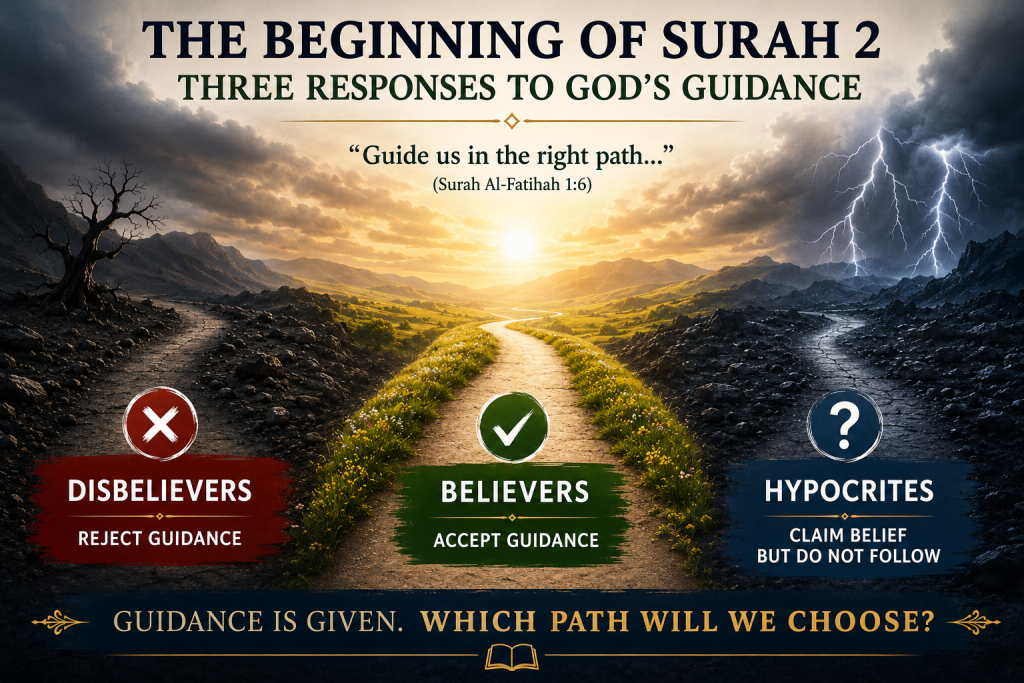
Sura two gives three Responses to God’s Guidance: Believers, Disbelievers and Hypocrites in the Quran. Surah Al-Fatihah ends with one of the most important requests a human being can make:
“Guide us in the right path; the path of those whom You blessed; not of those who have deserved wrath, nor of the strayers.” (1:6–7)
The opening chapter begins with God and concludes with humanity asking Him for guidance. The Quran then moves immediately into Surah 2, where the response to that request begins to unfold.
After the Quranic initials A.L.M., God introduces the scripture itself:
“This scripture is infallible; a beacon for the righteous.” (2:2)
The connection is striking. Humanity asks God for guidance, and the Quran directs us to the guidance He has provided.
But the presence of guidance does not mean that everyone will respond to it in the same way. Human beings have been given freedom to choose. The same revelation can therefore produce very different responses depending upon the individual receiving it.
At the very beginning of Surah 2, the Quran describes three such responses.
First are those who believe. They accept God’s guidance, live according to it, and are described as being guided by their Lord and ultimately successful (2:2–5).
Then come those who disbelieve. They have become resistant to God’s warnings and reject the guidance placed before them (2:6–7).
Finally, and at considerably greater length, the Quran describes the hypocrites – people who claim belief outwardly while their actions and inner condition reveal something very different (2:8–20).
These descriptions are important because they come from God Himself. The Quran does not begin by defining people according to the religious names they adopt, the communities to which they belong, or the identities they claim for themselves. Instead, it describes their relationship with God and their response to His guidance.
This changes the way these verses should be read. They are not simply descriptions of other people. They invite every reader to examine himself or herself.
Do I accept God’s guidance when it reaches me?
Do I resist it when it conflicts with what I already believe?
Do I profess belief while allowing something else to govern my choices?
The question is therefore not merely, “Who are the believers, disbelievers, and hypocrites?”
The more personal question is:
Which response to God’s guidance is reflected in me?
After describing these three responses, God does something equally significant. He addresses humanity as a whole:
“O people, worship your Lord…” (2:21)
The discussion therefore does not end with classification or condemnation. It returns to an invitation – an invitation addressed to everyone to recognize the Creator, worship Him, and not set up equals beside Him (2:21–22).
This brings us directly back to the declaration in the Opening Chapter:
“You alone we worship; You alone we ask for help.” (1:5)
Surah 1 asks for the straight path. Surah 2 presents God’s guidance, describes how people respond to it, and calls humanity to worship the One who provided it.
This study will examine these opening verses of Surah 2 not primarily as labels for dividing humanity, but as three responses to God’s guidance – and as a mirror through which each of us can examine our own response to God.
1. The Believers — Those Who Accept God’s Guidance
“Who believe in the unseen, observe the Contact Prayers (Salat), and from our provisions to them, they give to charity. And they believe in what was revealed to you, and in what was revealed before you, and with regard to the Hereafter, they are absolutely certain. These are guided by their Lord; these are the winners.” (2:3–5)
The first response to God’s guidance described in Surah 2 is belief.
Significantly, the Quran does not simply tell us that these people are believers. It describes them. Their belief is recognizable through certain characteristics, and those characteristics involve both what they believe and how they live.
The description begins with those who “believe in the unseen.” Belief in God necessarily reaches beyond what can be observed with the physical senses. We see the universe and the signs within it, but we do not see God. We cannot presently see the Hereafter, the Day of Judgment, Paradise, or many of the realities God has revealed. The believer accepts what God has made known even when those realities lie beyond direct human observation.
But belief does not remain an intellectual conviction. It produces action.
The believers observe the Salat. Their recognition of God leads them to remember and worship Him. The relationship established in Surah Al-Fatihah—“You alone we worship”—is reflected in their lives through their devotion to God.
Their relationship with God also affects their relationship with others. From what God has provided them, they give. They recognize that their possessions ultimately come from God and that His provisions are not merely to be accumulated for themselves. Faith therefore produces generosity.
The description then turns to revelation. The believers accept what was revealed to Muhammad and what was revealed before him. Their faith is not based upon loyalty to one messenger while rejecting the others. They recognize the continuity of God’s guidance throughout human history.
This is an important Quranic characteristic of belief. God’s messengers did not establish competing religions requiring people to choose one messenger against another. They brought guidance from the same God. The believer therefore recognizes God’s revelations and messengers as belonging to the same continuing history of divine guidance.
Finally, the believers possess certainty concerning the Hereafter.
This certainty gives meaning to everything that precedes it. Salat, generosity, obedience to revelation, and righteous conduct are not merely practices for this temporary life. The believer knows that earthly life will end and that every person will ultimately return to God.
The Hereafter therefore changes how life is understood. Choices that may appear insignificant from a purely worldly perspective acquire lasting importance. Success can no longer be measured simply by wealth, status, influence, or comfort.
God Himself provides the definition of success:
“These are guided by their Lord; these are the winners.” (2:5)
That conclusion is particularly important in light of the prayer immediately preceding Surah 2.
Surah Al-Fatihah asks:
“Guide us in the right path.” (1:6)
And only a few verses later, God describes people of whom He says:
“These are guided by their Lord.” (2:5)
The connection brings us back to the central theme. The straight path is not merely something to discuss or identify. It must be followed. The characteristics in 2:3–5 show what accepting God’s guidance begins to look like in a person’s life.
Key Insight
At the beginning of the Quran, God does not define a believer merely by a religious name or profession of faith. He describes a person whose belief is reflected in faith in the unseen, worship of God, generosity, acceptance of God’s revelations, and certainty in the Hereafter.
And God, rather than society or religious institutions, gives the final assessment:
“These are guided by their Lord; these are the winners.”
The first category therefore answers the prayer of Surah Al-Fatihah. These are people who receive God’s guidance and choose to follow it.
2. The Disbelievers — Those Who Reject God’s Guidance
“As for those who disbelieve, it is the same for them; whether you warn them, or not warn them, they cannot believe. GOD seals their minds and their hearing, and their eyes are veiled. They have incurred severe retribution.” (2:6–7)
After describing those who accept God’s guidance, the Quran immediately presents the opposite response: rejection.
The contrast is striking. Four verses describe the believers and the characteristics of their faith. Only two verses are needed to describe the disbelievers in this passage. Their defining characteristic is not simply that they lack belief; they have reached a condition in which God’s warning no longer affects them.
This distinction is important.
The Quran does not describe every person who presently lacks belief as someone whose mind and hearing have been sealed. People may question, doubt, search, reconsider, and ultimately come to believe. The Quran itself repeatedly calls people to examine the evidence, reflect upon God’s signs, and change their ways. Such invitations would have little meaning if every person who did not presently believe had already become incapable of responding.
The condition described in 2:6–7 is more serious.
These are people who have become so resistant to God’s guidance that whether they are warned or not warned produces the same result. The warning reaches them, but they no longer respond to it.
A Condition of the Heart and Mind
Verse 2:7 describes the consequence:
“GOD seals their minds and their hearing, and their eyes are veiled.”
This should not be understood as God arbitrarily preventing sincere people from believing and then punishing them for their unbelief. Elsewhere throughout the Quran, people are repeatedly presented with choices and held accountable for those choices.
Rather, persistent rejection has consequences.
A person can repeatedly resist evidence until resistance itself becomes habitual. Pride, attachment to existing beliefs, personal interests, or unwillingness to change can gradually make a person less receptive to truth. What begins as a choice can eventually become a condition.
The Quran frequently connects guidance and misguidance with the choices people themselves make. God provides signs and revelation, but He does not force belief upon anyone. Human freedom allows a person to accept God’s guidance—and also to persistently reject it.
The sealing described here therefore represents a profound spiritual condition: the means through which guidance would normally be received—mind, hearing, and sight—no longer lead the person toward truth.
They may still physically see and hear. What has been lost is the willingness to respond.
Disbelief Is More Than a Label
This description also cautions us against using “disbeliever” merely as a label for everyone outside a particular religious community.
God knows the individual’s knowledge, opportunities, intentions, and response to the truth. Human beings generally do not.
Someone unfamiliar with God’s message is not necessarily in the same condition as someone who recognizes the truth and deliberately rejects it. Likewise, merely belonging to a religious community cannot guarantee that a person is receptive to God’s guidance.
This is why the Quran’s descriptions are more useful than human labels.
The important question is not simply:
What religion does a person claim?
It is:
How does that person respond when God’s truth reaches them?
The believer described in 2:2–5 receives God’s guidance and acts upon it. The disbeliever described in 2:6–7 has become resistant to that guidance.
And between these two descriptions, Surah 2 establishes an important principle: the presence of guidance does not remove human choice.
The same Quran is placed before both.
One responds.
The other rejects.
Key Insight
The disbelievers described in 2:6–7 are not defined merely by the absence of a religious profession. They are characterized by resistance to God’s guidance so persistent that warning no longer changes their response.
This makes the passage a warning to every reader, not merely a description of other people. God’s guidance should be approached with humility and a willingness to change. When evidence conflicts with what we already believe, the proper response is not to defend our existing position at all costs, but to ask whether God is showing us something we need to reconsider.
Surah Al-Fatihah asks God to guide us to the straight path. These verses remind us that asking for guidance also requires something from us:
the willingness to follow it when it comes.
3. The Hypocrites — Those Who Claim Belief
“Then there are those who say, ‘We believe in GOD and the Last Day,’ while they are not believers.” (2:8)
The third response to God’s guidance is more difficult to recognize.
The believer accepts God’s guidance. The disbeliever rejects it. The hypocrite, however, claims to accept it while inwardly following another course.
This distinction is established immediately in verse 2:8. These people say that they believe in God and the Last Day, but God declares that “they are not believers.”
The contrast between what people say and what God knows is fundamental to understanding hypocrisy.
Human beings ordinarily judge one another by what they can observe. We hear someone’s profession of faith and see outward actions. God sees what lies behind them. A person may therefore appear religious, speak the language of belief, and associate with believers while possessing an inner condition known fully only to God.
This makes hypocrisy particularly dangerous—not only to a community, but also to the individual who falls into it.
Attempting to Deceive God
The Quran continues:
“In trying to deceive GOD and those who believe, they only deceive themselves without perceiving.” (2:9)
The very idea of deceiving God exposes the contradiction of hypocrisy. Nothing can be hidden from Him. A person may successfully create an appearance before other human beings, but outward appearances cannot conceal the condition of the heart from its Creator.
Ultimately, therefore, the hypocrites deceive only themselves.
This self-deception is important. Hypocrisy is not necessarily limited to a calculated performance in which someone consciously thinks, I will pretend to believe. A person can become so accustomed to justifying contradictions between profession and conduct that the contradiction is no longer clearly recognized.
The Quran describes this as a spiritual illness:
“In their minds there is a disease. Consequently, GOD augments their disease.” (2:10)
As with the sealing described in the preceding verses, a chosen direction can develop into a condition. Repeated dishonesty with oneself and with God makes genuine recognition of truth increasingly difficult.
Corruption Presented as Reform
The Quran then provides another revealing characteristic:
“When they are told, ‘Do not commit evil,’ they say, ‘But we are righteous!’ In fact, they are evildoers, but they do not perceive.” (2:11–12)
The problem is no longer simply doing wrong.
They have begun calling the wrong right.
This is one of the most dangerous consequences of self-deception. If a person recognizes wrongdoing, repentance remains an obvious response. But when wrongdoing is redefined as righteousness, the perceived need for correction disappears.
Again, God’s assessment and the people’s assessment of themselves are opposite.
They say they are reforming.
God says they are causing corruption.
They do not perceive the difference.
The passage therefore teaches an important principle: sincerity cannot be measured merely by our own conviction that we are right. Our beliefs and actions must continually be examined against God’s guidance.
When Believers Are Considered Foolish
The hypocrites are then told:
“Why do you not believe like the people who believed?” (2:13)
Their response is revealing. They regard the believers as fools.
This introduces pride into the picture. God’s guidance may require a person to abandon assumptions, traditions, interests, or positions that have become important to them. Rather than reconsider themselves, they may dismiss those who follow the guidance as naive or misguided.
Yet again, God reverses their assessment:
“In fact, it is they who are fools, but they do not know.” (2:13)
The recurring pattern is becoming clear.
They think they deceive others—but deceive themselves.
They think they are reformers—but cause corruption.
They think believers are foolish—but God identifies the foolishness in them.
Hypocrisy therefore involves more than outward pretense. It can distort a person’s ability to evaluate his or her own spiritual condition.
Different Faces for Different Company
Verses 2:14–15 reveal another characteristic:
“When they meet the believers, they say, ‘We believe,’ but when alone with their devils, they say, ‘We are with you; we were only mocking.’”
Their profession changes according to their audience.
Among believers, they speak as believers.
Among those who oppose the believers, they reveal a different allegiance.
This stands in sharp contrast to the believers described in 2:2–5. Genuine faith has consistency because its ultimate concern is God’s approval. Hypocrisy becomes unstable because it is influenced by the approval of different audiences.
The Quran then declares that their mockery ultimately returns upon themselves and that they are left wandering in their transgression.
Trading Guidance for Misguidance
Verse 2:16 summarizes what has happened:
“It is they who bought the straying at the expense of guidance. Such trade never prospers, nor do they receive any guidance.”
The language of exchange is powerful.
Guidance was available.
But they traded it for straying.
This brings us directly back to the prayer of Surah Al-Fatihah:
“Guide us in the right path…”
“…nor of the strayers.” (1:6–7)
At the very beginning of Surah 2, we encounter people who have done precisely what the believer prayed to avoid. Guidance was placed before them, yet they exchanged it for another path.
Their failure was therefore not simply a lack of information. It concerned their response to the guidance they received.
Key Insight
The hypocrites described in 2:8–16 demonstrate why claiming belief and actually believing are not necessarily the same thing.
They profess belief in God and the Last Day, yet God says they are not believers. They deceive themselves, call corruption reform, regard believers as foolish, change their profession according to their company, and ultimately exchange guidance for straying.
This makes the passage especially relevant for self-examination.
The Quran does not invite us to search for hypocrites among other people. Since God alone fully knows what lies within another person’s heart, the more useful question is directed inward:
Does what I profess to believe agree with the way I respond to God’s guidance?
That question prepares us for 2:17–20, where God moves from describing hypocrisy to illustrating its condition through two vivid examples—a disappearing light and a storm filled with darkness, thunder, and lightning.
4. Two Illustrations of Hypocrisy
After describing the hypocrites directly, the Quran changes its method. Rather than continuing to list their characteristics, God gives two vivid illustrations of their condition.
The first is a fire whose light disappears. The second is a storm filled with darkness, thunder, and lightning.
Both illustrations concern light and darkness. This is particularly appropriate in a passage about guidance. Light allows a person to see the way forward; darkness leaves a person uncertain of where to go.
The Light That Disappears
The first illustration begins:
“Their example is like those who start a fire, then, as it begins to shed light around them, GOD takes away their light, leaving them in darkness, unable to see.” (2:17)
For a moment, there is light.
The surroundings become visible. Direction becomes possible. But then the light is taken away, leaving them in darkness.
The illustration follows naturally from what the Quran has just told us. Verse 2:16 says that the hypocrites “bought the straying at the expense of guidance.” Guidance had been available to them. Light had appeared. Yet they did not remain with it.
The tragedy is therefore not simply that they are in darkness. It is that light had reached them, but they lost it.
The Quran continues:
“Deaf, dumb, and blind; they fail to return.” (2:18)
These descriptions are not about physical disabilities. The people can physically hear, speak, and see. The problem is their inability or unwillingness to use those faculties to respond to God’s guidance.
They have encountered the light but do not return to it.
This again connects naturally with Surah Al-Fatihah. The believer asks God to “Guide us in the right path.” Guidance enables us to see where we are going. The hypocrite, by contrast, is pictured as someone left in darkness, unable to find the way.
The Storm
The second illustration is more complex:
“Another example: a rainstorm from the sky in which there is darkness, thunder, and lightning…” (2:19)
The scene is unsettling. Darkness surrounds them. Thunder frightens them. Lightning suddenly illuminates their surroundings.
Their response is fear:
“They put their fingers in their ears, to evade death.” (2:19)
But the Quran immediately reminds us that no attempt to escape can place anyone beyond God’s reach.
The imagery now moves from the disappearance of light to an unstable relationship with light.
“The lightning almost snatches away their eyesight. When it lights for them, they move forward, and when it turns dark, they stand still.” (2:20)
This is an extraordinary picture of spiritual instability.
When there is light, they walk.
When darkness returns, they stop.
Their movement depends upon circumstances.
This corresponds closely with the behavior already described in verse 2:14. When the hypocrites meet the believers, they say, “We believe.” When they return to their own companions, they say something different. Their outward position changes according to the environment around them.
The storm therefore provides a picture of people who do not walk steadily according to God’s guidance. Their direction is uncertain and their progress inconsistent.
Guidance Is Not Something to Follow Selectively
The imagery also raises a broader question about our response to revelation.
Do we follow God’s guidance only when it agrees with what we already believe?
Do we move forward when God’s commands are comfortable but stop when they require us to reconsider our assumptions, traditions, or desires?
True guidance cannot operate that way.
The believer described earlier accepts what God has revealed and acts upon it. The hypocrite’s relationship with guidance is unstable. There are moments of light, but there is no steady commitment to follow where that light leads.
This makes the imagery relevant far beyond the people originally being described. It becomes another opportunity for every reader to examine his or her own relationship with God’s word.
God Could Take Away Their Faculties
The second illustration ends with a sobering reminder:
“If GOD wills, He can take away their hearing and their eyesight. GOD is Omnipotent.” (2:20)
The hearing and sight through which people encounter God’s signs are themselves gifts from God.
This connects the illustration with the warning given concerning the disbelievers in 2:7. Human beings should never assume that repeated rejection of guidance has no consequence. The ability to recognize truth should itself be regarded as a blessing and protected through humility and willingness to respond.
The proper reaction to receiving light is therefore not merely to admire it.
It is to walk by it.
Key Insight
The two illustrations in 2:17–20 portray hypocrisy through the contrast between light and darkness.
In the first, light appears and is lost.
In the second, people move when light appears but stop when darkness returns.
Together they portray an unstable relationship with God’s guidance. The problem is not that guidance was unavailable. The light reached them. The problem was their response to it.
This gives additional meaning to the prayer that opened the Quran:
“Guide us in the right path.” (1:6)
To receive God’s guidance is a blessing. But guidance must also be followed consistently. The goal is not merely to see the light for a moment, but to allow God’s guidance to determine the direction in which we continue to walk.
5. Why Does the Quran Spend So Much Time on Hypocrisy?
The opening of Surah 2 gives noticeably different amounts of attention to the three responses to God’s guidance.
The believers are described in four verses (2:2–5).
The disbelievers are described in two verses (2:6–7).
The hypocrites are described across thirteen verses (2:8–20).
The number of verses by itself does not establish that hypocrisy is more serious than every other form of rejection. But the difference is striking and invites an important question:
Why does the Quran devote so much attention to the hypocrites?
One possible answer becomes apparent from the descriptions themselves. Belief and open disbelief are comparatively easy to recognize. The believer accepts God’s guidance. The disbeliever rejects it. The hypocrite occupies a more complicated position: he claims belief while his actual response to God’s guidance reveals something different.
The Danger of Appearing to Believe
The section on hypocrisy begins:
“Then there are those who say, ‘We believe in GOD and the Last Day,’ while they are not believers.” (2:8)
This immediately establishes the problem.
What they say about themselves and what God knows about them are not the same.
A person who openly rejects God’s guidance at least recognizes his position. The hypocrite may possess the outward appearance of belief while inwardly resisting the very guidance he claims to follow.
That makes hypocrisy more difficult for human beings to recognize.
Other people hear the profession:
“We believe.”
God sees the reality.
This is also why these verses should make us cautious about judging the inner faith of others. Human beings generally see words and actions; God knows what lies within the heart.
The passage is therefore more useful as a mirror than as a tool for identifying other people.
The Danger of Self-Deception
Perhaps even more serious is that the hypocrites do not merely deceive others. The Quran says:
“They only deceive themselves without perceiving.” (2:9)
This theme continues throughout the passage.
They cause corruption but say:
“We are righteous!” (2:11)
They regard the believers as foolish, while God says that they themselves are the fools (2:13).
They believe they are successfully navigating between opposing groups, while God describes them as wandering in their transgression (2:15).
Finally, they exchange guidance for straying while apparently failing to recognize the disastrous nature of the transaction (2:16).
A disturbing pattern emerges:
They do not see themselves as God sees them.
That may be one reason the Quran describes their condition in such detail. Open rejection can be confronted as rejection. Self-deception is harder to correct because the person may no longer recognize the need for correction.
Religious Profession Is Not Enough
The placement of these verses near the very beginning of the Quran carries another important lesson.
Simply saying “We believe in God” is not sufficient evidence of belief.
The Quran has already described believers in 2:2–5 through characteristics that extend beyond words. They believe, worship, give, accept God’s revelations, and possess certainty concerning the Hereafter.
The hypocrites also profess belief in God and the Last Day—but God distinguishes their profession from genuine belief.
The difference therefore cannot simply be the words people use to describe themselves.
This principle applies to every religious community. A religious name, inherited identity, membership in a group, or verbal declaration cannot substitute for an individual’s actual relationship with God and His guidance.
Hypocrisy Is a Warning to the Believer
There is a danger in reading these verses primarily to identify hypocrites around us.
Doing so can allow us to avoid the more uncomfortable purpose of the passage: examining ourselves.
Do I profess submission to God but resist His guidance when it challenges something important to me?
Do I call something righteous because I want it to be righteous, even when God’s guidance indicates otherwise?
Do I change my principles depending upon the people around me?
Do I seek God’s approval, or the approval of the group with which I happen to be standing?
Do I approach the Quran wanting it to guide me—or wanting it to confirm what I already believe?
These are much more useful questions than attempting to determine who among other people might secretly be a hypocrite.
The Quran repeatedly places responsibility upon the individual. Each person will ultimately stand before God and answer for his or her own choices.
A Particularly Subtle Form of Straying
The final description in verse 2:16 connects hypocrisy directly with the closing prayer of Surah Al-Fatihah:
“It is they who bought the straying at the expense of guidance.”
Surah Al-Fatihah asks God:
“Guide us in the right path…”
and concludes:
“…nor of the strayers.”
The hypocrites demonstrate that straying does not always begin with an open declaration against God. A person can speak the language of belief while gradually exchanging God’s guidance for something else.
That is precisely what makes hypocrisy so subtle.
The outward profession may remain.
The religious vocabulary may remain.
The association with believers may remain.
Yet the guiding authority in the person’s life may have changed.
Key Insight
The Quran’s extended description of hypocrisy should not primarily encourage believers to search for hypocrites among others. It should encourage self-examination.
The hypocrites of 2:8–20 claim belief, but their relationship with God’s guidance tells another story. Their greatest danger may be their inability to recognize the contradiction themselves: they deceive themselves, call corruption reform, consider others foolish, and ultimately exchange guidance for straying.
The lesson at the beginning of the Quran is therefore profound:
Calling ourselves believers does not define us. God does.
And His description directs us away from religious labels and toward the question that matters most:
How do we actually respond to His guidance?
6. God’s Definitions, Not Religious Labels
The opening verses of Surah 2 reveal an important principle that can easily be overlooked: God describes people according to their relationship with Him and their response to His guidance—not simply according to the religious labels they claim.
The believers are described by their faith and actions. The disbelievers are described by their rejection of guidance. The hypocrites actually claim to believe, yet God says that they are not believers.
This distinction should cause us to think carefully about how we use religious labels.
What Is a Believer?
The Quran has already answered the question.
The believers described in 2:2–5:
- believe in the unseen,
- observe the Salat,
- give from what God has provided,
- believe in the revelation given to Muhammad,
- believe in what was revealed before him,
- and are certain of the Hereafter.
God then declares:
“These are guided by their Lord; these are the winners.” (2:5)
The emphasis is not upon what these people call themselves. It is upon what they believe and do.
A religious identity may tell us something about the community with which a person associates, but it cannot by itself tell us the person’s standing before God.
God knows that.
What Is a Disbeliever?
Likewise, the Quran’s description of the disbelievers in 2:6–7 goes beyond simply identifying people who do not carry a particular religious label.
These verses describe people who have become resistant to God’s warning. Whether they are warned or not warned, their response remains unchanged.
This is important because the Quran continually invites human beings to believe, reconsider, repent, and follow God’s guidance. A person who is still searching, questioning, or unfamiliar with the truth should not automatically be placed by other human beings into the spiritual condition God describes in 2:6–7.
God alone knows precisely what guidance has reached each individual, what that person understands, and how sincerely he or she has responded.
The Quran therefore gives us characteristics by which to understand disbelief without giving us license to pronounce God’s final judgment upon individuals.
What Is a Hypocrite?
The third category makes the inadequacy of labels even clearer.
The hypocrites themselves say:
“We believe in GOD and the Last Day…” (2:8)
If religious identity were determined solely by profession, their statement would settle the matter.
But God immediately says:
“…while they are not believers.”
Their own description of themselves and God’s description of them are different.
This may be one of the strongest lessons in the entire passage.
A person can possess the language of belief without the reality of belief.
Religious vocabulary does not establish faith.
Association with believers does not establish faith.
Even saying “We believe in God and the Last Day” does not, by itself, establish faith.
God knows what human beings cannot fully see.
The Danger of Turning Descriptions into Group Identities
Human beings naturally organize themselves into groups. Over time, those groups acquire names, institutions, traditions, doctrines, and boundaries.
The danger arises when those identities begin to replace God’s criteria.
A community may begin to assume:
We are the believers because we belong to this group.
And consequently:
Those outside our group are the disbelievers.
But the opening of Surah 2 does not allow such an easy classification.
A person may call himself a believer while God knows otherwise. Conversely, human beings may be unable to determine accurately another person’s standing before God because they do not know what lies within that person’s heart or what knowledge and opportunities that person has received.
Religious labels may describe human affiliation.
They do not determine God’s judgment.
The Quran Turns the Question Back on Us
This changes how we should read these verses.
Instead of asking:
Who are the believers today?
Which people are the disbelievers?
Who among others might be hypocrites?
the Quran encourages a more useful examination:
Do I possess the characteristics God associates with belief?
How do I respond when God’s guidance challenges something I already believe?
Is my profession of faith consistent with my actions?
Am I following God’s guidance, or am I asking God’s revelation to conform to my existing beliefs?
The categories suddenly become personal.
The Quran is no longer merely describing humanity.
It is describing possibilities within each human response to God.
God Has the Final Judgment
This distinction becomes especially important when we remember what Surah Al-Fatihah has just taught us:
“Master of the Day of Judgment.” (1:4)
God alone possesses the complete knowledge necessary to judge a human being.
He knows what we believe.
He knows what we know.
He knows what we conceal.
He knows the opportunities we have received.
He knows our intentions.
And He knows how we responded when His guidance reached us.
The final determination of who truly believed, who knowingly rejected, and who merely professed belief therefore belongs to Him.
Our responsibility is different.
It is to examine God’s definitions and then examine ourselves.
Key Insight
At the very beginning of the Quran, God defines belief, disbelief, and hypocrisy through people’s response to His guidance, rather than merely through the religious identities they claim.
This makes 2:2–20 much more than a classification of three groups. It becomes a warning against allowing religious labels to give us a false sense of security.
The question is not simply:
“What do I call myself?”
Nor is it:
“To which religious group do I belong?”
The question the Quran places before every individual is far more searching:
When God gives me guidance, how do I respond?
Ultimately, it is God’s definition—not ours—that matters.
7. God’s Call to All Humanity
“O people, worship your Lord, the One who created you and those before you, that you may be saved.” (2:21)
After describing the believers, the disbelievers, and the hypocrites, the Quran makes an important transition.
God does not address only the believers.
He does not address one religious community.
He says:
“O people…”
The call is universal.
After showing us three different responses to His guidance, God addresses humanity as a whole and returns to the most fundamental command of the Quran:
Worship your Lord.
The One Who Created You
God immediately gives the reason He alone deserves worship:
“…the One who created you and those before you…” (2:21)
Human beings may differ in language, nationality, culture, and religious affiliation, but they share the same Creator.
No prophet created us.
No religious leader created us.
No institution created us.
No object of worship created us.
God did.
His claim upon humanity therefore precedes every human division. Before we belonged to a nation, family, culture, or religious community, we were creatures of God.
This brings the reader directly back to Surah Al-Fatihah:
“Praise be to GOD, Lord of the universe.” (1:2)
The Lord whom the believer addresses in the Opening Chapter is the same Lord who now addresses all humanity.
Look at What God Has Provided
The Quran then directs attention to the world around us:
“The One who made the earth habitable for you, and the sky a structure. He sends down from the sky water, to produce all kinds of fruits for your sustenance.” (2:22)
The argument is remarkably direct.
Look at the earth upon which you live.
Look at the sky above you.
Look at the water that sustains life.
Look at the food that grows from the earth.
These are not presented merely as natural phenomena. They are reminders of dependence upon the Creator.
The believer recognizes that the provisions of life ultimately come from God. Human beings may cultivate the land, transport food, build cities, and develop technologies, but the underlying conditions that make life possible were not created by us.
The earth itself is a gift.
Life is a gift.
Our provisions are gifts.
And the proper response to recognizing the Giver is gratitude and worship.
Do Not Set Up Equals With God
Verse 2:22 then reaches its central warning:
“You shall not set up idols to rival GOD, now that you know.”
The universal call to worship God is therefore immediately accompanied by the command not to place anything alongside Him.
This is the essence of monotheism in the Quran.
It is not enough merely to acknowledge that God exists. The people described throughout the Quran frequently believed in God while also giving religious devotion, authority, or worship to others.
The Quran’s call is more demanding:
God alone.
Nothing is to be elevated to a position that belongs exclusively to Him.
This brings us again to the declaration in Surah Al-Fatihah:
“You alone we worship…” (1:5)
What the believer declares in Surah 1, God commands humanity to practice in Surah 2.
The connection between the two chapters is difficult to miss.
The Three Responses Remain Choices
The placement of this universal invitation after the descriptions of the three responses is also important.
God has just described those who accept guidance, those who reject it, and those who claim belief while inwardly resisting it.
Yet He still says:
“O people…”
The invitation is placed before humanity.
This reinforces an important point about the categories we have examined. They should not be understood merely as permanent religious identities assigned by human beings. Earthly life remains a period in which people can hear God’s guidance, reconsider their position, repent, and choose a different path.
The person who has strayed can return.
The person who has doubted can seek.
The person who has done wrong can repent.
And the person who believes must continue seeking God’s guidance rather than assuming that a religious identity guarantees success.
The call remains:
Worship your Lord.
From Guidance to Worship
We can now see the remarkable progression from the end of Surah Al-Fatihah through the first twenty-two verses of Surah 2.
Humanity asks:
“Guide us in the right path.” (1:6)
God presents the scripture as guidance (2:2).
He describes those who accept that guidance (2:2–5).
He describes those who reject it (2:6–7).
He exposes those whose profession of belief does not correspond with their actual condition (2:8–20).
And then He addresses everyone:
“O people, worship your Lord…” (2:21)
The destination of guidance is therefore not merely knowledge.
It is God.
Guidance teaches us who He is, what He expects from us, and how we are to live. Ultimately, it brings the human being to the recognition expressed at the center of Surah Al-Fatihah:
“You alone we worship; You alone we ask for help.” (1:5)
Key Insight
After describing three different responses to His guidance, God does not leave humanity divided into labels. He addresses all people and calls them back to their common Creator.
The reason for worshipping God alone is presented in the simplest possible terms: He created us and sustains us.
The opening of Surah 2 therefore leads back to the central declaration of the Opening Chapter.
“You alone we worship.”
The believer says it in Surah 1.
God calls all humanity to live it in Surah 2.
Conclusion — Which Path Will We Choose?
The opening of the Quran presents a remarkable progression.
Surah Al-Fatihah begins by introducing God—The Most Gracious, The Most Merciful, Lord of the universe, and Master of the Day of Judgment. It then expresses the believer’s relationship with Him:
“You alone we worship; You alone we ask for help.” (1:5)
And finally comes the request:
“Guide us in the right path.” (1:6)
Surah 2 begins to show us what happens when that guidance arrives.
God presents the scripture as guidance and then describes three different human responses to it.
The believers receive God’s guidance. Their faith is reflected in worship, generosity, acceptance of God’s revelations, and certainty in the Hereafter. God describes them as “guided by their Lord” and as the winners (2:2–5).
The disbelievers represent the opposite response. They have become so resistant to God’s guidance that warning no longer changes them (2:6–7).
The hypocrites present a more subtle condition. They say they believe in God and the Last Day, yet God says they are not believers. Their outward profession conceals an inner reality characterized by self-deception, inconsistency, and an unstable relationship with God’s guidance (2:8–20).
These descriptions teach us something important about the Quran’s use of such terms. Believer, disbeliever, and hypocrite are not merely religious labels to be assigned according to group membership. God describes characteristics and responses to His guidance.
This turns the passage into something much more personal.
The natural temptation is to read these verses and ask:
Who are the believers?
Who are the disbelievers?
Who are the hypocrites?
But the more important question is:
How do I respond to God’s guidance?
Do I approach His revelation willing to follow wherever it leads?
Or do I accept what agrees with what I already believe while resisting what challenges me?
Do I allow religious tradition, community, personal desire, or human authority to determine what I believe before turning to God’s words?
And perhaps most importantly, am I willing to change when God’s guidance shows me that I have been wrong?
These are questions that no religious label can answer for us.
The Quran Returns Us to God
After describing the three responses, God does not conclude by telling one group to condemn another.
Instead, He addresses everyone:
“O people, worship your Lord…” (2:21)
The discussion therefore ends where Surah Al-Fatihah has already directed us:
God alone.
He created us.
He created those before us.
He made the earth suitable for life.
He established the sky.
He sends down water and provides our sustenance.
And therefore the Quran warns:
“You shall not set up idols to rival GOD, now that you know.” (2:22)
The purpose of guidance is ultimately to bring humanity back to its Creator.
From the Prayer to the Choice
Read together, the transition between the first two surahs is powerful.
Surah Al-Fatihah asks:
“Guide us in the right path.”
Surah 2 presents God’s guidance.
Then humanity must respond.
Some follow it.
Some reject it.
Some claim to follow it while inwardly moving in another direction.
And God calls all of them back to the same fundamental truth:
Worship your Lord.
The Quran therefore places responsibility directly upon each individual. Guidance is provided, but it is not forced upon us. Each person must decide what to do when God’s words reach them.
That choice cannot ultimately be made by our parents, our religious leaders, our communities, or the traditions we inherit.
It belongs to us.
And one day, as Surah Al-Fatihah has already reminded us, every individual will stand before the Master of the Day of Judgment and answer for that choice.
The opening of the Quran therefore leaves us with a question that extends far beyond these twenty-two verses:
When God gives us His guidance, which path will we choose?
Key Insight
Surah Al-Fatihah asks God for guidance. The beginning of Surah 2 shows us that receiving guidance is only the beginning. What matters next is our response to it.
The believer follows it.
The disbeliever rejects it.
The hypocrite professes belief while failing to follow it sincerely.
And God continues to call humanity to the same destination:
Worship Him alone and follow the guidance He has provided.
In this sense, the opening of Surah 2 does not merely describe three kinds of people. It places a mirror before every reader of the Quran and asks:
Which response to God’s guidance is reflected in me?
A Note on A.L.M. and the Quran’s Infallibility
Surah 2 actually begins one verse before the discussion examined in this study:
“A.L.M.” (2:1)
It is immediately followed by:
“This scripture is infallible; a beacon for the righteous.” (2:2)
The placement is noteworthy. Before describing how people respond to God’s guidance, the Quran begins with the initials A.L.M. and then identifies the scripture itself as a reliable source of guidance.
The Quran contains sets of initials at the beginning of several surahs. Their significance has been the subject of discussion for centuries. Rashad Khalifa’s research proposed that these initials form part of a mathematical structure within the Quran associated with the number 19.
That subject is much larger than the purpose of this article and should be examined on its own evidence. However, the Quran itself draws particular attention to the number 19 in Surah 74:
“Over it is nineteen.” (74:30)
The following verse, 74:31, gives several purposes connected with that number, including providing certainty to those who received the scripture, strengthening the faith of believers, removing doubt, and serving as a test for those whose hearts contain disease and for the disbelievers.
For the present study, the important point is simpler.
Surah Al-Fatihah asks God:
“Guide us in the right path.” (1:6)
Surah 2 then opens with A.L.M. and immediately directs the reader to the scripture as the source of that guidance:
“This scripture is infallible; a beacon for the righteous.” (2:2)
The remainder of the passage examined in this article then describes what human beings do when confronted with that guidance.
Some accept it.
Some reject it.
Some profess belief while resisting it.
The discussion of A.L.M., the Quranic initials, and the mathematical structure associated with 19 therefore belongs to a separate study. But its position at the beginning of Surah 2 provides an appropriate reminder of the foundation upon which this article rests: the Quran presents God’s revelation—not human religious labels, traditions, or opinions—as the standard by which guidance is recognized.
Continue Your Study
The opening verses of Surah 2 continue themes introduced in Surah Al-Fatihah and developed throughout the Quran. The following studies explore these subjects in greater depth.
The Opening Chapter: How Surah Al-Fatihah Introduces the Major Themes of the Quran
This study begins where the present article begins—God, His grace and mercy, worship of Him alone, and humanity’s request to be guided to the straight path. It provides the natural starting point for understanding how Surah 2 continues that message.
The Purpose of Life According to the Quran
Why does God give humanity the freedom to accept or reject His guidance? This study examines the larger Quranic framework of human choice, the earthly test, Satan’s role, death, resurrection, and the Day of Judgment.
Worship God Alone
Surah 2:21–22 concludes the passage examined here with God’s universal call:
“O people, worship your Lord…”
This study explores one of the Quran’s central messages—the exclusive worship of God and what that principle means for the believer’s relationship with religious authority.
The Quran and the Mathematical Miracle of 19
For readers interested in the A.L.M. that opens Surah 2, this study can examine the Quranic initials, Rashad Khalifa’s research, and the significance the Quran itself assigns to the number 19 in 74:30–31.
Together, these studies explore the progression established at the very beginning of the Quran:
God → Guidance → Human Choice → Worship → Accountability.
The Quran provides the guidance. The question placed before every individual is how we choose to respond to it.