What Does the Quran Actually Prohibit?
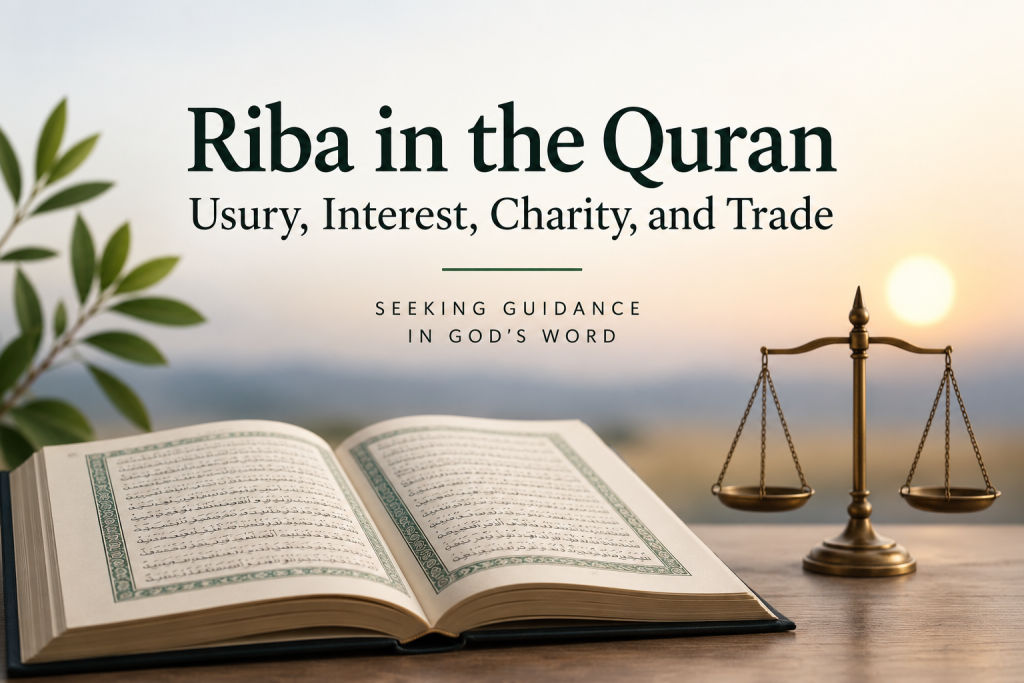
Few financial subjects generate as much disagreement among Muslims as riba in the Quran. It is commonly translated today as “interest,” leading to the conclusion that virtually any predetermined interest on money is prohibited by the Quran. Others understand riba more narrowly as usury—an excessive or exploitative increase imposed upon a debtor.
Rather than beginning with modern banking terminology or later religious rulings, the more fundamental question is:
What does the Quran itself tell us about riba?
The Quran unquestionably condemns riba. But it also permits commerce, encourages charity, recognizes loans and debts, protects the capital belonging to a creditor, requires consideration for a debtor in financial difficulty, and establishes mutually acceptable transactions as a general economic principle.
Taken together, these verses provide a broader framework than simply replacing the Quranic word riba with the modern word “interest.”
Quran translations quoted in this article are from Rashad Khalifa’s translation, Quran: The Final Testament.
Where Does the Quran Discuss Riba?
The Quran discusses riba in a relatively small number of verses: 2:275–280, 3:130, 4:161, and 30:39.
These verses should not be studied in isolation. The most extensive discussion occurs in Sura 2, where the surrounding passage deals extensively with charity, commerce, debt, capital, financial hardship, and the documentation of loans.
The Quran therefore provides its own context in which riba should be understood.
God Permits Commerce and Prohibits Usury
One of the most important statements occurs in 2:275:
“This is because they claim that usury is the same as commerce. However, GOD permits commerce, and prohibits usury.”
— Quran 2:275
This distinction should not be overlooked.
The people being criticized claimed that usury was the same as commerce. God rejects that equivalence. There are therefore two distinct categories:
Commerce is permitted. Riba is prohibited.
Financial gain itself cannot consequently be what defines riba. Commerce normally involves an expectation of financial gain, yet God explicitly permits it.
The Quran elsewhere establishes another broad economic principle:
“O you who believe, do not consume each others’ properties illicitly― only mutually acceptable transactions are permitted.”
— Quran 4:29
Thus, the Quran does not condemn commerce, investment, profit, or the increase of wealth as such. The question is what distinguishes permissible commerce from prohibited riba.
Riba and Charity
There is nevertheless an unmistakable relationship between riba and charity in the Quran.
The principal riba passage in Sura 2 comes immediately after an extended discussion of charitable giving in 2:261–274. Then God places the two concepts directly opposite each other:
“GOD condemns usury, and blesses charities.”
— Quran 2:276
The same contrast occurs independently in Sura 30:
“The usury that is practiced to increase some people’s wealth, does not gain anything at GOD. But if you give to charity, seeking GOD’s pleasure, these are the ones who receive their reward manifold.”
— Quran 30:39
The contrast is deliberate.
One approach seeks an increase in wealth through riba. The other gives wealth away seeking God’s pleasure—and God promises the real increase.
This is an important part of the Quranic understanding of riba.
But Riba Is Not Exclusively About Charity
It would be a mistake, however, to conclude that the Quran discusses riba exclusively as the opposite of charity.
The Quran’s discussion is broader.
Verse 2:275 compares riba with commerce.
Verse 2:279 discusses the creditor’s capital.
Verse 2:280 discusses a debtor unable to pay.
Verse 3:130 describes usury being “compounded over and over.”
Verse 4:161 associates the practice with consuming people’s money illicitly.
And immediately afterward, 2:282 provides detailed instructions concerning loans.
The Quranic framework therefore includes:
Charity — Riba — Commerce — Loans — Debt — Capital — Hardship — Justice.
All of these elements should be considered before defining riba.
“You May Keep Your Capitals”
Verse 2:279 is particularly important because it tells us what happens when someone abandons riba:
“But if you repent, you may keep your capitals, without inflicting injustice, or incurring injustice.”
— Quran 2:279
The creditor does not lose what belongs to him. The capital remains his.
But immediately alongside that right, God establishes the governing principle:
“without inflicting injustice, or incurring injustice.”
The creditor should not commit injustice against the debtor, but neither should the creditor suffer injustice.
This makes justice to both parties an important element of the Quranic economic framework.
It also demonstrates that the riba passage concerns an underlying financial obligation from which the creditor’s capital can be distinguished.
What If the Debtor Cannot Pay?
The very next verse provides additional context:
“If the debtor is unable to pay, wait for a better time. If you give up the loan as a charity, it would be better for you, if you only knew.”
— Quran 2:280
This is particularly revealing.
When someone genuinely cannot repay a debt, the Quran does not encourage the creditor to exploit that hardship. Instead:
Give the debtor more time.
Better still:
Give up the loan as charity.
This does not mean that every person seeking money must be given that money as charity. The Quran recognizes loans and, in the following verses, provides detailed rules governing them.
Rather, when a debtor is genuinely unable to pay, God’s instruction moves in the direction of mercy and generosity rather than financial exploitation.
This helps explain the Quran’s repeated contrast between riba and charity without reducing the entire subject of riba to charity alone.
Loans Themselves Are Recognized by the Quran
The next major verse is important because borrowing and lending are not themselves prohibited.
Verse 2:282 begins:
“O you who believe, when you transact a loan for any period, you shall write it down.”
— Quran 2:282
The verse then provides extensive safeguards involving documentation, the debtor’s statement of the terms, witnesses, and fairness.
Thus the sequence is revealing:
Riba prohibited → capital protected → debtor in hardship protected → forgiveness encouraged → loans regulated and documented.
The Quran does not abolish lending. It regulates human financial dealings while repeatedly emphasizing justice.
“Compounded Over and Over”
Another important description occurs in 3:130:
“O you who believe, you shall not take usury, compounded over and over. Observe GOD, that you may succeed.”
— Quran 3:130
The expression “compounded over and over” provides another characteristic associated with riba.
A debt that repeatedly increases can eventually overwhelm the debtor. This fits naturally with the concern for the debtor unable to pay in 2:280.
However, caution is necessary in both directions.
The verse does not establish a specific percentage at which riba begins. Nor should we conclude from this verse alone that only compounded charges constitute riba, since 2:278 more generally commands believers to abandon what remains of riba.
What we can say is that compounding is explicitly part of the Quran’s description of the prohibited practice.
Riba and the Illicit Consumption of Wealth
Sura 4 provides another dimension:
“And for practicing usury, which was forbidden, and for consuming the people’s money illicitly.”
— Quran 4:161
The verse mentions riba alongside the illicit consumption of people’s wealth.
Again, this fits the broader Quranic concern with justice in financial relationships.
Compare the principle of 4:29:
“O you who believe, do not consume each others’ properties illicitly― only mutually acceptable transactions are permitted.”
The Quran’s economic ethic is therefore not merely concerned with terminology. It is concerned with what people actually do to one another.
Does Riba Mean Usury or Interest?
This brings us to the modern controversy.
The Quranic word is riba (ربا). Rashad Khalifa translates it as “usury.” Other English translations frequently use “interest.”
Modern Arabic commonly uses fāʾidah (فائدة) for financial interest, while the Quran uses riba.
That distinction is worth noting, but it cannot by itself settle the issue. Modern financial vocabulary developed long after the Quran. We cannot simply argue that because modern Arabic uses another word for interest, riba could never encompass something that today is called interest.
The reverse assumption is equally problematic.
Simply translating riba as “interest” does not establish that every financial arrangement described as interest in today’s economy is necessarily the practice condemned by the Quran.
The better approach is to examine the characteristics the Quran itself gives us.
The Quran tells us that riba is prohibited while commerce is permitted (2:275); riba is contrasted with charity (2:276; 30:39); the creditor retains his capital when abandoning riba (2:279); neither creditor nor debtor should suffer injustice (2:279); a debtor unable to pay must be given additional time (2:280); forgiving the loan as charity is better (2:280); riba is described as being compounded over and over (3:130); and loans themselves are recognized and regulated (2:282).
That Quranic description should define the discussion.
The Quran therefore gives us characteristics by which riba can be understood, but it does not establish a modern financial definition of “interest,” nor does it specify an interest rate above or below which a transaction becomes riba. Our task is to understand the Quranic term from the Quran itself, rather than defining it through either modern banking terminology or later religious interpretations.
Modern Usury Laws Do Not Define Quranic Riba
In modern legal systems, including the United States, laws may distinguish ordinary interest from excessive or unlawful interest classified as usury. The allowable rates and rules can vary according to jurisdiction and the type of transaction.
This modern distinction can be useful for understanding how the terms are used today, but it cannot define the Quranic word riba.
Something being legally permissible does not automatically make it permissible before God. Conversely, a modern government’s definition of “usury” does not determine the boundaries of the Quranic prohibition.
The Quran must remain the standard for determining the Quranic meaning of riba.
What About Ordinary Commercial Interest?
This distinction becomes especially relevant in a modern economy.
The word “interest” today covers substantially different transactions.
Consider the differences between a desperate person borrowing money at an extremely high rate to meet immediate living expenses; a homeowner obtaining a thirty-year mortgage; a business borrowing capital to expand; a government issuing bonds; and a bank paying interest to depositors whose money it uses in its business.
Modern financial terminology may describe an increase in all of these situations as interest.
That does not establish that the Quran treats every one of these transactions identically.
At the same time, the fact that interest is an accepted worldwide commercial practice does not establish its Quranic permissibility. Social acceptance neither makes something lawful nor unlawful before God.
The relevant questions remain Quranic ones:
Is this riba?
Is this legitimate commerce?
Is one party exploiting another’s indebtedness or hardship?
Is either party being wronged?
Is the transaction mutually acceptable?
The distinction established by God remains:
“GOD permits commerce, and prohibits usury.”
— Quran 2:275
Our responsibility is to understand and preserve that distinction rather than erase it.
What About “Interest-Free” Islamic Banking?
The same Quranic standard should be applied to financial institutions calling themselves “Islamic.”
A transaction does not necessarily become acceptable to God simply because its terminology has been changed.
Suppose a conventional bank finances the purchase of a property and earns a predetermined financial return over many years.
An “Islamic” institution may instead purchase the property and resell it to the customer at a substantially higher deferred price, describing the difference as profit or markup rather than interest.
The relevant Quranic question should not simply be:
What does the institution call the transaction?
It should be:
What is actually taking place?
If the economic substance remains essentially the same while a series of transactions has merely been constructed to avoid the word “interest,” attaching an Islamic label to the arrangement does not itself establish its Quranic legitimacy.
Conversely, neither should a transaction automatically be condemned simply because a conventional financial institution uses the word “interest.”
God knows the substance of our actions. Religious terminology cannot transform one economic reality into another.
This is particularly important in light of 2:275. The Quran itself distinguishes commerce from riba. We should therefore be careful neither to disguise riba as commerce nor to redefine legitimate commerce as riba through humanly constructed religious rules.
A Quranic Framework for Financial Transactions
Rather than creating another complicated system of religious financial terminology, several Quranic questions can guide the believer.
Is the transaction legitimate commerce?
God permits commerce (2:275).
Does it constitute the riba God prohibited?
The prohibition must be taken seriously (2:275, 278).
Are the parties entering a mutually acceptable transaction?
This is the principle expressed in 4:29.
Is someone’s financial hardship being exploited?
The treatment of the distressed debtor in 2:280 points in the opposite direction.
Is either party being wronged?
God says, “without inflicting injustice, or incurring injustice” (2:279).
Are debts clearly documented and understood?
Verse 2:282 provides unusually detailed instructions precisely for this purpose.
When someone genuinely needs help, would generosity be better than financial gain?
The Quran repeatedly contrasts riba with charity and explicitly says that forgiving the distressed debtor’s loan as charity is better (2:276, 280; 30:39).
These principles provide something more meaningful than simply attaching religious labels to modern financial products.
Conclusion
The Quran’s treatment of riba is clear in its prohibition, while providing a broader framework within which that prohibition must be understood.
There is no question that riba is prohibited.
But the Quran does not discuss riba exclusively in the context of charity. It places the subject within a much broader framework involving commerce, charity, loans, debt, capital, hardship, mutually acceptable transactions, and justice.
God explicitly permits commerce while prohibiting riba.
The creditor’s capital is protected, but so is the debtor from injustice. A debtor experiencing hardship must be given time, and forgiving the loan as charity is even better. Loans themselves are recognized and carefully regulated.
The Quran therefore gives us principles by which financial transactions can be evaluated rather than the terminology of a modern banking system.
Nor should the question be reduced to whether a financial institution calls its return “interest,” “profit,” “markup,” or something else. A conventional label does not determine what God has prohibited, and neither does an “Islamic” label make a transaction righteous.
The Quran provides the essential distinction:
“GOD permits commerce, and prohibits usury.”
— Quran 2:275
And it provides the moral principle governing creditor and debtor:
“…without inflicting injustice, or incurring injustice.”
— Quran 2:279
Those principles should remain at the center of a Quran-based understanding of riba: God has permitted legitimate commerce, God has prohibited riba, and financial dealings should not become instruments of injustice.
Quran quotations: Rashad Khalifa, Quran: The Final Testament.
Continue Your Study
The Quran Is Fully Detailed
The Quran provides the principles by which God’s laws and guidance are understood.
Who Explains the Quran?
Explore how the Quran explains its own terminology and teachings through its verses and context.
God Alone Teaches the Quran
Why God’s words—not later religious systems—must remain the authority for determining religious law.