Introduction: A Widely Misused Concept
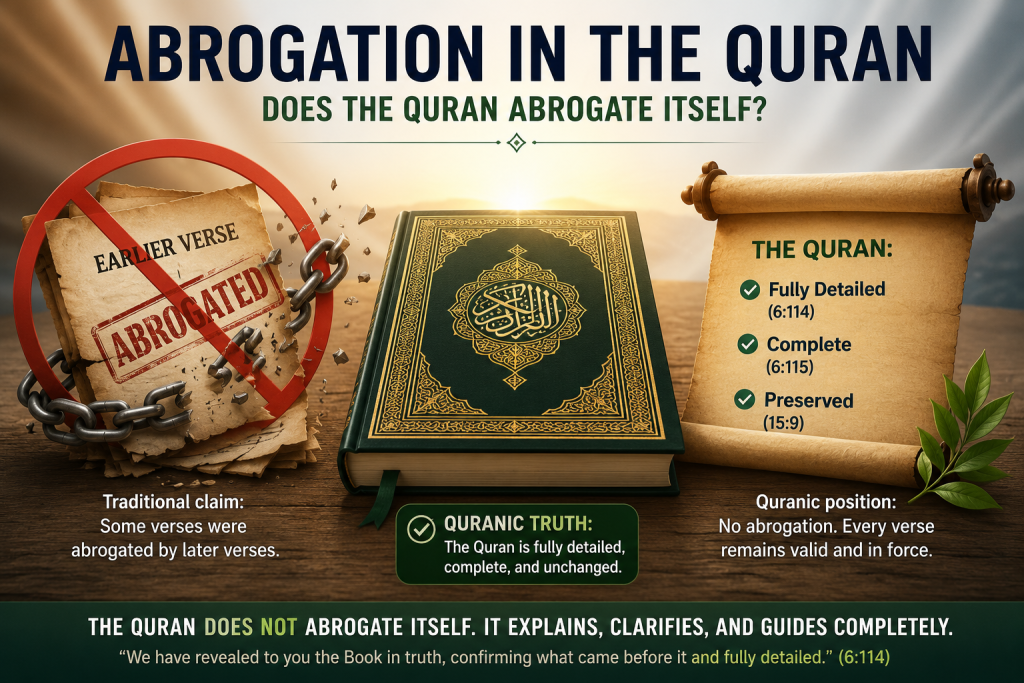
The concept of “abrogation” in the Quran is one of the most frequently invoked, and most misunderstood, ideas in discussions about the Quran.
It is often used to claim that:
- certain Quranic verses cancel others
- some commands are no longer applicable
- parts of the Quran have been superseded internally
This claim rests heavily on one verse:
“When we abrogate any ayah, or cause it to be forgotten, we produce a better one, or at least an equal one…” (2:106)
The central question is clear:
Does the Quran allow its own verses to be canceled?
The Meaning of “Ayah”
The word “ayah” (آية) is central to the discussion. It does not have a single fixed meaning. Throughout the Quran, it is used to refer to:
- a verse of scripture
- a sign in creation
- a miracle given to a messenger
The correct meaning is always determined by context.
To assume that “ayah” in 2:106 must mean “Quranic verse” is not a linguistic rule. It is an interpretive choice, and one that must be tested against the rest of the Quran.
Reading 2:106 in Context
The verse speaks of:
- replacing something with something better or equal
- a process tied to God’s power
This description aligns naturally with:
- the progression of divine signs
- the replacement of one form of proof with another
It does not naturally describe:
- the cancellation of parts of a single, final revelation
The Quran’s Position on Its Own Words
The Quran makes unequivocal statements about the status of God’s words:
“The word of your Lord is complete, in truth and justice. Nothing shall abrogate His words.” (6:115)
“You shall recite what is revealed to you of your Lord’s scripture. Nothing shall abrogate His words…” (18:27)
These verses are direct and explicit.
They do not allow for exceptions.
No Contradiction in the Quran
The Quran also establishes:
“Had it been from other than GOD, they would have found in it numerous contradictions.” (4:82)
If one verse cancels another, the result is contradiction:
- one verse commands
- another nullifies
This is precisely what 4:82 denies.
No Change to God’s Words
The Quran further states:
“Nothing shall change the words of GOD…” (10:64)
To claim that verses are abrogated, rendered inactive or replaced, is to introduce change into what the Quran declares unchangeable.
The Quran Is Fully Detailed
“Shall I seek other than GOD as a source of law, when He has revealed to you this book fully detailed?” (6:114)
A fully detailed book does not require:
- internal cancellation
- later correction
- selective deactivation of its own content
The doctrine of abrogation, as applied to Quranic verses, implies incompleteness, something the Quran explicitly rejects.
What 2:106 Actually Refers To
When read in harmony with the rest of the Quran, 2:106 points to a broader pattern:
- God gives signs and miracles to different messengers
- these signs vary across time
- some are replaced with others more suited to their context
This is consistent with the Quran’s description of revelation across history:
“We revealed to you the Book in truth, confirming what came before it and superseding it…” (5:48)
The progression is:
- from earlier revelations
- to the final revelation (the Quran)
Not within the Quran itself.
The Consequence of Misreading 2:106
When 2:106 is used to justify internal abrogation:
- verses are dismissed
- teachings are selectively ignored
- external interpretations override the text
This transforms the Quran from a complete and consistent revelation into a fragmented document governed by human preference.
A Serious Distortion
To declare that one part of the Quran cancels another is not a minor interpretive difference.
It attributes to God:
- inconsistency
- revision
- internal contradiction
This stands in direct opposition to the Quran’s own description of itself.
Conclusion
The Quran presents itself as:
- complete (6:114)
- consistent (4:82)
- unchangeable (6:115, 10:64, 18:27)
Any interpretation that introduces internal cancellation of its verses conflicts with these core principles.
Abrogation in 2:106 refers to the progression of divine signs and miracles across time, not the cancellation of Quranic verses.
Final Reflection
The Quran does not require correction.
It does not cancel itself.
It does not contradict itself.
It is to be understood as a complete and consistent revelation, on its own terms.
Continue Exploring This Topic
This article is part of a broader study of the Quran’s message regarding monotheism, association (shirk), and the historical development of sectarian religion. You may also find these articles helpful: