Introduction
The Quran repeatedly describes itself as:
- guidance
- light
- clarification
- wisdom
- mercy
- and healing
Yet the Quran also openly acknowledges a striking reality:
Not everyone who reads or hears the Quran understands it.
Some people:
- become guided
- humbled
- transformed
while others:
- become resistant
- defensive
- hostile
- spiritually blinded
This raises an important question:
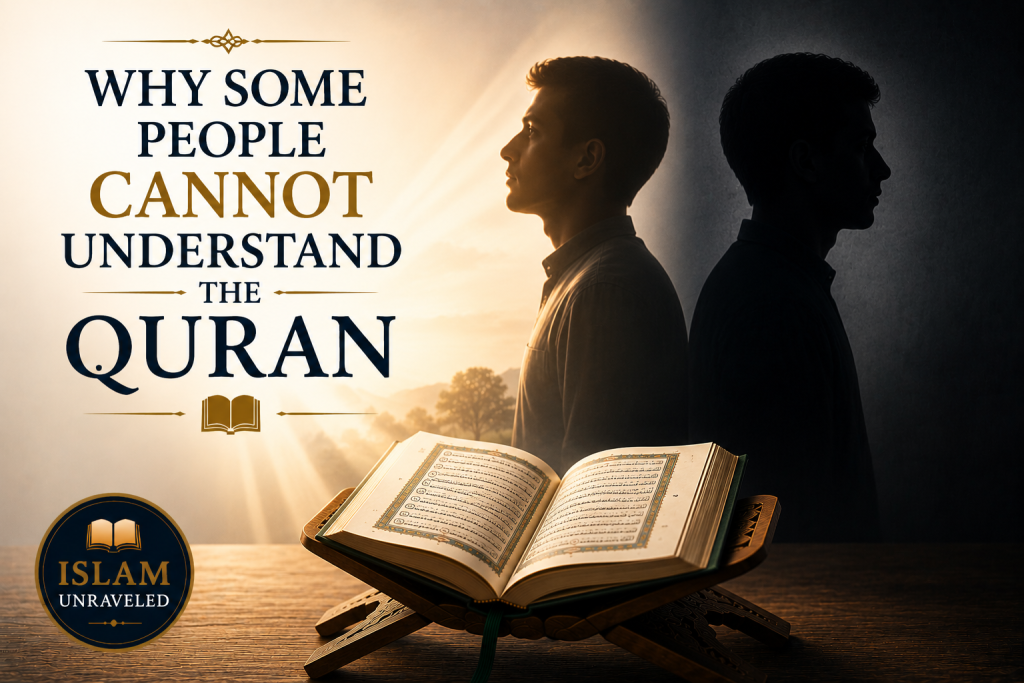
If the Quran is clear guidance from God, why some people cannot understand the Quran?
The Quran’s answer is profound.
The problem is not primarily:
- intelligence
- language
- literacy
- education
The deeper issue is the condition of the human heart.
The Quran Distinguishes Between Hearing and Understanding
The Quran repeatedly describes people who physically hear revelation but remain spiritually disconnected from it.
“Some of them listen to you, but We place veils over their hearts to prevent them from understanding it, and deafness in their ears…” (6:25)
This verse introduces one of the Quran’s central principles:
There is a difference between:
- hearing words
and - truly understanding guidance
A person may:
- memorize verses
- analyze grammar
- debate interpretations
yet remain untouched by the Quran’s actual message.
The Heart Is Central
The Quran repeatedly locates spiritual understanding within the heart.
“They have hearts with which they do not understand…” (7:179)
This is extraordinarily important.
The Quran does not merely describe misunderstanding as an intellectual problem.
It describes it as:
- a spiritual condition
- a moral condition
- an internal condition of the soul
Arrogance Blocks Understanding
One of the greatest barriers to understanding the Quran is arrogance.
“I will divert from My revelations those who are arrogant on earth without justification.” (7:146)
The Quran repeatedly portrays arrogance as spiritual blindness.
An arrogant person often approaches revelation:
- seeking confirmation of existing beliefs
- defending ego
- resisting surrender
- protecting identity
rather than sincerely seeking truth.
The Quran repeatedly teaches that guidance requires humility.
The Quran Guides Some and Misguides Others
One of the Quran’s most striking verses states:
“He guides many with it, and misguides many with it.” (2:26)
The same Quran:
- softens one heart
while - hardening another
The revelation itself does not change.
What changes is the condition of the reader.
Prejudice and Inherited Assumptions
The Quran repeatedly warns that inherited beliefs can become barriers to truth.
“When they are told, ‘Follow what GOD has revealed,’ they say, ‘We follow only what we found our parents doing.’” (2:170)
People often approach the Quran carrying:
- sectarian assumptions
- inherited doctrines
- cultural expectations
- emotional attachments
Instead of allowing the Quran to shape belief, they attempt to force the Quran into preexisting frameworks.
The Quran repeatedly challenges this mentality.
The Problem of Reading With Ego
The Quran repeatedly exposes a particular type of reader:
- one who seeks contradiction
- fault
- argument
- self-justification
rather than guidance.
“As for those who harbor doubt in their hearts, it only adds impurity to their impurity…” (9:125)
The Quran therefore acts almost like a spiritual exposure.
It reveals:
- sincerity
- hypocrisy
- humility
- resistance
Why Intelligence Alone Is Not Enough
The Quran never equates intelligence alone with guidance.
Many highly educated individuals may:
- study the Quran academically
- analyze linguistics
- debate theology
while remaining spiritually distant from its message.
Meanwhile, a sincere believer with little formal education may genuinely receive guidance.
The Quran repeatedly prioritizes:
- sincerity
- reverence toward God
- humility
- willingness to submit
over intellectual pride.
The Quran and Spiritual Disease
The Quran frequently describes spiritual corruption as disease.
“In their hearts there is disease…” (2:10)
This disease includes:
- hypocrisy
- arrogance
- dishonesty
- love of worldly authority
- attachment to falsehood
The Quran repeatedly teaches that such conditions distort perception itself.
The issue is therefore not lack of information.
It is resistance to truth.
The Sealing of Hearts
One of the Quran’s most serious warnings concerns sealed hearts.
“GOD seals their hearts and their hearing…” (2:7)
The Quran does not present this as arbitrary.
Repeated rejection of truth gradually produces:
- hardness
- spiritual numbness
- blindness to guidance
This is one of the Quran’s deepest psychological principles:
persistent rejection transforms the human being internally.
When God Alone Is Mentioned
The Quran provides a powerful diagnostic test regarding sincerity toward pure monotheism:
“When GOD ALONE is mentioned, the hearts of those who do not believe in the Hereafter shrink with aversion…” (39:45)
This reaction itself reveals internal resistance.
The Quran repeatedly exposes how many people become uncomfortable when:
- God alone is emphasized
- human religious authority is challenged
- inherited traditions are questioned
The issue is not lack of comprehension.
The issue is attachment.
The Quran Requires Reflection
The Quran repeatedly calls people to:
- think
- reflect
- reason
- examine
“Why do they not reflect upon the Quran?” (4:82)
“This is a scripture that we revealed to you, full of blessings, that they may reflect upon its verses…” (38:29)
The Quran was never meant to be approached mechanically.
It demands:
- sincerity
- reflection
- humility
- willingness to confront oneself
God Alone Grants Guidance
Ultimately, the Quran repeatedly teaches that true understanding comes from God.
“The Most Gracious. Teacher of the Quran.” (55:1–2)
“Then it is for Us to explain it.” (75:19)
Human beings may:
- read
- discuss
- analyze
- debate
But genuine guidance is granted by God.
This is why the Quran repeatedly calls human beings toward:
- sincerity
- repentance
- purification
- reverence toward God
The Quran as a Mirror
The Quran often functions like a mirror.
A sincere person may read it and become:
- humbled
- transformed
- spiritually awakened
An arrogant person may read the same verses and become:
- defensive
- hostile
- dismissive
The Quran exposes what already exists within the human being.
The Final Reality
The Quran repeatedly acknowledges that not everyone will understand or accept revelation.
This is not because the Quran lacks clarity.
Rather, the Quran teaches that:
- ego
- arrogance
- inherited beliefs
- hypocrisy
- insincerity
- attachment to worldly identity
can prevent the human being from receiving guidance.
The barrier is ultimately spiritual before it is intellectual.
Related Articles in This Series
The themes explored in this article connect to broader Quranic discussions on sincerity, accountability, guidance, ego, leadership, and the human soul. The following companion articles explore these subjects in greater depth:
- The Quran Reads You — Sincerity and Guidance in the Quran
How the Quran is not merely read to the human being but the Quran reads the human being. - The Quran Is a Mirror — Human Nature and Divine Guidance
How the Quran exposes sincerity, hypocrisy, ego, and the internal condition of the reader. - God Alone Teaches the Quran
The Quran’s repeated emphasis that true understanding and guidance come from God alone. - The Quran and the Purified Heart — Sincerity Before Knowledge
Why the Quran prioritizes humility and purification of the soul over mere scholarship. - The Quran Is Not a Passive Book
How the Quran actively interacts with the conscience, intellect, and spiritual state of the human being.
Conclusion
The Quran repeatedly teaches that understanding revelation is not merely an academic exercise.
The greatest obstacles are often:
- arrogance
- ego
- attachment to inherited beliefs
- refusal to surrender to truth
The Quran therefore becomes more than a book of information.
It becomes a criterion exposing the inner state of the reader.
Some approach it seeking guidance and receive light.
Others approach it seeking confirmation of themselves and remain spiritually blind.
The Quran repeatedly calls human beings to:
- humility
- reflection
- sincerity
- and submission to God alone
because ultimately, true understanding is not merely learned.
It is granted.
Related Discussion (Video)
This article was inspired in part by themes discussed in the following video: