Introduction
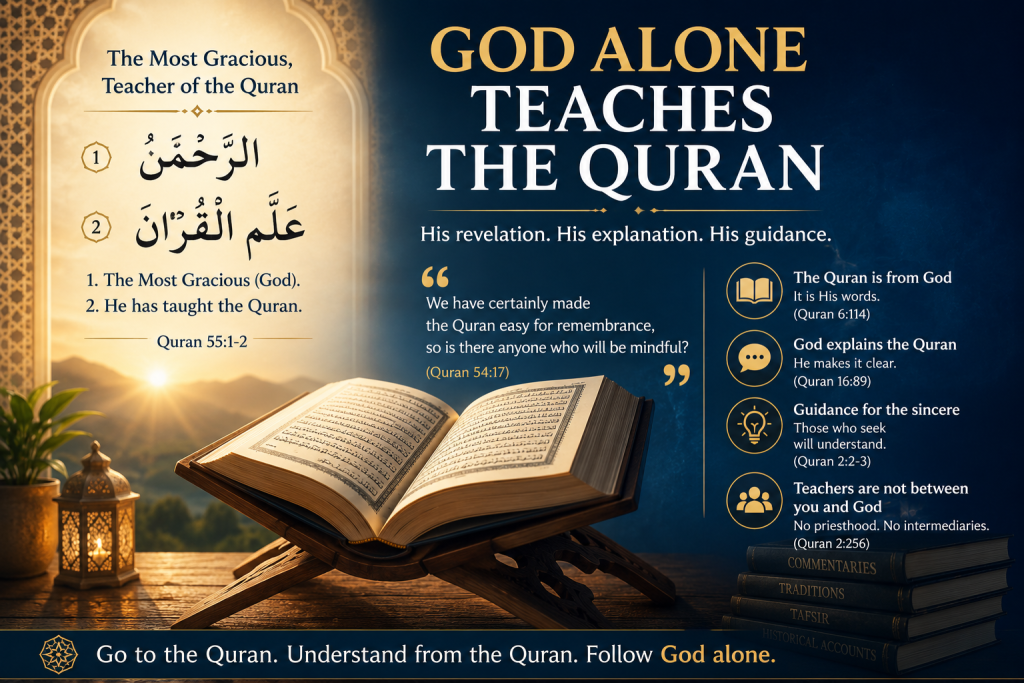
One of the Quran’s most profound and often overlooked principles is that ultimate understanding of revelation comes from God alone.
The Quran repeatedly attributes:
- teaching
- explanation
- guidance
- clarification
directly to God. God alone teaches the Quran.
This principle fundamentally reshapes how the believer approaches the Quran.
The Quran is not merely:
- a human intellectual exercise
- an academic subject
- a linguistic puzzle
- or a collection of historical information
It is divine revelation whose true understanding ultimately depends upon:
- God’s guidance
- sincerity of the reader
- and the condition of the heart
The Quran repeatedly calls human beings to:
- reflect
- reason
- study
Yet it simultaneously reminds them that:
God alone is the true Teacher of the Quran.
The Most Direct Statement
The clearest declaration appears at the opening of Surah 55:
“The Most Gracious. Teacher of the Quran.” (55:1–2)
The sequence is remarkable.
Before mentioning:
- creation
- humanity
- speech
the Quran first identifies God as:
Teacher of the Quran
The source of understanding is therefore divine before it is human.
God Explains the Quran
The Quran further states:
“Then it is for Us to explain it.” (75:19)
This verse is extraordinarily important.
The Quran does not say:
- scholars explain it
- institutions explain it
- traditions explain it
It attributes ultimate explanation directly to God.
Human beings may:
- discuss
- study
- analyze
- reflect
But true understanding comes from God.
The Prophet’s Duty Was Delivery
The Quran repeatedly defines the messenger’s role as delivery of revelation.
“The sole duty of the messenger is delivery.” (5:99)
“If they turn away, your sole mission is the clear delivery.” (16:82)
This principle is fundamental.
The Quran consistently emphasizes:
- transmission of revelation
not - independent religious authority beside revelation
The prophet delivered the Quran faithfully.
The understanding and guidance of hearts ultimately belong to God.
The Quran Was Made Easy
The Quran repeatedly states that God Himself made the Quran accessible for remembrance:
“We made the Quran easy to learn. Does any of you wish to learn?” (54:17)
This verse appears repeatedly in Surah 54.
The ease comes from God.
This does not mean:
- every verse is immediately understood identically by all people
- no reflection is required
- no effort is needed
Rather, the Quran repeatedly teaches that guidance is accessible to sincere seekers because God facilitates it.
Guidance Belongs to God Alone
The Quran repeatedly emphasizes that guidance itself belongs to God.
“You cannot guide the ones you love. GOD is the only One who guides in accordance with His will…” (28:56)
Even prophets could not independently guide hearts.
This is one of the Quran’s deepest principles.
Human beings may:
- present evidence
- teach language
- discuss meanings
But spiritual understanding is granted by God.
The Quran and the Condition of the Heart
The Quran repeatedly connects understanding with:
- sincerity
- humility
- reverence toward God
“This scripture is infallible; a beacon for the righteous.” (2:2)
The Quran does not describe itself as equal guidance for every heart regardless of condition.
The human being’s internal state matters.
This is why the Quran repeatedly warns against:
- arrogance
- hypocrisy
- blind following
- attachment to inherited beliefs
These conditions can block understanding.
Knowledge Alone Is Not Enough
The Quran repeatedly distinguishes between:
- information
and - guidance
A person may:
- know Arabic
- memorize the Quran
- master grammar
- study theology
yet remain spiritually distant from the Quran’s message.
Meanwhile, another person with little formal education may approach revelation sincerely and receive genuine guidance from God.
The Quran repeatedly prioritizes:
- sincerity
- humility
- reverence
- submission to truth
over intellectual pride.
Why Scholars Alone Cannot Guarantee Guidance
The Quran never establishes a permanent priesthood or infallible scholarly class.
Religious scholarship may:
- assist
- preserve language
- provide historical context
But the Quran repeatedly warns that scholars themselves can:
- err
- distort
- follow desires
- mislead others
“They set up their religious leaders and scholars as lords beside GOD…” (9:31)
The Quran repeatedly redirects ultimate authority back to:
- God
- revelation
- sincere reflection
The Quran Interprets Itself
The Quran repeatedly demonstrates internal explanation through:
- recurring themes
- parallel passages
- clarification across verses
This is one reason the Quran constantly calls readers to:
- reflect deeply
- compare verses
- examine context
“Why do they not reflect upon the Quran? If it were from other than GOD, they would have found in it numerous contradictions.” (4:82)
The Quran repeatedly explains itself internally rather than depending upon external religious systems.
God Teaches Through Reflection
The Quran repeatedly commands reflection:
“This is a scripture full of blessings that they may reflect upon its verses…” (38:29)
Reflection itself becomes part of divine teaching.
The sincere reader:
- contemplates
- reconsiders
- purifies assumptions
- returns repeatedly to revelation
Over time, understanding deepens.
Not because the human being independently masters divine truth, but because God gradually opens understanding.
The Danger of Human Religious Authority
One of the Quran’s major themes is the danger of replacing God’s authority with human authority.
People frequently elevate:
- scholars
- sects
- traditions
- institutions
- inherited interpretations
above direct engagement with revelation.
The Quran repeatedly warns against this mentality.
True guidance comes from:
- God alone
through - sincere engagement with His revelation
The Quran and Spiritual Receptivity
The Quran repeatedly teaches that revelation affects people differently.
“He guides many with it, and misguides many with it.” (2:26)
The same Quran:
- softens one heart
- hardens another
This reality demonstrates again that understanding is not merely mechanical.
The heart itself matters.
The Believer’s Relationship With the Quran
The Quran repeatedly encourages believers to approach revelation with:
- humility
- sincerity
- reverence
- openness to correction
The believer is not meant to approach the Quran merely seeking:
- self-confirmation
- sectarian defense
- inherited assumptions
The believer approaches seeking:
- truth
- guidance
- closeness to God
The Final Reality
Ultimately, the Quran repeatedly returns human beings to one central truth:
God alone teaches the Quran.
Human beings may assist each other in:
- study
- language
- discussion
- reflection
But true guidance:
- cannot be manufactured
- cannot be inherited mechanically
- cannot be guaranteed by institutions
It is granted by God to sincere seekers.
Related Articles in This Series
The themes explored in this article connect to broader Quranic discussions on sincerity, accountability, guidance, ego, leadership, and the human soul. The following companion articles explore these subjects in greater depth:
- The Quran Reads You — Sincerity and Guidance in the Quran
How the Quran is not merely read to the human being but the Quran reads the human being. - Why Some People Cannot Understand the Quran
A Quranic study of arrogance, sincerity, inherited beliefs, and spiritual blindness. - The Quran Is a Mirror — Human Nature and Divine Guidance
How the Quran exposes sincerity, hypocrisy, ego, and the internal condition of the reader. - The Quran and the Purified Heart — Sincerity Before Knowledge
Why the Quran prioritizes humility and purification of the soul over mere scholarship. - The Quran Is Not a Passive Book
How the Quran actively interacts with the conscience, intellect, and spiritual state of the human being.
Conclusion
The Quran repeatedly attributes:
- teaching
- explanation
- guidance
directly to God.
This principle transforms the believer’s relationship with revelation.
The Quran is not merely an academic subject to be mastered intellectually.
It is divine guidance requiring:
- sincerity
- humility
- reflection
- reverence toward God
Human beings may study and discuss the Quran, but ultimate understanding belongs to God alone.
The believer therefore approaches the Quran not with arrogance or blind dependence upon human authority, but with sincere prayer for God’s guidance and understanding.
For the Quran repeatedly reminds humanity:
“The Most Gracious. Teacher of the Quran.” (55:1–2)
Related Discussion (Video)
This article was inspired in part by themes discussed in the following video: