A Quranic and Historical Examination of Early Monotheism and Later Religious Identity
Introduction
Modern Islam is often understood primarily as a rigid sectarian identity sharply separated from Judaism and Christianity. Muslims, Jews, and Christians are commonly viewed as entirely distinct and competing religious communities with little theological overlap beyond historical origin.
However, the Quran repeatedly presents a broader and more profound framework.
The Quran consistently emphasizes:
- belief in God
- righteousness
- accountability
- submission to God alone
- and sincere monotheism
far more than later sectarian identity.
In recent decades, modern historian Fred M. Donner, in his book Muhammad and the Believers: At the Origins of Islam, argued that the earliest movement surrounding Muhammad may initially have been a broader “Believers’ movement” centered primarily upon monotheism and righteousness, rather than the sharply defined sectarian Islam that developed later.
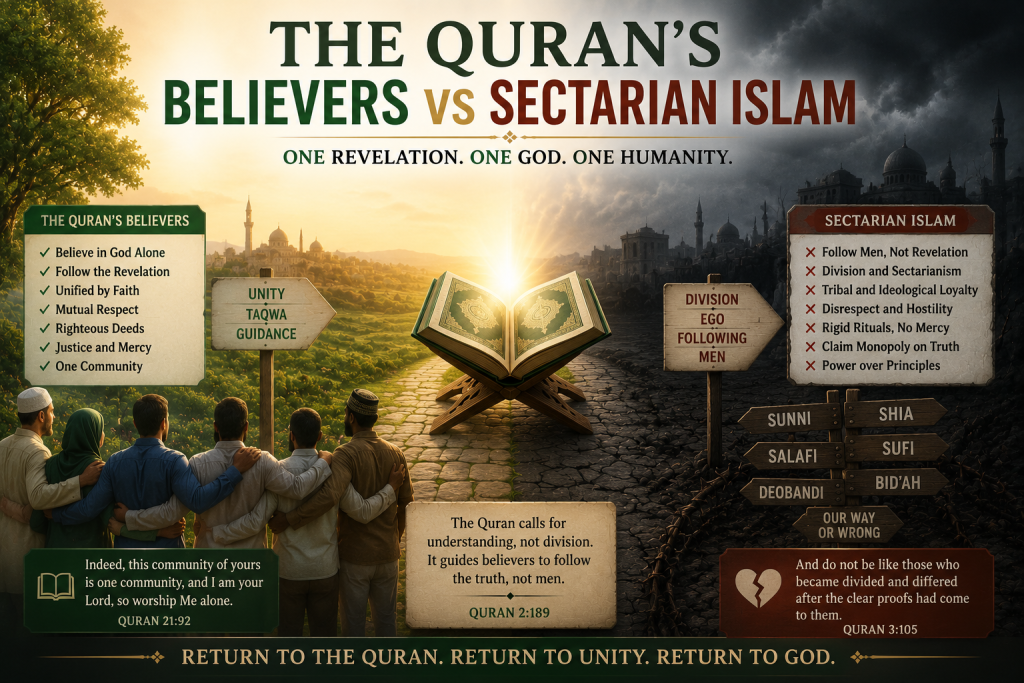
Whether or not every aspect of Donner’s historical reconstruction is accepted, some of his observations are strikingly consistent with themes repeatedly found in the Quran’s believers vs sectarian Islam.
Most importantly, the Quran repeatedly condemns sectarian division while emphasizing sincere submission to God above inherited religious identity.
The Quran’s Language of “Believers”
The Central Quranic Identity
One of the most striking features of the Quran is its repeated emphasis on “those who believe” (alladhina amanu) rather than later sectarian labels.
The Quran repeatedly acknowledges that sincere believers may exist among Jews and Christians:
“Surely, those who believe, those who are Jewish, the Christians, and the converts; anyone who believes in GOD, and believes in the Last Day, and leads a righteous life, will receive their recompense from their Lord. They have nothing to fear, nor will they grieve.” (2:62)
The same principle appears again:
“Surely, those who believe, those who are Jewish, the converts, and the Christians; anyone who believes in GOD and the Last Day, and leads a righteous life, has nothing to fear, nor will they grieve.” (5:69)
The Quran also explicitly praises some among the People of the Book:
“They are not all the same; among the followers of the scripture, there are those who are righteous…” (3:113)
And again:
“Surely, some followers of the scripture do believe in GOD…” (3:199)
These verses are extraordinary because they do not reduce salvation to later sectarian labels. Instead, the Quran repeatedly emphasizes:
- belief in God
- the Last Day
- righteousness
- sincerity
The Quran’s framework is therefore broader and more spiritually centered than later institutional sectarianism.
“Muslim” in the Quran — Submission Rather Than Sectarian Label
Abraham Before Sectarian Religion
The Quran repeatedly presents “Muslim” not primarily as a later institutional label, but as one who submits to God.
Abraham himself is described as a Muslim long before later religious sects emerged:
“When his Lord said to him, ‘Submit,’ he said, ‘I submit to the Lord of the universe.’” (2:131)
“Abraham was neither Jewish, nor Christian; he was a monotheist submitter. He never was an idol worshiper.” (3:67)
The Quran repeatedly presents Abraham as the model of pure monotheistic submission beyond sectarian boundaries.
Similarly:
“He is the One who named you ‘Submitters’ originally.” (22:78)
Thus, the Quran’s primary religious identity is submission to God alone, not later sectarian division.
Fred Donner’s “Believers Movement” Thesis
A Modern Historical Observation
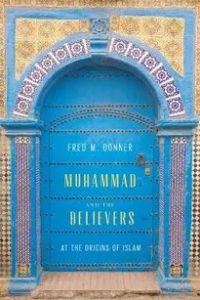
Modern historian Fred Donner proposed that the earliest movement surrounding Muhammad may have initially consisted of a broader community of monotheistic “Believers,” including sincere Jews and Christians who accepted the movement’s core emphasis on:
- monotheism
- righteousness
- accountability before God
rather than a sharply separated institutional religion.
Donner argues that the rigid sectarian boundaries associated with later Islam may have developed more gradually over time.
Whether or not every aspect of Donner’s historical reconstruction is accepted, the thesis is noteworthy because it partially aligns with the Quran’s own language emphasizing:
- believers
- righteousness
- monotheism
- submission to God
over sectarian identity.
Importantly, the Quran itself remains the criterion—not academic historians. Historical observations are valuable only insofar as they align with the Quran.
The Medina Agreement and the Early Concept of Ummah
A Broader Community Framework
One of the earliest historical documents associated with the Prophet Muhammad is commonly referred to as the Constitution (or Charter) of Medina.
In this agreement, various tribes and communities — including Jewish groups — were reportedly described collectively as part of a broader Ummah (community), while still maintaining distinct religious practices.
This historical memory is strikingly consistent with the Quran’s broader monotheistic framework.
The Quran repeatedly recognizes righteous People of the Book while simultaneously calling believers toward unity under God:
“You shall hold fast to the rope of GOD, all of you, and do not be divided.” (3:103)
The Medina framework appears far closer to:
- covenantal monotheistic community
than - later hardened sectarian identity.
This does not eliminate theological differences, but it suggests that the earliest believing movement may have been broader and less rigidly sectarian than what later developed historically.
The Rise of Sectarian Islam
From Believers to Institutional Identity
Over time, however, historical Islam appears to have evolved into a more formally distinct sectarian system.
Modern historians such as Donner point particularly to the Umayyad period, especially during the reign of Abd al-Malik ibn Marwan (685–705 CE), as a period when Islamic identity became more sharply differentiated from Judaism and Christianity.
Historians note several developments during this period:
- increased emphasis on Muhammad’s distinct prophetic role
- stronger state-centered religious identity
- clearer separation from Jewish and Christian communities
- monumental Islamic architecture such as the Dome of the Rock in Jerusalem
These developments may reflect the historical transition from a broader “Believers” movement toward a more rigid institutional religion.
Regardless of the precise historical reconstruction, the Quran itself repeatedly warns against sectarian fragmentation:
“Those who divide themselves into sects do not belong with you. Their judgment rests with GOD…” (6:159)
“Do not be among the idol worshipers. Among those who divided their religion into sects; each party rejoicing with what they have.” (30:31–32)
The Quran consistently places emphasis upon:
- submission to God
- righteousness
- accountability
- sincere belief
rather than sectarian identity itself.
The Quran’s Condemnation of Sectarianism
Division as Religious Corruption
Sectarianism is repeatedly condemned throughout the Quran.
The Quran portrays religious fragmentation as a corruption that emerged after revelation:
“They divided themselves into disputing sects…” (23:53)
“Religious disputes among the people resulted from jealousy after knowledge had come to them.” (42:14)
The Quran repeatedly connects sectarianism with:
- ego
- pride
- attachment to human authority
- inherited religion
Instead of centering religion upon:
- God alone
- righteousness
- revelation
human beings repeatedly transformed religion into:
- competing sects
- institutions
- inherited identities
The Quran warns strongly against elevating religious authorities beside God:
“They set up their religious leaders and scholars as lords beside GOD…” (9:31)
God Alone as the Center of Religion
The Quran’s Corrective Principle
The Quran repeatedly redirects human beings away from sectarian identity and toward pure devotion to God alone.
“They were commanded to worship only GOD, devoting the religion absolutely to Him alone…” (98:5)
The central question in the Quran is not:
- “Which sect do you belong to?”
but rather:
- Do you sincerely submit to God?
- Do you worship God alone?
- Do you live righteously?
- Do you uphold justice and truth?
The Quran repeatedly emphasizes:
- accountability
- righteousness
- sincerity
- reverence toward God
above inherited sectarian identity.
Conclusion
The Quran’s Vision Beyond Sectarian Boundaries
The Quran repeatedly presents religion in terms of:
- belief
- righteousness
- submission to God
- accountability
- monotheism
rather than rigid sectarian identity.
Historical observations such as Fred Donner’s “Believers movement” thesis and the early Medina framework may partially reflect this broader Quranic vision before later institutional and political developments hardened sectarian distinctions.
The Quran repeatedly condemns division into sects while calling human beings back toward:
- God alone
- sincere submission
- righteousness
- and unity under divine guidance
Ultimately, the Quran’s vision transcends later sectarian boundaries.
Its central message remains:
“You shall devote yourself completely to this religion of monotheism. Such is the natural instinct placed into the people by GOD…” (30:30)