Textual Anomaly, Historical Accident, or Deliberate Quranic Structure?
Introduction
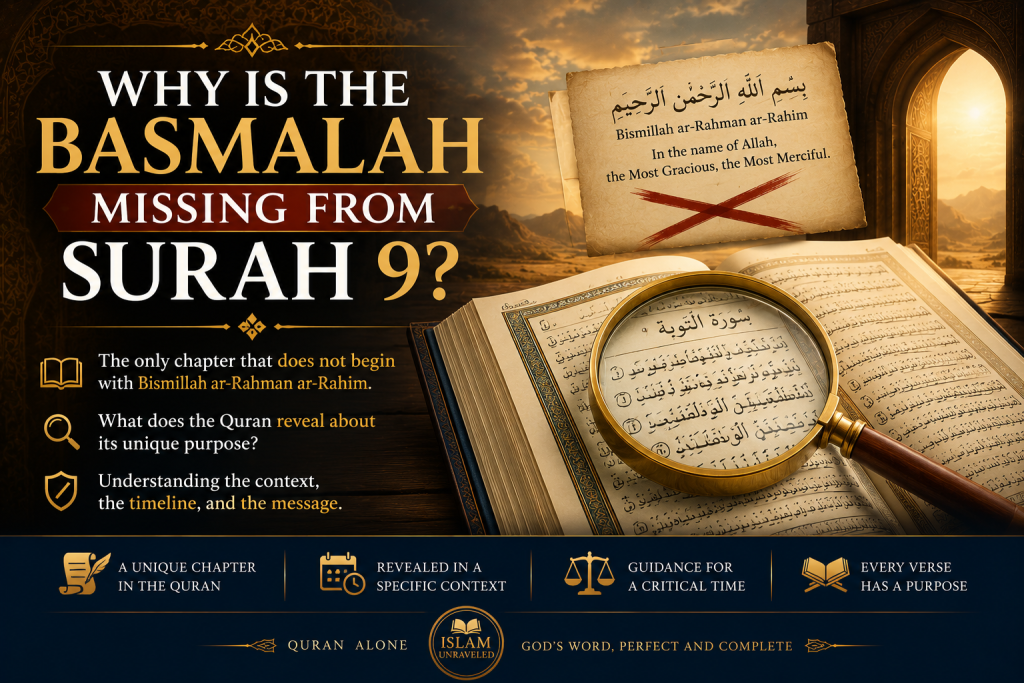
One of the most discussed structural features of the Quran concerns the opening, specifically the Basmalah missing from Surah 9.
Every surah of the Quran begins with the Basmalah:
“In the name of GOD, Most Gracious, Most Merciful.”
except:
Surah 9 (At-Tawbah / Bara’ah)
The omission has attracted attention for centuries because the Basmalah is one of the most recognizable and repeated phrases in the Quran.
Traditional Islamic scholarship proposed several explanations:
- Surah 9 continues the subject matter of Surah 8,
- the surah begins with declarations of war and therefore lacks the formula of mercy,
- or the omission reflects early codification practices.
Modern scholarship has similarly approached the issue through:
- manuscript history,
- redaction theory,
- editorial development,
- or liturgical convention.
Yet the omission remains structurally remarkable.
Why would a text that otherwise exhibits extraordinary consistency omit the Basmalah from only one surah?
From the perspective of the Quranic proof centered upon the number nineteen, however, the omission is neither accidental nor editorially arbitrary. Rather, it functions as part of a larger internally integrated mathematical structure connected to:
- the arrangement of the Quran,
- the total number of Basmalahs,
- and the status of verses 9:128–129.
This article examines the issue through:
- traditional scholarship,
- modern academic discussion,
- and the Quranic proof framework.
The Structural Anomaly
The Quran contains:
- 114 surahs,
- and normally 114 Basmalahs.
However:
- Surah 9 lacks the Basmalah,
while - Surah 27 contains an additional Basmalah within verse 27:30.
Thus:
- the total number of Basmalahs in the Quran remains:
114
which equals:
19 × 6
This numerical symmetry becomes highly significant within the Quranic proof framework centered upon:
“Over it is nineteen.” (74:30)
Under this perspective, the omission is not an irregularity but a deliberate structural feature preserving the mathematical balance of the Quran.
Traditional Explanations
Classical Muslim commentators proposed several explanations for the omission.
One common explanation argued that:
- Surah 9 continues the subject matter of Surah 8,
and therefore no new Basmalah was inserted between them.
Others suggested that:
- the opening declaration of disassociation and conflict was incompatible with the formula:
“Most Gracious, Most Merciful.”
Still others viewed the omission as part of the historical arrangement of the Quran during early codification.
While these explanations preserved traditional transmission, they did not fully explain:
- why the omission occurs only once,
- why the total Basmalah count remains mathematically balanced,
- or why Surah 27 uniquely compensates with an additional Basmalah.
Modern Academic Approaches
Modern historical-critical scholarship generally approaches the issue through:
- editorial development,
- manuscript transmission,
- liturgical practice,
- or redaction history.
Some scholars have proposed that:
- Surah 9 may originally have circulated independently,
- or that its relationship to Surah 8 reflects compositional history.
Others interpret the omission as evidence of:
- evolving textual arrangement,
- scribal convention,
- or historical compilation processes.
However, these explanations often treat the phenomenon as:
- accidental,
- historically contingent,
- or editorially unresolved.
The Quranic proof framework approaches the issue differently.
The Quranic Proof Perspective
Within the Quranic proof framework, the omission of the Basmalah from Surah 9 is structurally necessary.
The Quran repeatedly presents itself as:
- precise,
- internally coherent,
- and protected.
“The Word of your Lord is complete, in truth and justice.” (6:115)
Under the nineteen-based structure:
- the total number of Basmalahs,
- surah arrangement,
- verse numbering,
- and structural relationships
operate together as components of an internally integrated system.
The omission in Surah 9 preserves:
exactly 114 Basmalahs in the Quran.
This mathematical balance becomes especially significant because:
- 114 = 19 × 6.
Thus, what appears as textual irregularity may instead reflect deliberate structural precision.
The Relationship Between Surahs 8 and 9
The traditional observation that Surahs 8 and 9 are closely connected is itself noteworthy.
Within the Quranic proof framework:
- their structural relationship may function mathematically as well as thematically.
The absence of the Basmalah between them creates a deliberate structural continuity while simultaneously preserving the overall numerical system.
This differs significantly from viewing the omission as:
- editorial uncertainty,
- scribal oversight,
- or historical accident.
The Question of Verses 9:128–129
The omission of the Basmalah becomes even more significant in relation to verses 9:128–129.
Within the Quranic proof framework, these two verses occupy a central position because their inclusion disrupts several numerical relationships associated with the nineteen-based structure.
Particularly noteworthy is verse 9:128, which attributes to Muhammad qualities elsewhere used uniquely for God:
- ra’uf
- rahim
Modern scholars such as Nicolai Sinai have themselves noted the theological tension created by this verse within the broader Quranic discourse.
From the Quranic proof perspective, the structural anomalies associated with these verses become part of a larger internally coherent warning mechanism embedded within Surah 9 itself.
Whether one accepts this conclusion or not, the relationship between:
- the missing Basmalah,
- Surah 9’s structure,
- and the numerical system
deserves serious analytical consideration.
The Quran and Deliberate Arrangement
The omission of the Basmalah raises a broader issue concerning the arrangement of the Quran itself.
If:
- surah placement,
- Basmalah distribution,
- and structural relationships
participate in an internally integrated system, then the Quran’s arrangement reflects deliberate design rather than merely historical compilation.
This has important implications for:
- textual integrity,
- preservation,
- and Quranic coherence.
Methodological Questions
The broader disagreement again concerns methodology.
Historical-critical scholarship generally seeks explanations through:
- historical reconstruction,
- manuscript evolution,
- and literary development.
The Quranic proof framework instead proposes that certain structural phenomena may require recognition of:
- internally embedded mathematical coordination.
Such possibilities fall largely outside the explanatory scope of conventional academic methodology because:
- methodological naturalism generally excludes internally revelatory structure as a primary explanatory category.
The issue therefore concerns not merely evidence, but the range of explanations considered methodologically permissible.
The Quran as an Integrated System
The omission of the Basmalah in Surah 9 illustrates a recurring theme throughout the Quranic proof framework:
features often treated as:
- anomalies,
- irregularities,
- or unresolved textual problems
may instead function as components of an internally integrated system.
Within this framework:
- the Quranic initials,
- spelling variations,
- verse placement,
- Basmalah distribution,
- and numerical relationships
operate together coherently.
The explanatory model is therefore cumulative rather than isolated.
Part of a Larger Series
This article is part of the series:
Can Modern Scholarship Explain the Quran Without the Quranic Proof?
which examines unresolved Quranic questions in modern scholarship in light of the Quran’s internally coherent structure and the Quranic proof centered upon the number nineteen.
Articles in This Series
- The Quranic Initials and the Mathematical Structure of the Quran
- Why “Becca” Instead of “Mecca”?
- Abrogation in the Quran — Proof or Verse?
- Why Is the Basmalah Missing from Surah 9?
- Did Prophet Muhammad Write the Quran?
- Surah 74 and the Hidden Secret of the Quran
- Purified Sheets and the Messenger After the Prophets
Conclusion
The absence of the Basmalah from Surah 9 remains one of the most intriguing structural features of the Quran.
Traditional scholarship preserved the transmission while offering thematic and historical explanations. Modern academic scholarship generally interprets the omission through:
- editorial history,
- manuscript development,
- or literary convention.
The Quranic proof centered upon the number nineteen proposes a different possibility:
that the omission serves a deliberate structural function within the Quran’s internally integrated mathematical architecture.
Under this framework:
- the omission preserves the total number of Basmalahs,
- contributes to broader numerical symmetry,
- and participates in a larger system of structural coherence.
The broader issue therefore extends beyond one omitted phrase.
It concerns whether the Quran contains dimensions of internally coordinated design that conventional historical-critical methodology is not presently equipped to recognize fully.
The Quran repeatedly invites reflection upon:
- its signs,
- precision,
- and internal harmony.
The missing Basmalah of Surah 9 may represent one of the clearest structural invitations to undertake precisely such reflection.