“Over It Is Nineteen” and the Question of Quranic Structure
Introduction
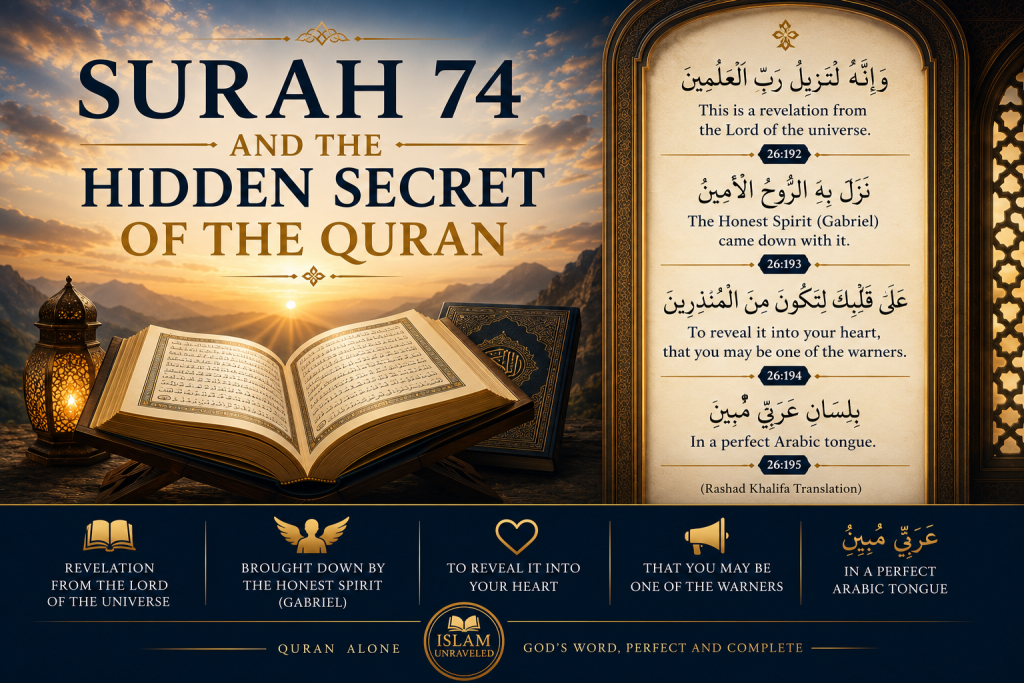
Exploring the deeper meanings of Surah 74 and the Hidden Secret reveals fascinating insights.
Few verses in the Quran have generated as much fascination, controversy, and debate as:
“Over it is nineteen.” (74:30)
At first glance, the statement appears brief and enigmatic. Yet the very next verse assigns extraordinary significance to this number:
“We appointed angels to be guardians of Hell, and we assigned their number only to disturb the disbelievers, to convince the Christians and Jews, to strengthen the faith of the faithful, to remove all traces of doubt from the hearts of Christians, Jews, as well as the believers…” (74:31)
The verse explicitly presents the number nineteen as:
- a test,
- a sign,
- a source of certainty,
- and a means of distinguishing belief from disbelief.
Historically, both traditional Muslim scholarship and modern academic scholarship have struggled to explain:
- why the number nineteen appears,
- what role it serves,
- and why the Quran attributes such extraordinary significance to it.
Traditional exegesis often restricted the number to:
- the nineteen angels guarding Hell.
Modern scholarship has generally approached the passage through:
- literary analysis,
- apocalyptic symbolism,
- Biblical parallels,
- or rhetorical function.
Yet neither approach fully explains the remarkable language of 74:31.
From the perspective of the Quranic proof centered upon the number nineteen, however, the verses function very differently:
not merely as symbolic rhetoric,
but as the disclosure of an internally embedded structural system extending throughout the Quran itself.
This article examines:
- the Quranic text,
- traditional and academic interpretations,
- and the possibility that Surah 74 reveals a mathematically integrated structure within the Quran.
The Quranic Passage
The key verses state:
“Over it is nineteen.” (74:30)
followed immediately by:
“We appointed angels to be guardians of Hell, and we assigned their number only to disturb the disbelievers, to convince the Christians and Jews, to strengthen the faith of the faithful, to remove all traces of doubt from the hearts of Christians, Jews, as well as the believers, and to expose those who harbor doubt in their hearts, and the disbelievers…” (74:31)
Several observations are immediately striking.
The number nineteen is not presented merely as:
- descriptive information.
Rather, it is assigned multiple functions:
- testing,
- convincing,
- strengthening faith,
- removing doubt,
- and exposing disbelief.
The verse itself therefore signals that the number possesses significance extending beyond ordinary numerical reference.
Traditional Interpretations
Classical Muslim commentators generally interpreted the nineteen as:
- the number of angels guarding Hell.
Most traditional exegesis focused primarily upon:
- theological discussion,
- reactions of unbelievers,
- or symbolic meanings.
Some commentators emphasized:
- divine testing,
- while others explored numerological symbolism.
However, classical scholarship generally did not identify:
- a system-wide mathematical structure extending throughout the Quran.
As a result, the broader functions described in 74:31 remained difficult to explain fully.
Why would the number of angels alone:
- strengthen faith,
- remove doubt,
- and convince scriptural communities?
The verse appears to point toward something more substantial.
Modern Academic Approaches
Modern scholarship generally approaches Surah 74 through:
- literary criticism,
- historical context,
- and Late Antique apocalyptic traditions.
Some scholars interpret the number nineteen symbolically, drawing parallels with:
- Biblical numerology,
- Jewish apocalyptic literature,
- or symbolic numeration.
Others view the passage rhetorically:
- as a challenge to skeptics,
- or as part of the Quran’s broader eschatological discourse.
While such approaches offer historical context, they often leave unresolved the central issue:
why the Quran itself assigns such extraordinary epistemological significance to the number.
The passage repeatedly emphasizes:
- certainty,
- proof,
- and removal of doubt.
The language exceeds ordinary symbolic reference.
The Quranic Proof Framework
Within the Quranic proof framework, the number nineteen functions as the organizing principle of an internally embedded mathematical structure spanning the Quran.
Under this framework:
- letter frequencies,
- Quranic initials,
- surah arrangements,
- verse structures,
- and textual patterns
exhibit interconnected numerical relationships based upon multiples of nineteen.
Examples frequently discussed include:
- the total number of surahs,
- Basmalah distribution,
- Quranic initials,
- specific letter frequencies,
- and structural symmetries.
Under this perspective, Surah 74 is not merely referencing nineteen symbolically.
Rather, it is disclosing the existence of the Quran’s internal structural architecture.
Why Surah 74 Is Central
The placement and structure of Surah 74 itself become highly significant under this framework.
The chapter introduces:
- the messenger,
- warning,
- revelation,
- opposition,
- and finally:
the number nineteen.
The sequence culminates in the disclosure of the proof.
Particularly noteworthy is that 74:31 explicitly describes the proof’s functions:
- strengthening believers,
- removing doubt,
- exposing disbelief,
- and convincing People of the Scripture.
The verse therefore functions almost like an interpretive key to the Quran’s internal structure.
The “Hidden Secret”
The title of Surah 74:
Al-Muddaththir
is often translated:
- “The Cloaked One”
or - “The Hidden One.”
Within the Quranic proof framework, the surah takes on additional significance because it introduces what may be understood as:
- a hidden structural feature embedded within the Quran itself.
The proof is not externally imposed upon the Quran.
Rather, it is presented as arising from the Quran’s own internal structure.
This distinction is critically important.
Internal Structure vs External Miracle
Traditional apologetics often emphasized:
- linguistic beauty,
- eloquence,
- or rhetorical power.
While these remain important, the Quranic proof framework shifts the discussion toward:
- internal mathematical integration,
- structural coherence,
- and system-wide precision.
The argument is therefore not merely aesthetic.
It concerns:
- architecture,
- coordination,
- and internally embedded design.
The Role of the Quranic Initials
One of the most significant aspects of the proof framework involves the Quranic initials appearing at the beginning of twenty-nine surahs.
Traditional and modern scholarship alike have struggled to explain these initials satisfactorily.
Within the nineteen-based structure, however, the initials become integral components of the mathematical system.
Thus, phenomena historically treated as:
- isolated anomalies,
- unexplained symbols,
- or literary remnants
become structurally interconnected.
The Problem of Methodology
The broader issue again concerns methodology.
Historical-critical scholarship generally operates within methodological naturalism:
- explanations must remain historically reconstructable and materially grounded.
An internally embedded mathematical structure extending across the Quran naturally falls outside the normal explanatory categories of conventional scholarship.
The issue therefore is not necessarily lack of scholarly rigor, but the methodological boundaries governing permissible explanations.
A Unified Explanatory Framework
One of the most important features of the Quranic proof framework is that it attempts to explain multiple unresolved phenomena simultaneously.
Under this framework:
- the Quranic initials,
- Basmalah distribution,
- verse arrangement,
- spelling anomalies,
- and structural symmetries
become interconnected components of a unified system.
A unified explanatory model possesses analytical significance because it seeks coherence across multiple textual features rather than treating each issue independently.
The Quran’s Self-Presentation
The Quran repeatedly describes itself as:
- protected,
- precise,
- internally coherent,
- and divinely guarded.
“Falsehood cannot enter it, in the past or in the future…” (41:42)
“Had it been from other than GOD, they would have found in it numerous contradictions.” (4:82)
The Quran repeatedly invites readers to examine:
- its signs,
- patterns,
- and consistency.
Within this broader context, Surah 74 functions as an explicit invitation to investigate the Quran’s internal structure.
Part of a Larger Series
This article is part of the series:
Can Modern Scholarship Explain the Quran Without the Quranic Proof?
which examines unresolved Quranic questions in modern scholarship in light of the Quran’s internally coherent structure and the Quranic proof centered upon the number nineteen.
Articles in This Series
- The Quranic Initials and the Mathematical Structure of the Quran
- Why “Becca” Instead of “Mecca”?
- Abrogation in the Quran — Proof or Verse?
- Why Is the Basmalah Missing from Surah 9?
- Did Prophet Muhammad Write the Quran?
- Surah 74 and the Hidden Secret of the Quran
- Purified Sheets and the Messenger After the Prophets
Conclusion
Surah 74 contains one of the Quran’s most enigmatic and consequential statements:
“Over it is nineteen.”
Traditional scholarship generally interpreted the number symbolically in relation to the guardians of Hell, while modern scholarship approached it through:
- literary,
- historical,
- or apocalyptic analysis.
The Quranic proof framework proposes a fundamentally different possibility:
that the number nineteen functions as the organizing principle of an internally embedded mathematical structure extending throughout the Quran.
Under this framework, Surah 74 serves not merely as symbolic rhetoric, but as the disclosure of the Quran’s internal architecture.
Whether one ultimately accepts this conclusion or not, the framework possesses significant analytical importance because it attempts to explain multiple longstanding textual and structural questions through a unified internally Quranic model.
The broader issue therefore concerns not only interpretation, but methodology itself.
Can the Quran contain dimensions of internally coordinated structure that conventional historical-critical scholarship is not presently designed to recognize?
The Quran repeatedly calls readers to examine:
- its signs,
- precision,
- and internal coherence.
Surah 74 may represent the Quran’s most direct invitation to undertake precisely such an examination.