Part of the Series: The Quran, Idolatry, and the Emergence of Sectarian Religion
Introduction
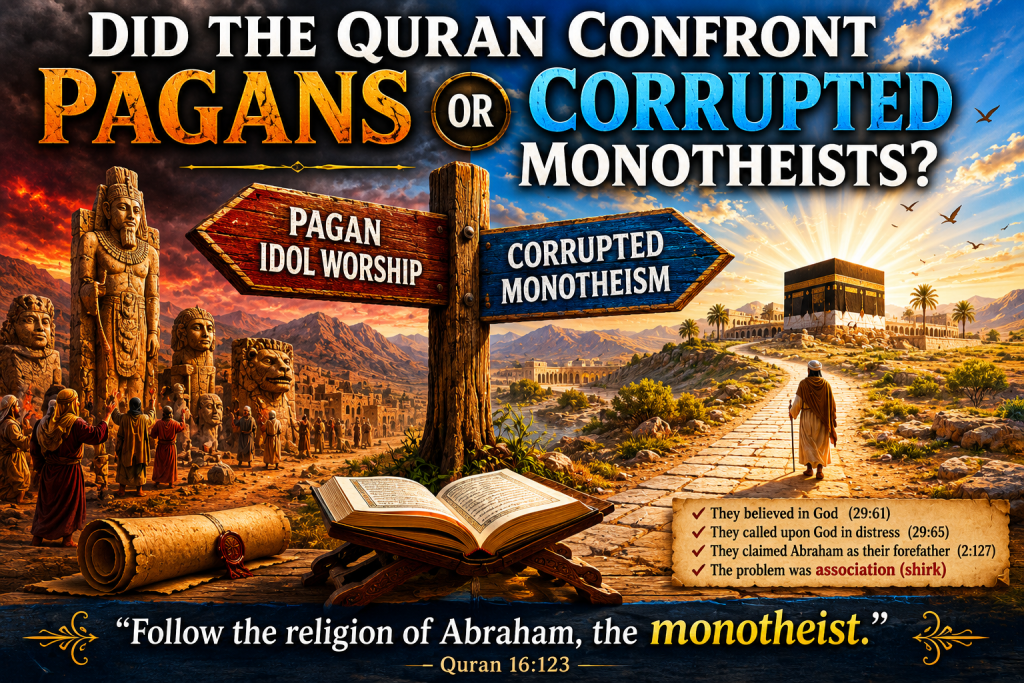
A common understanding of early Islamic history is that Muhammad confronted a society dominated by pagan idol worship. Did the Quran Confront Pagans or Corrupted Monotheists? According to the familiar narrative, the Arabs of western Arabia worshipped numerous idols, filled the Kaaba with statues, and practiced a religion largely disconnected from Abrahamic monotheism.
Yet when we turn to the Quran itself, a different picture begins to emerge.
The Quran’s opponents frequently acknowledge God as Creator. They recognize His power, call upon Him during times of distress, perform pilgrimage, and claim a connection to Abraham.
This raises an important question:
Did the Quran primarily confront pagans who knew little about God, or did it confront communities that had inherited elements of Abraham’s religion but had corrupted them over time?
The answer may help us better understand both the Quran’s message and the recurring pattern of religious corruption described throughout scripture.
The Quran’s Opponents Believed in God
One of the most striking features of the Quran is that its opponents are rarely portrayed as denying God’s existence.
The Quran repeatedly states:
If you ask them who created the heavens and the earth, they will say, “God.” (29:61)
If you ask them who created the heavens and the earth, they will say, “God.” (31:25)
If you ask them who created the heavens and the earth, they will say, “God.” (39:38)
These are not descriptions of atheists.
Nor are they descriptions of people unfamiliar with the Creator.
The Quran’s opponents already believed in God.
They Called Upon God Sincerely
The Quran also tells us that in moments of danger they turned directly to God.
When they ride aboard a ship, they implore God sincerely, devoting the religion entirely to Him. But when He saves them to the shore, they revert. (29:65)
This is a remarkable description.
In times of crisis they recognized that only God could save them.
The problem was not ignorance of God.
The problem was what happened after the crisis passed.
They Claimed Abraham as Their Heritage
The Quran repeatedly links Muhammad’s mission to Abraham.
God commands:
Follow the religion of Abraham, the monotheist. (16:123)
The Kaaba itself is connected to Abraham and Ishmael.
Abraham and Ishmael raised the foundations of the House. (2:127)
Pilgrimage is also linked to Abraham.
Proclaim the pilgrimage among the people. (22:27)
These references suggest that Abraham’s legacy was already known.
Muhammad was not introducing Abraham to the people.
He was calling them back to Abraham’s original monotheism.
The Quran’s Main Criticism
When the Quran criticizes its opponents, the emphasis is often surprising.
The primary accusations are not:
- atheism,
- denial of God,
- ignorance of Abraham.
Instead, the Quran repeatedly condemns:
- association (shirk),
- inherited traditions,
- fabricated religious laws,
- intercessors,
- following forefathers,
- religious authority besides God.
For example:
Shall I seek other than God as a source of law when He has revealed to you this Book fully detailed? (6:114)
And:
Or do they have partners who legislate for them religious laws never authorized by God? (42:21)
The struggle described by the Quran is fundamentally about authority and worship.
Where Are the Statues?
An interesting observation emerges when we examine the Quran’s references to physical idols.
The Quran clearly mentions idols in the stories of:
- Abraham (6:74; 21:52-58),
- Moses and the calf (7:138; 20:88),
- Elias and Baal (37:125).
However, when discussing Muhammad’s contemporaries, the Quran rarely focuses on physical statues.
Traditional narratives often emphasize a Kaaba filled with idols, yet the Quran itself does not mention such physical statues as idols..
Instead, its arguments concentrate on religious corruption, association, and deviation from revelation.
The emphasis is theological rather than archaeological.
A Pattern Repeated Throughout History
The Quran presents a recurring historical pattern.
Noah
People abandoned God’s guidance and elevated others for devotion.
Abraham
His society inherited beliefs that had become corrupted.
Moses
The Israelites repeatedly introduced innovations and deviations.
Jesus
His message was altered after him.
Muhammad
His audience inherited religious practices that no longer reflected pure monotheism.
The Quran’s narrative is remarkably consistent.
The problem is not simply paganism.
The problem is corruption of revelation.
The Corruption of Abraham’s Religion
The Quran describes Abraham as neither Jew nor Christian.
Abraham was neither a Jew nor a Christian; he was a monotheist submitter. (3:67)
This suggests that religious labels and institutions emerged later.
Abraham’s original submission to God became surrounded by later traditions, identities, and doctrines.
Muhammad’s mission was therefore not merely to oppose idol worship.
It was to restore Abraham’s original devotion to God alone.
A Lesson for Every Generation
Perhaps the most important lesson is that corruption is not confined to ancient history.
Every community begins with revelation.
Over time:
- Traditions accumulate.
- Authorities emerge.
- Human opinions gain sacred status.
- Revelation becomes obscured.
The Quran repeatedly warns that this cycle has occurred before.
There is no reason to assume any religious community is immune from it.
Conclusion
The Quran certainly condemns idolatry and association.
Yet its own descriptions suggest that Muhammad’s opponents were not people who denied God altogether.
They believed in God.
They acknowledged His power.
They claimed a connection to Abraham.
Their error was not the absence of monotheism but its corruption.
The Quran’s primary mission was therefore not simply to replace paganism with belief in God.
Its mission was to restore pure devotion to God alone.
That distinction is important because it transforms how we understand both the past and the present.
The Quran’s challenge is not merely to believe in God.
It is to worship Him alone, follow His revelation alone in matters of religion, and avoid elevating anything alongside Him.
Related Reading
If you found this article helpful, you may also enjoy:
- Who Were the Mushrikeen in the Quran? – Examining whether the Quran’s opponents were merely idol worshippers or something more complex.
- The Forgotten Meaning of Idolatry – How the Quran’s concept of shirk extends beyond statues and physical idols.
- Did the Quran Confront Pagans or Corrupted Monotheists? – Exploring the religious landscape addressed by the Quran.
- From Believers to Sectarian Islam – How a movement centered on believers and submitters became associated with sectarian identities.
- The Kaaba Before Muhammad: What Does the Quran Actually Say? – Investigating Abraham’s sanctuary through the Quran’s own testimony.
- How Did the Traditional Story of Pagan Arabia Arise? – Comparing the traditional narrative with the Quran’s emphasis.
- The Idols of Noah and the Idols of Arabia: What Does the Quran Say? – Examining what the Quran actually reveals about ancient idols and religious corruption.