Part of the Series: The Quran, Idolatry, and the Emergence of Sectarian Religion
Introduction
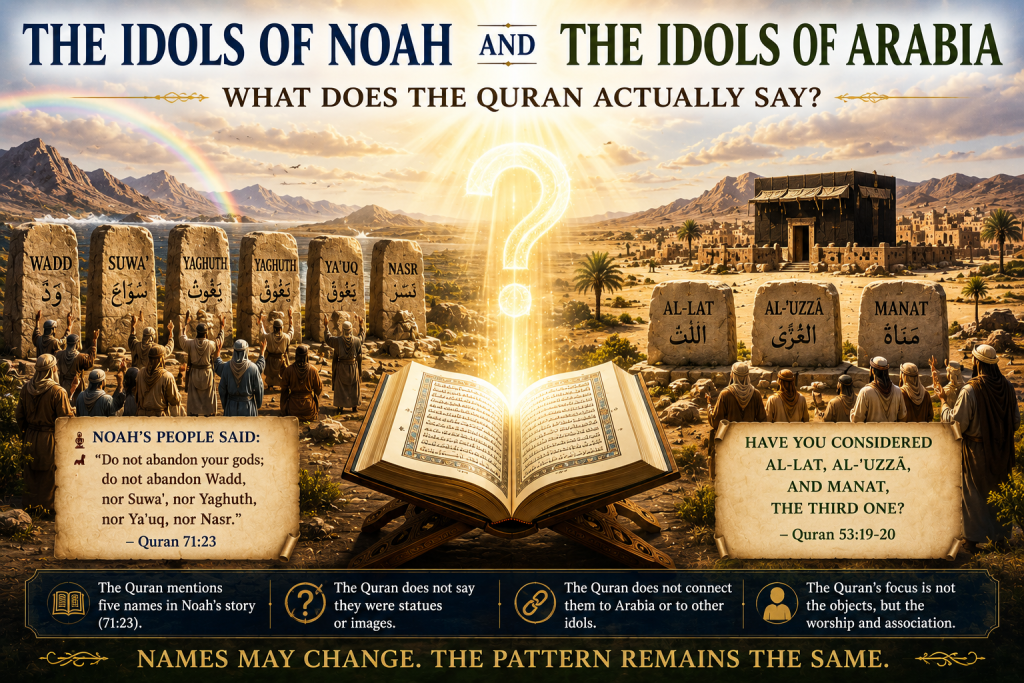
One of the most familiar stories found in traditional Islamic literature concerns five famous idols of Noah:
- Wadd
- Suwa’
- Yaghuth
- Ya’uq
- Nasr
According to the traditional narrative, these names first belonged to righteous individuals who lived before Noah. Over time, statues were erected in their honor, eventually becoming objects of worship. The same idols, we are told, survived through the centuries and later appeared among the Arabs before Muhammad.
The story is widely repeated.
But what does the Quran actually say?
The answer is surprisingly brief.
The Quran mentions these five names only once, and it does not tell us many of the details that later became central to the traditional narrative.
This raises an important question:
Does the Quran connect the idols of Noah’s people with the religious practices of Muhammad’s contemporaries?
What the Quran Actually Says
The names appear in Noah’s account.
The leaders of Noah’s people said:
“Do not abandon your gods; do not abandon Wadd, nor Suwa’, nor Yaghuth, nor Ya’uq, nor Nasr.” (71:23)
This verse provides several pieces of information.
Certain Facts
The five names:
- Wadd
- Suwa’
- Yaghuth
- Ya’uq
- Nasr
were regarded as gods by Noah’s people.
The people were encouraged to continue their devotion to them.
This much is clear.
What the Verse Does Not Say
The verse does not say:
- they were statues,
- they were images,
- they were carvings,
- they were formerly righteous men,
- they survived until Muhammad’s time.
None of these details appear in the Quran.
The verse simply preserves five names.
Were They Statues?
This is an important question.
From the Quran alone, the answer is uncertain.
The Quran calls them:
“your gods” (71:23)
But it never identifies them as physical statues.
This is significant because the Quran clearly uses specific terms elsewhere when discussing physical idols.
Abraham’s People
“What are these statues to which you are devoted?” (21:52)
Abraham’s Father
“Do you take idols as gods?” (6:74)
In these passages, the Quran explicitly identifies physical objects.
In 71:23, however, the Quran merely preserves five names.
Therefore, from the Quran alone, we cannot confidently state that Wadd, Suwa’, Yaghuth, Ya’uq, and Nasr were statues.
They were certainly objects of devotion.
Whether they were physical idols, symbolic figures, revered ancestors, or something else is not explained.
Does the Quran Connect Them to Arabia?
This is where the discussion becomes particularly interesting.
The Quran never states that these five names existed among Muhammad’s contemporaries.
The Quran never says:
- Wadd survived into Arabia,
- Suwa’ survived into Arabia,
- Yaghuth survived into Arabia,
- Ya’uq survived into Arabia,
- Nasr survived into Arabia.
The connection commonly found in traditional literature is absent from the Quran itself.
The Quran simply leaves the matter there.
The Three Names in Surah 53
The Quran does mention three other names:
Have you considered Al-Lat, Al-‘Uzza, and Manat, the third one? (53:19-20)
These names are often assumed to be idols.
What is important for our discussion is that they are completely different names from those found in Noah’s account.
Notice:
Noah’s Account
- Wadd
- Suwa’
- Yaghuth
- Ya’uq
- Nasr
Surah 53
- Al-Lat
- Al-‘Uzza
- Manat
The Quran itself never links these two groups.
The connection appears only in later interpretations.
Why Does the Quran Preserve the Names?
If the identities of these figures are not explained, why mention them at all?
The answer may lie in the Quran’s broader message.
The focus is not historical detail.
The focus is religious corruption.
The verse demonstrates how people can become attached to objects of devotion and resist abandoning them even after receiving divine guidance.
The names themselves are secondary.
The lesson is primary.
A Repeated Pattern
The Quran repeatedly describes the same process.
Noah
People became attached to other objects of devotion.
Abraham
People inherited practices from their forefathers.
Moses
The Israelites desired visible objects of worship.
Muhammad
People followed inherited traditions and associated partners with God.
The names change.
The pattern remains the same.
The Quran’s Real Concern
An interesting observation emerges.
The Quran rarely focuses on the physical nature of idols.
Instead, it repeatedly focuses on:
- association,
- inherited tradition,
- devotion directed elsewhere,
- authority besides God.
The revelation is less concerned with the shape of an idol than with the act of elevating something beside God.
This helps explain why the Quran provides very little detail about the five names in Noah’s story.
The details are not the point.
The warning is the point.
A Lesson for Modern Readers
Many readers become fascinated by the historical identity of Wadd, Suwa’, Yaghuth, Ya’uq, and Nasr.
The Quran itself does not pursue that discussion.
Instead, it directs attention to a more important question:
What are the objects of devotion in our own lives?
Anything elevated alongside God can become part of the same pattern that the Quran repeatedly condemns.
The names may differ.
The principle does not.
Conclusion
The Quran mentions Wadd, Suwa’, Yaghuth, Ya’uq, and Nasr only once.
It identifies them as gods worshipped by Noah’s people.
Beyond that, the Quran says remarkably little.
It does not explicitly identify them as statues.
It does not explain their origins.
It does not connect them to Muhammad’s contemporaries.
It does not connect them to Al-Lat, Al-‘Uzza, or Manat.
Those connections belong to later traditions, not to the Quranic text itself.
The Quran’s focus is elsewhere.
Its concern is not preserving the history of ancient idols.
Its concern is warning every generation about the danger of elevating anything alongside God.
That warning remains as relevant today as it was in the time of Noah.
Related Reading
If you found this article helpful, you may also enjoy:
- Who Were the Mushrikeen in the Quran? – Examining whether the Quran’s opponents were merely idol worshippers or something more complex.
- The Forgotten Meaning of Idolatry – How the Quran’s concept of shirk extends beyond statues and physical idols.
- Did the Quran Confront Pagans or Corrupted Monotheists? – Exploring the religious landscape addressed by the Quran.
- From Believers to Sectarian Islam – How a movement centered on believers and submitters became associated with sectarian identities.
- The Kaaba Before Muhammad: What Does the Quran Actually Say? – Investigating Abraham’s sanctuary through the Quran’s own testimony.
- How Did the Traditional Story of Pagan Arabia Arise? – Comparing the traditional narrative with the Quran’s emphasis.
- The Idols of Noah and the Idols of Arabia: What Does the Quran Say? – Examining what the Quran actually reveals about ancient idols and religious corruption.