Introduction
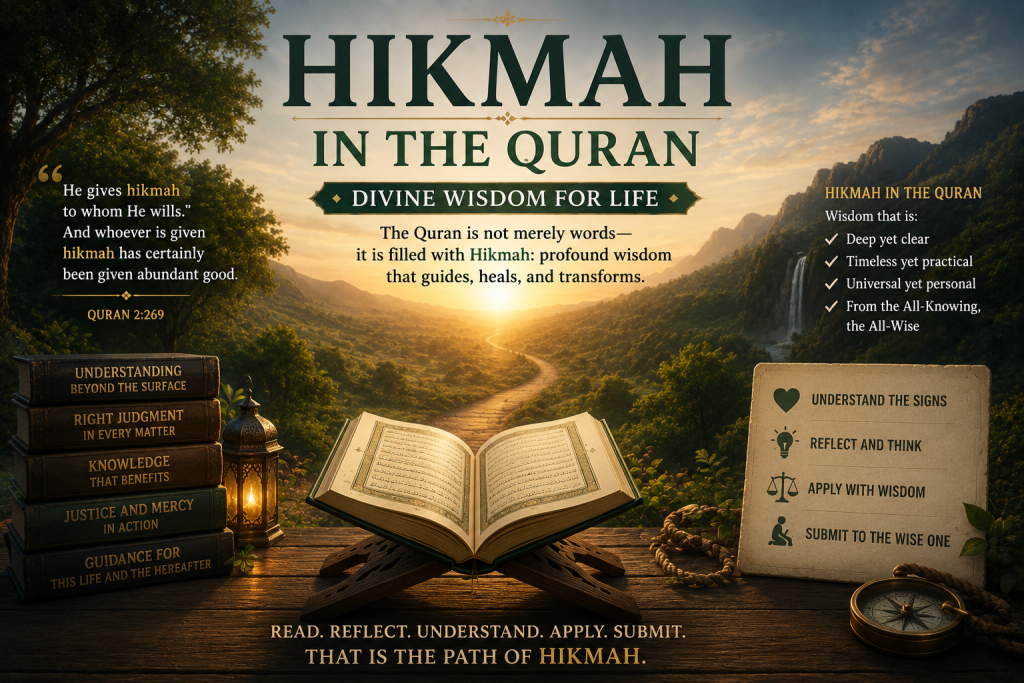
The term “Hikmah” in the Quran appears frequently and is often translated as wisdom. While this translation captures part of its meaning, it does not fully convey the depth and function of the term within the Quranic framework.
A significant issue arises when Hikmah is defined outside the Quran, leading to conclusions that are not supported by the text itself.
This article examines Hikmah through the Quran alone, its linguistic root, its usage, and the meaning it conveys within the Quran’s own system.
The Linguistic Root of Hikmah
The word Hikmah comes from the root:
ḥ-k-m (ح ك م)
This root conveys the ideas of:
- judging
- governing
- restraining from error
From this, Hikmah carries meanings such as:
- sound judgment
- wisdom grounded in truth
- correct application of knowledge
It is not merely theoretical knowledge, it is knowledge applied correctly.
Hikmah in the Quran: A Pattern of Usage
A recurring phrase in the Quran is:
“the Book and the Hikmah”
(2:129, 2:151, 3:164, 62:2)
This pairing is central to understanding Hikmah.
The key question is:
Is Hikmah a second source of revelation, or is it something derived from the Book itself?
Hikmah and the Kitab
As explained in our article on Al-Kitab in the Quran: meaning and context, the Kitab refers to divine revelation—what is given by God as guidance.
Hikmah, when paired with Kitab, represents:
the correct understanding and application of that revelation
This means:
- Kitab = the message
- Hikmah = the proper use of the message
Hikmah is not independent, it is dependent on the Kitab.
Hikmah as a Divine Gift
The Quran states:
“Whoever is granted Hikmah has been granted great good.” (2:269)
It also mentions:
- Luqman was given Hikmah (31:12)
- David was given Hikmah (38:20)
This shows:
- Hikmah is granted by God
- It is not tied to a separate text
- It is not restricted to one individual or tradition
Hikmah as Judgment and Decision-Making
Hikmah is also associated with judgment:
- making correct decisions
- applying divine law appropriately
This reflects its root meaning:
to judge rightly and avoid error
Hikmah is therefore:
- practical
- applied
- grounded in divine guidance
The Quran as the Source of Hikmah
The Quran describes itself as:
As discussed in our article on the Quran as the sole source of guidance, the Quran presents itself as complete in matters of law and guidance.
Therefore:
Hikmah must emerge from the Quran itself, not from an external source.
Hikmah and the Unity of the Quran’s Message
The Quran consistently:
- explains itself
- clarifies its concepts
- connects its verses
This is further explored in our discussion on truth and falsehood in the Quran, where clarity comes from understanding the text as a unified whole.
Hikmah is the outcome of this process:
- understanding
- reflection
- correct application
A Critical Misinterpretation: Hikmah as “Sunnah”
A common claim is:
Hikmah = the Sunnah of the Prophet
This conclusion presents several problems when examined through the Quran.
1. The Quran Never Defines Hikmah This Way
There is no verse in the Quran that equates:
Hikmah with Sunnah
If this were a central concept, it would be stated clearly.
2. The Quran Uses “Sunnah” Only for God
The word Sunnah in the Quran appears as:
“Sunnat Allah” (the system/law of God)
As explained in our article on returning to the Quran as the primary source, the Quran does not refer to a “Sunnah of the Prophet” as a separate authority.
3. Hikmah Is Given Beyond One Individual
Verses such as:
show that Hikmah is granted broadly.
It is not tied to:
- one person
- one set of actions
- or a secondary body of teachings
4. Logical Implication
If Hikmah were a second source of law:
the Quran would not describe itself as fully detailed (6:114)
This would create a contradiction.
Consequences of Misinterpreting Hikmah
Equating Hikmah with an external body of teachings leads to:
- introduction of secondary authority
- weakening of the Quran’s completeness
- confusion between source and application
The Quran’s Self-Contained System
The Quran provides:
- the message (Kitab)
- the explanation (75:19)
- the application (Hikmah)
This forms a complete and coherent system.
Conclusion
Hikmah in the Quran is not a separate body of teachings. It is:
- wisdom
- sound judgment
- correct application
Derived from the Quran itself
The relationship is clear:
- Kitab is revelation/scripture
- Hikmah is understanding and application
The Quran is the source of guidance, and Hikmah is the proper use of that guidance.