The Quran, Literacy, Writing, and the Question of Authorship
Introduction
One of the central questions in both Islamic theology and modern Quranic scholarship concerns the relationship between Prophet Muhammad and the Quran itself.
Did prophet Muhmmad compose the Quran?
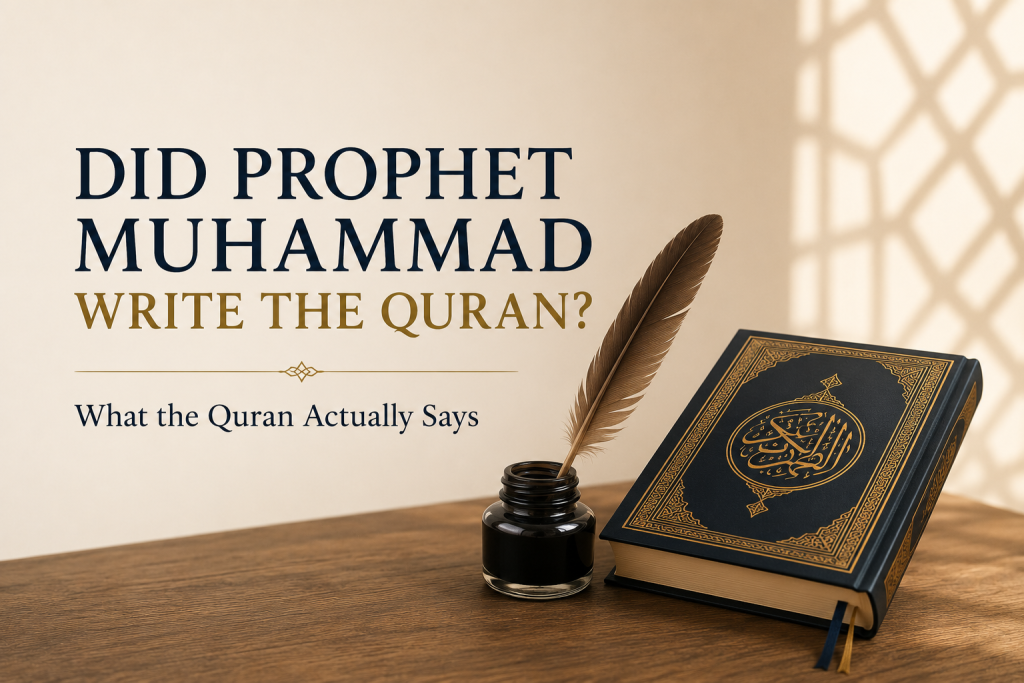
Did Prophet Muhammad write the Quran?
Was the Quran gradually authored through reflection, adaptation, and religious experience?
Or does the Quran present itself as revelation fundamentally distinct from ordinary human composition?
Modern academic scholarship has approached these questions through:
- historical-critical analysis,
- literary development,
- oral composition theory,
- and the religious environment of Late Antiquity.
Traditional Islamic scholarship, meanwhile, often emphasized Muhammad’s alleged illiteracy as evidence that he could not have authored the Quran himself.
The issue, however, is considerably more nuanced than the simple question:
“Could Muhammad read or write?”
The Quran itself presents a broader framework involving:
- revelation,
- recitation,
- writing,
- preservation,
- and internally integrated structure.
This article examines:
- the Quran’s own presentation of Muhammad,
- the meaning of the term ummi,
- the Quran’s emphasis upon writing,
- modern scholarly discussions,
- and the implications of the Quranic proof centered upon the number nineteen.
The broader issue is not merely literacy.
It is whether the Quran exhibits features exceeding ordinary human literary production altogether.
The Traditional View of Illiteracy
Classical Islamic tradition generally held that Muhammad was:
- unable to read,
- unable to write,
- and entirely dependent upon revelation.
This interpretation centered primarily upon verses such as:
“You did not read any scripture before this, nor did you write it with your hand…” (29:48)
Traditional theology viewed Muhammad’s supposed illiteracy as evidence of:
- divine revelation,
- miraculous authorship,
- and protection against accusations of copying earlier scriptures.
Under this framework, the Quran’s extraordinary literary quality was seen as especially miraculous because it emerged through someone traditionally described as:
unlettered.
However, the Quran itself presents a more nuanced picture.
The Meaning of “Ummi”
A central issue concerns the Quranic term:
ummi
Traditional translations frequently render the word as:
- illiterate,
- unlettered,
- or unschooled.
Yet the Quran’s own usage suggests a broader meaning.
For example:
“Among them are gentiles (ummiyyun) who do not know the scripture…” (2:78)
The term here clearly refers collectively to people outside scriptural tradition rather than merely individuals incapable of reading.
Similarly:
“Say to those who received the scripture and to the gentiles (ummiyyin)…” (3:20)
Again, the contrast is between:
- scriptural communities,
and - non-scriptural communities.
Likewise:
“He is the One who sent among the gentiles (ummiyyin) a messenger from among them…” (62:2)
The Quran therefore appears to use ummi primarily in the sense of:
- gentile,
- non-scriptural,
- or outside previous revealed communities,
rather than necessarily:
illiterate.
This distinction is significant because much traditional apologetics depended heavily upon reducing the word exclusively to illiteracy.
The Quran’s Emphasis on Writing and the Pen
The earliest revelations themselves place remarkable emphasis upon:
- reading,
- writing,
- and the pen.
The first revelation states:
“Read, in the name of your Lord who created… Your Lord is the Most Generous. He teaches by means of the pen.” (96:1–4)
The second revelation begins:
“Noon. By the pen and what they write.” (68:1)
The Quran therefore introduces:
- writing,
- recording,
- and preservation
at the very beginning of revelation itself.
This emphasis becomes difficult to reconcile with simplistic assumptions that writing played little or no role in the transmission of revelation.
What Does the Quran Actually Say?
Importantly, the Quran never explicitly states:
“Muhammad could neither read nor write.”
What the Quran states is more specific:
“You did not read any scripture before this, nor did you write it with your hand…” (29:48)
The verse primarily addresses:
- prior scriptural study,
- and accusations of copying earlier revelation.
Its central function appears apologetic:
to rebut claims that Muhammad simply reproduced earlier scriptures through prior literary dependence.
The issue therefore is not merely literacy itself, but:
- independent authorship,
- scriptural borrowing,
- and revelation.
The Significance of 25:5
Another important verse records accusations made by Muhammad’s opponents:
“They also said, ‘Tales from the past that he wrote down; they are being dictated to him day and night.’” (25:5)
Whether hostile or not, the accusation itself presupposes:
- writing,
- recording,
- and textual activity.
The statement would possess little coherence if Muhammad were universally understood as entirely incapable of writing.
At minimum, the verse suggests that Muhammad’s contemporaries did not regard the question as self-evident.
Modern Academic Approaches
Modern scholarship generally approaches the Quran within the broader literary and religious environment of Late Antiquity.
Scholars investigate:
- oral transmission,
- Biblical intertextuality,
- poetic structures,
- communal proclamation,
- and the gradual emergence of the Quranic text.
Within academic methodology, the Quran is usually analyzed as:
- historical discourse,
- religious proclamation,
- or evolving oral composition.
Importantly, modern scholarship generally does not treat:
- divine revelation,
- miraculous structure,
- or internally embedded mathematical coordination
as explanatory categories.
As a result, discussions of authorship remain confined primarily to:
- human literary production,
- oral culture,
- and historical context.
The Quran’s Distinctive Self-Presentation
The Quran repeatedly presents itself as fundamentally distinct from ordinary human speech.
“Had all the humans and all the jinn banded together in order to produce a Quran like this, they could never produce anything like it…” (17:88)
The Quran repeatedly challenges critics to:
- produce a comparable surah,
- identify contradictions,
- or explain its structure.
“Had it been from other than GOD, they would have found in it numerous contradictions.” (4:82)
The Quran’s claim therefore transcends merely:
- literary eloquence,
or - rhetorical beauty.
Its deeper claim concerns:
- coherence,
- structure,
- precision,
- and divine origin.
The Quranic Proof and Mathematical Structure
The discussion changes substantially under the Quranic proof framework centered upon the number nineteen.
Within this framework, the Quran exhibits:
- intricate structural relationships,
- mathematically integrated patterns,
- coordinated letter frequencies,
- and interconnected textual architecture extending throughout the Quran.
Examples include:
- the Quranic initials,
- Basmalah distribution,
- structural symmetries,
- verse placement,
- and numerical relationships.
If such a structure exists intentionally across the Quranic corpus, the authorship question acquires a fundamentally different dimension.
The issue would no longer concern merely:
- whether Muhammad possessed ordinary literacy,
or - whether oral composition occurred.
Rather, the question becomes whether a seventh-century human environment could deliberately generate an internally integrated mathematical structure spanning the entire Quran.
The Question of Compilation and Arrangement
Modern scholarship frequently emphasizes:
- compilation history,
- recension,
- manuscript development,
- and textual stabilization.
Yet an internally integrated mathematical structure presupposes:
- deliberate preservation,
- coordinated arrangement,
- and textual integrity.
Within the Quranic proof framework, the Quran’s final arrangement itself becomes significant evidence of internally coherent design.
This differs substantially from viewing the Quran primarily as:
- evolving oral tradition,
- editorial layering,
- or gradually accumulated proclamation.
The Miracle Beyond Illiteracy
One of the important implications of this discussion is that the Quran’s extraordinary nature does not depend solely upon the assumption of Muhammad’s illiteracy.
Even if Muhammad possessed ordinary literacy or participated in the written preservation of revelation, this would still not explain:
- the Quran’s structural integration,
- mathematical architecture,
- internal coherence,
- or sustained textual precision.
The central issue therefore moves beyond simplistic apologetic formulations.
The Quranic challenge is ultimately structural and revelatory rather than merely biographical.
Methodological Boundaries
The broader disagreement again concerns methodology.
Historical-critical scholarship generally operates within methodological naturalism:
- explanations must remain historically reconstructable and humanly generated.
An internally embedded mathematical structure extending throughout the Quran naturally falls outside such explanatory frameworks.
The issue therefore is not necessarily lack of scholarly rigor, but the boundaries imposed by methodology itself.
The Quran and Human Limitation
The Quran repeatedly presents revelation as transcending ordinary human capability.
“Falsehood cannot enter it, in the past or in the future…” (41:42)
The Quran’s self-presentation is not simply:
- inspired wisdom,
or - elevated poetry.
It presents itself as:
- protected,
- precise,
- internally coherent,
- and divinely guarded.
The authorship question therefore ultimately concerns the nature of the Quran itself.
Part of a Larger Series
This article is part of the series:
Can Modern Scholarship Explain the Quran Without the Quranic Proof?
which examines unresolved Quranic questions in modern scholarship in light of the Quran’s internally coherent structure and the Quranic proof centered upon the number nineteen.
Articles in This Series
- The Quranic Initials and the Mathematical Structure of the Quran
- Why “Becca” Instead of “Mecca”?
- Abrogation in the Quran — Proof or Verse?
- Why Is the Basmalah Missing from Surah 9?
- Did Prophet Muhammad Write the Quran?
- Surah 74 and the Hidden Secret of the Quran
- Purified Sheets and the Messenger After the Prophets
Conclusion
The question:
“Did Prophet Muhammad write the Quran?”
cannot be reduced merely to whether Muhammad possessed ordinary literacy.
The Quran itself presents a much broader and deeper claim:
that the revelation transcends ordinary human literary production altogether.
The Quran’s own terminology suggests that ummi refers primarily to:
- non-scriptural or gentile background,
rather than necessarily: - absolute illiteracy.
The Quran also repeatedly emphasizes:
- writing,
- the pen,
- recording,
- and preservation.
Meanwhile, modern scholarship continues to investigate:
- oral transmission,
- literary development,
- and historical context.
The Quranic proof centered upon the number nineteen introduces an additional dimension:
the possibility of an internally integrated mathematical structure extending throughout the Quran.
If such a structure exists intentionally, the discussion moves far beyond:
- rhetoric,
- oral culture,
- or literary talent alone.
The broader question then becomes whether the Quran contains dimensions of internally coordinated design exceeding the explanatory reach of conventional historical-critical models.
The Quran repeatedly invites examination of:
- its signs,
- precision,
- consistency,
- and internal coherence.
The question of authorship therefore ultimately returns to the Quran itself:
What kind of text is the Quran?