Part of the Series: The Quran, Idolatry, and the Emergence of Sectarian Religion
Introduction
Ask a Muslim what the Kaaba was like before Muhammad, and the answer is often immediate.
The Kaaba, we are told, was surrounded by idols. Pagan Arabs filled it with statues and images. Muhammad eventually purified the sanctuary by destroying hundreds of idols and restoring Abraham’s monotheism.
This narrative is deeply familiar.
But what happens if we set aside later historical accounts for a moment and ask a simple question:
What does the Quran itself tell us about the Kaaba before Muhammad?
The answer is both fascinating and surprising.
The Quran speaks extensively about the Kaaba, Abraham, pilgrimage, and the sacred sanctuary. Yet it says remarkably little about many of the details commonly associated with the traditional story.
Understanding what the Quran does—and does not—say can help us better understand the nature of Muhammad’s mission.
The Kaaba Predates Muhammad
The Quran clearly teaches that the Kaaba existed long before Muhammad.
God says:
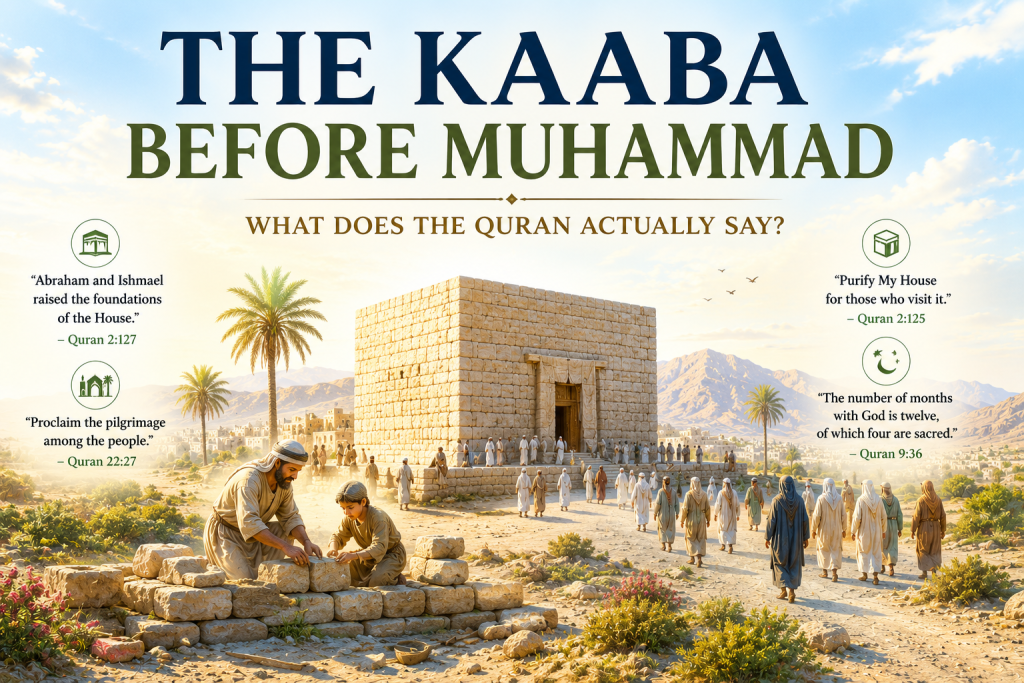
Abraham and Ishmael raised the foundations of the House. (2:127)
The Quran presents the Kaaba not as a new institution but as an ancient sanctuary associated with Abraham and Ishmael.
The House was already established centuries before Muhammad’s birth.
The Kaaba Was Established for Monotheism
The Quran repeatedly connects the sanctuary with worship of God alone.
God instructed Abraham:
Purify My House for those who visit it, those who stay there, and those who bow and prostrate. (2:125)
And:
We assigned Abraham the location of the House: “Do not associate anything with Me.” (22:26)
The original purpose of the Kaaba was clear.
It was established as a center of monotheistic worship.
Pilgrimage Existed Before Muhammad
The Quran presents pilgrimage as an existing institution rather than a new practice introduced by Muhammad.
God commanded Abraham:
Proclaim the pilgrimage among the people. (22:27)
This implies continuity.
Pilgrimage was already part of Abraham’s religious legacy.
Muhammad’s role was not to invent pilgrimage but to restore its proper purpose.
The Sacred Months Already Existed
The Quran also confirms the existence of sacred months.
The number of months with God is twelve, of which four are sacred. (9:36)
The Quran criticizes the manipulation of these months but does not introduce them as something new.
Like pilgrimage, they appear to have been inherited from an earlier tradition.
The Quran’s Surprising Silence
Given the prominence of the traditional narrative, one fact stands out.
The Quran says surprisingly little about idols in the Kaaba.
The Quran discusses physical idols in other contexts.
Abraham
Do you take idols as gods? (6:74)
Abraham’s People
What are these statues to which you are devoted? (21:52)
Moses
O Moses, make for us a god just as they have gods. (7:138)
The Golden Calf
Elias
Do you call upon Baal? (37:125)
The Quran clearly knows how to discuss physical idols when it wishes to do so.
Yet when speaking about the Kaaba and Muhammad’s mission, the emphasis is different.
What Does the Quran Criticize?
Rather than focusing on statues, the Quran repeatedly criticizes:
- association (shirk),
- inherited traditions,
- fabricated religious laws,
- religious authority besides God,
- intercessors,
- following forefathers.
The Quran’s opponents are portrayed as people who:
- believed in God,
- acknowledged Him as Creator,
- called upon Him during times of distress.
The central issue was not ignorance of God.
The issue was association.
Abraham’s Religion Had Been Corrupted
The Quran repeatedly describes Muhammad as restoring Abraham’s religion.
Follow the religion of Abraham, the monotheist. (16:123)
This language is significant.
You restore something that already exists.
The Quran’s message suggests continuity rather than replacement.
The problem was not the absence of Abraham’s religion.
The problem was its corruption.
The Kaaba’s Original Function
The Quran repeatedly highlights the Kaaba’s role as:
- a sanctuary,
- a place of pilgrimage,
- a center of monotheism,
- a symbol of Abraham’s legacy.
The first sanctuary established for the people was the one at Bakkah. (3:96)
This description emphasizes blessing, guidance, and devotion to God.
The Quran never presents the Kaaba as originally pagan.
Rather, it presents it as originally monotheistic.
Why the Quran’s Emphasis Matters
The Quran’s focus may reveal something important.
The revelation is far less interested in describing the physical contents of the sanctuary than in addressing the spiritual corruption surrounding it.
The central problem is not architecture.
The central problem is worship.
The Quran’s concern is not primarily what stood inside the sanctuary.
Its concern is whether people devoted their religion to God alone.
A Lesson for Today
The Quran’s treatment of the Kaaba carries an important lesson.
Religious corruption does not necessarily begin with abandoning God entirely.
Often it begins with adding partners, intermediaries, traditions, and authorities alongside Him.
This pattern appears throughout scripture.
It occurred before Noah.
It occurred before Abraham.
It occurred before Moses.
It occurred before Jesus.
And according to the Quran, it had occurred before Muhammad.
The physical form may change.
The principle remains the same.
Conclusion
The Quran presents the Kaaba as an ancient sanctuary established by Abraham and Ishmael for the worship of God alone.
It confirms the existence of pilgrimage, sacred months, and monotheistic practices long before Muhammad.
At the same time, the Quran devotes surprisingly little attention to details that later became central to popular narratives.
Instead, its focus remains consistent:
The true struggle was not merely against physical objects.
It was against association, religious corruption, and devotion directed toward anything besides God.
The Kaaba before Muhammad was not portrayed by the Quran as a pagan invention.
It was portrayed as an Abrahamic sanctuary whose original purpose had been obscured.
Muhammad’s mission was therefore not to create something new.
It was to restore what had been forgotten.
Related Reading
If you found this article helpful, you may also enjoy:
- Who Were the Mushrikeen in the Quran? – Examining whether the Quran’s opponents were merely idol worshippers or something more complex.
- The Forgotten Meaning of Idolatry – How the Quran’s concept of shirk extends beyond statues and physical idols.
- Did the Quran Confront Pagans or Corrupted Monotheists? – Exploring the religious landscape addressed by the Quran.
- From Believers to Sectarian Islam – How a movement centered on believers and submitters became associated with sectarian identities.
- The Kaaba Before Muhammad: What Does the Quran Actually Say? – Investigating Abraham’s sanctuary through the Quran’s own testimony.
- How Did the Traditional Story of Pagan Arabia Arise? – Comparing the traditional narrative with the Quran’s emphasis.
- The Idols of Noah and the Idols of Arabia: What Does the Quran Say? – Examining what the Quran actually reveals about ancient idols and religious corruption.