Reconsidering One of the Longest Unresolved Questions in Quranic Studies
Introduction
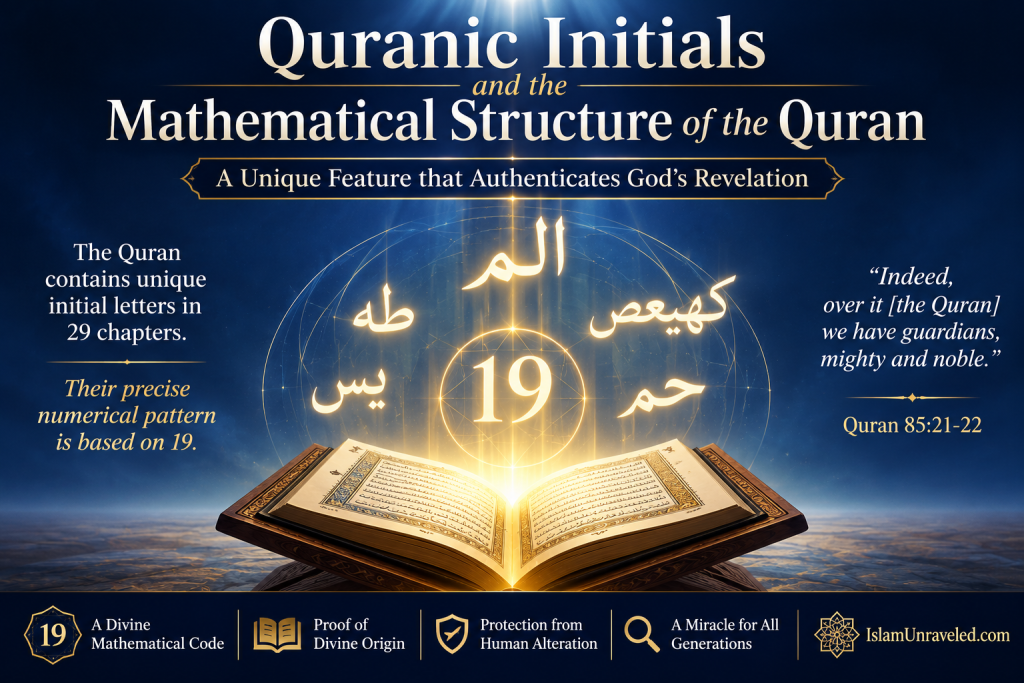
Among the most enduring unresolved questions in Quranic studies are the disconnected or enigmatic letters that appear at the beginning of twenty-nine surahs of the Quran called the Quranic initials.
Examples include:
- Alif Lam Meem (2:1)
- Kaf Ha Ya ‘Ayn Sad (19:1)
- Ya Seen (36:1)
- Qaf (50:1)
- Noon (68:1)
These letters — often referred to in Western scholarship as “mysterious letters” or “isolated letters” — have generated centuries of discussion among:
- traditional Muslim commentators,
- linguists,
- historians,
- and modern academic scholars.
Despite extensive commentary, no universally accepted explanation has emerged.
Traditional Islamic exegesis frequently concludes that:
“God alone knows their meaning.”
Modern scholarship has proposed numerous theories:
- scribal abbreviations,
- liturgical markers,
- mystical symbolism,
- numerical notation,
- ownership marks,
- or remnants of oral recitation practices.
Yet none of these explanations has achieved scholarly consensus.
The unresolved nature of the initials raises an important question:
What if the initials are not isolated anomalies requiring external explanation, but components of an internally integrated mathematical structure embedded throughout the Quran itself?
The Quranic proof centered upon the number nineteen proposes precisely such a framework.
The Initials as a Quranic Phenomenon
The disconnected letters appear in twenty-nine surahs and consist of fourteen Arabic letters:
- Alif
- Lam
- Meem
- Sad
- Ra
- Kaf
- Ha
- Ya
- ‘Ayn
- Ta
- Seen
- Ha
- Qaf
- Noon
The initials are striking for several reasons:
- they occur in structured patterns,
- often recur across multiple surahs,
- and appear prominently at the beginning of revelation units.
The Quran itself draws attention to them repeatedly.
For example:
“Alif Lam Meem. This scripture is infallible…” (2:1–2)
“Qaf, and the glorious Quran.” (50:1)
“Noon. By the pen and what they write.” (68:1)
The initials are not presented casually or incidentally. They function as deliberate textual features integrated into the Quranic discourse.
Traditional and Modern Explanations
Classical Muslim scholarship generally approached the initials through:
- symbolic interpretation,
- theological speculation,
- or suspension of judgment.
Some commentators viewed them as:
- divine mysteries,
- abbreviations of divine names,
- or symbolic references.
Modern historical-critical scholarship has approached the initials differently.
Proposed explanations include:
- remnants of scribal notation,
- ownership marks from codices,
- liturgical recitation symbols,
- or literary conventions inherited from Late Antique traditions.
However, these theories remain speculative and lack broad consensus.
Importantly, no prevailing explanation fully accounts for:
- why the initials appear only in certain surahs,
- why specific letter combinations recur systematically,
- or why they exhibit structured distribution patterns across the Quran.
The Quranic Proof and the Number Nineteen
The Quran itself introduces the number nineteen explicitly in Surah 74:
“Over it is nineteen.” (74:30)
The following verse immediately presents the number as:
- a test,
- a source of certainty,
- and a sign for believers and skeptics alike:
“We appointed angels to be guardians of Hell, and we assigned their number only to disturb the disbelievers, to convince the Christians and Jews, to strengthen the faith of the faithful, to remove all traces of doubt…” (74:31)
Within the Quranic proof framework, the initials are not random literary fragments. Rather, they form part of an intricate mathematical system based upon multiples of nineteen extending throughout the Quranic text.
Under this framework:
- the initials correspond to precise letter frequencies,
- structural patterns,
- and numerical relationships embedded within the surahs in which they appear.
The significance of the initials therefore shifts fundamentally:
they become components of an internally coherent textual structure.
Examples of Structural Relationships
One of the most frequently cited examples involves the initials:
Qaf
The letter Qaf appears at the beginning of:
- Surah 50
- Surah 42
Within the Quranic proof framework, the frequency of the letter Qaf in each surah corresponds to multiples of nineteen.
Similarly, the initials:
- Alif Lam Meem
- Ha Meem
- Ya Seen
- and others
are associated with structured numerical relationships within their respective surahs.
The argument is not merely that isolated numerical coincidences exist, but that the Quran exhibits:
- repeated,
- interconnected,
- and system-wide structural relationships.
The broader claim is therefore cumulative rather than isolated.
The Methodological Divide
At this point, an important methodological distinction emerges.
Historical-critical scholarship generally seeks explanations through:
- literary history,
- manuscript development,
- oral transmission,
- or Late Antique context.
The Quranic proof framework instead approaches the text as:
- internally integrated,
- mathematically structured,
- and deliberately composed beyond ordinary literary convention.
The difference is therefore not merely interpretive, but methodological.
Conventional academic methodology typically does not treat:
- internally embedded mathematical structure,
- especially one associated with revelation,
as a primary explanatory category.
As a result, the initials remain unresolved within mainstream scholarship because the explanatory framework itself excludes the possibility under consideration.
The Quran’s Self-Presentation
The Quran repeatedly presents itself as:
- precise,
- protected,
- and internally coherent.
“Had it been from other than GOD, they would have found in it numerous contradictions.” (4:82)
The Quran also repeatedly invites examination of its:
- signs,
- patterns,
- and structure.
The initials themselves may function precisely within this broader Quranic invitation to reflection and analysis.
Rather than being meaningless remnants or unexplained fragments, they may serve as visible entry points into a deeper structural architecture embedded throughout the Quran.
A Unified Explanatory Framework
One of the strengths of the Quranic proof framework is that it attempts to explain multiple unresolved phenomena simultaneously.
Under this framework:
- the initials,
- structural arrangement,
- verse placement,
- textual consistency,
- and other anomalies
become interconnected rather than isolated problems.
A unified explanatory framework possesses significant analytical value because it seeks coherence across multiple textual features rather than treating each phenomenon independently.
Whether one ultimately accepts the framework or not, its explanatory ambition deserves serious consideration.
The Limits of Reductionist Explanations
Many modern explanations of the initials reduce them to:
- historical residue,
- scribal convention,
- or literary accident.
Yet such explanations often leave fundamental questions unanswered:
- Why were the initials preserved so carefully?
- Why do they exhibit structured recurrence?
- Why do they correlate with broader textual patterns?
- Why does the Quran itself repeatedly foreground them?
A purely reductionist explanation may therefore risk explaining away the phenomenon rather than explaining it.
The Quran as an Integrated System
The Quranic proof perspective ultimately views the Quran not merely as:
- a collection of individual passages,
but as: - an integrated textual system.
Within such a system:
- placement,
- structure,
- repetition,
- initials,
- and numerical relationships
may all operate together intentionally.
This perspective differs substantially from approaches that view the text primarily through:
- compositional layering,
- historical development,
- or editorial accumulation.
Part of a Larger Series
This article is part of the series:
Can Modern Scholarship Explain the Quran Without the Quranic Proof?
which examines unresolved Quranic questions in modern scholarship in light of the Quran’s internally coherent structure and the Quranic proof centered upon the number nineteen.
Articles in This Series
- The Quranic Initials and the Mathematical Structure of the Quran
- Why “Becca” Instead of “Mecca”?
- Abrogation in the Quran — Proof or Verse?
- Why Is the Basmalah Missing from Surah 9?
- Did Prophet Muhammad Write the Quran?
- Surah 74 and the Hidden Secret of the Quran
- Purified Sheets and the Messenger After the Prophets
Conclusion
The disconnected Quranic initials remain one of the most enduring unresolved questions in both traditional and modern Quranic studies.
Classical scholarship largely suspended judgment regarding their meaning, while modern academic theories remain speculative and fragmented.
The Quranic proof centered upon the number nineteen proposes a fundamentally different possibility:
that the initials are neither random nor symbolic remnants, but components of an internally embedded mathematical structure extending throughout the Quran.
Whether one ultimately accepts this framework or not, it offers something significant:
a unified internally Quranic explanation for phenomena that have otherwise remained unresolved across centuries of interpretation.
The broader issue is therefore methodological as much as textual.
Can the Quran contain dimensions of internally integrated structure that conventional historical-critical methodology is not presently equipped to recognize?
The Quran itself repeatedly invites readers to examine:
- its signs,
- consistency,
- and internal coherence.
The Quranic initials may represent one of the clearest invitations to undertake precisely such an examination.