The Quran: Fully Detailed for Religious Guidance
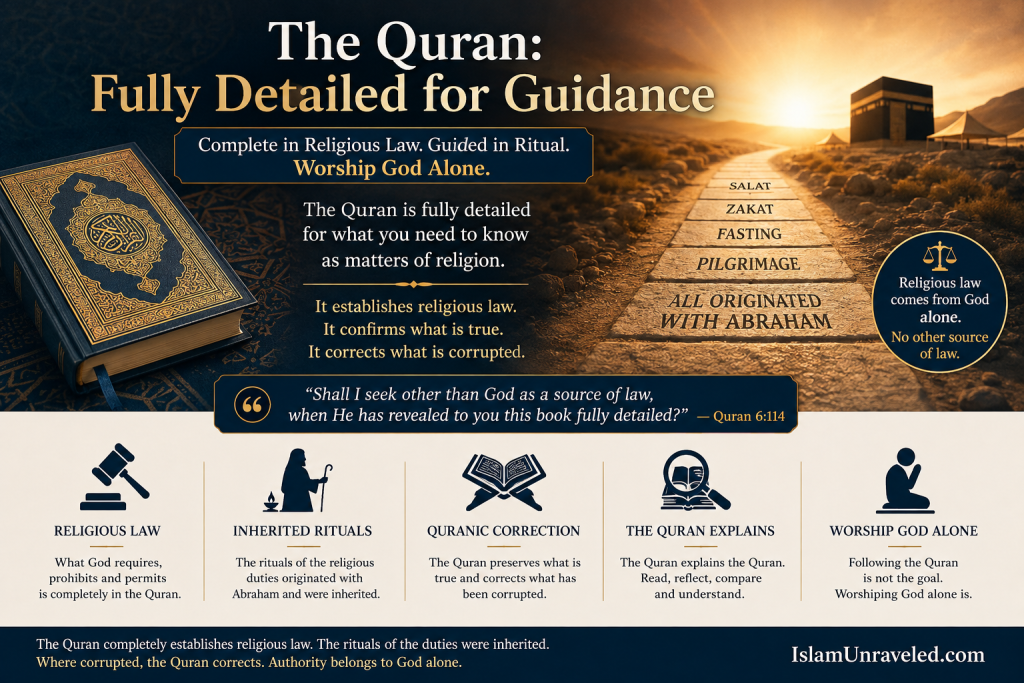
What Does “Fully Detailed” Mean?
The Quran makes an extraordinary claim about itself: God’s revelation is complete and fully detailed for guidance, the purpose for which it was revealed.
This does not mean that the Quran contains every fact about history, science, language, medicine, or everyday human activity. Nor does it mean that every subject must be completely explained in a single verse.
It means that God has provided what is necessary for religious guidance, religious law, and accountability.
What God requires of us, what He prohibits, what He permits, and what He will hold us accountable for as matters of religion do not depend upon another religious source completing His revelation.
This distinction is fundamental.
The Quran is not an encyclopedia of everything humans can know.
It is God’s complete guidance for what human beings need to know in order to submit to Him.
The Quran's Claim About Itself
The starting point should not be what later religious traditions say about the Quran. It should be what the Quran says about itself.
God asks:
“Shall I seek other than God as a source of law, when He has revealed to you this book fully detailed?”
— Quran 6:114
The following verse continues:
“The word of your Lord is complete, in truth and justice. Nothing shall abrogate His words.”
— Quran 6:115
The Quran makes similar declarations elsewhere:
“…a fully detailed scripture…”
— Quran 10:37
“…a detailed account of everything…”
— Quran 12:111
“…We have revealed to you this book to provide explanations for everything, and guidance, and mercy…”
— Quran 16:89
These statements establish the Quran’s own claim concerning its sufficiency.
The question therefore becomes:
Sufficient for what?
The context provides the answer: guidance, religious law, truth, justice, mercy, accountability, and the distinction between right and wrong.
Fully Detailed Does Not Mean “Everything About Everything”
The Quran never presents itself as a technical manual for every human activity.
It does not teach people how to construct houses, perform surgery, cultivate every crop, manufacture tools, or conduct every aspect of ordinary life.
Human beings learn such things through observation, experience, reason, accumulated knowledge, and one another.
None of this challenges the Quran’s completeness.
The Quran’s claim concerns the purpose for which revelation was given.
When something is made obligatory as religion, the authority for that obligation must ultimately come from God.
When something is prohibited as religion, the authority for that prohibition must ultimately come from God.
When people are told that God requires something of them, the claim must have authorization from God.
The Quran is therefore complete in religious law.
But that raises an important question concerning religious duties such as Salat, Zakat, fasting, and pilgrimage.
Religious Law and the Rituals of Religious Duties
An important distinction must be made between religious law and the ritual procedure by which an established religious duty is performed.
The Quran is complete in religious law.
It determines what God requires, what He prohibits, what He permits, and what people will be held accountable for as matters of religion.
Salat is obligatory because the Quran commands Salat.
Zakat is obligatory because the Quran commands Zakat.
Fasting is obligatory because the Quran commands fasting.
Pilgrimage is obligatory for those able to undertake it because the Quran commands pilgrimage.
These obligations therefore do not depend upon another source of religious law.
But the Quran also makes clear that these religious duties did not originate with Muhammad. They existed before the Quran and are connected with Abraham and the religious tradition that preceded Muhammad.
The distinction is therefore:
The Quran establishes the religious law: the duties must be observed.
The rituals through which those duties are performed were already known through the religion of Abraham.
Where inherited ritual remained intact, the Quran had no need to originate it again.
Where inherited practice had become corrupted, the Quran corrected it.
This is not an exception to the Quran being fully detailed.
It demonstrates how a fully detailed revelation functions as the final authority and criterion over inherited religious practice.
Who Has the Authority to Make Religious Law?
The question of a fully detailed Quran is ultimately not about the quantity of information contained in a book.
It is about who has the authority to define religion.
If God has revealed what He requires, can another authority subsequently declare something religiously obligatory that God did not make obligatory?
Can a scholar prohibit what God did not prohibit?
Can inherited tradition create new religious requirements?
Can consensus turn a human judgment into divine law?
Can a messenger independently legislate another body of religious law alongside God’s revelation?
The Quran repeatedly returns religious authority to God.
This is why 6:114 does not merely say that the book is fully detailed. It begins with the question:
“Shall I seek other than God as a source of law…?”
The two ideas belong together.
The Quran is fully detailed because religious authority belongs to God.
The issue is therefore larger than “Quran alone” as a slogan.
It concerns worship itself.
If God alone is worshiped, God alone determines the religious obligations by which people are held accountable.
Related Studies
If Salat Is Religious Law, Why Isn't Its Ritual Given Step by Step?
Salat unquestionably belongs to religious law.
The Quran repeatedly commands believers to observe it.
The question, therefore, is not whether Salat is required. The Quran establishes that requirement.
The question is why the Quran does not introduce every movement and element of its ritual in a new step-by-step sequence.
The answer begins with the Quran’s presentation of religious history.
Salat did not originate with Muhammad.
Abraham prayed:
“My Lord, make me one who observes the Contact Prayers (Salat), and also from my descendants.”
— Quran 14:40
God also describes Abraham and those associated with his line as being commanded to observe Salat and give Zakat (21:73).
The Quran connects Abraham with the Sacred House and pilgrimage (22:26–27).
Fasting is explicitly described as a religious obligation prescribed for earlier communities (2:183).
The Quran therefore entered a world in which these religious duties and their rituals already existed.
God did not need to reveal Salat as though no one had ever performed Salat before. Its ritual had been transmitted through the religion of Abraham.
What the Quran does is establish God’s authority over the inherited practice.
It confirms the religious duty.
It preserves what remains valid.
And where corruption has entered the inherited ritual, the Quran corrects it.
For Salat, for example, the Quran addresses matters requiring correction or clarification, including purification, direction, times, circumstances, congregation, and other aspects of the practice.
Thus two different questions must not be confused:
What has God made religious law?
The Quran provides the authority.
How was an already-established religious duty ritually practiced?
The ritual was inherited through the religion of Abraham.
The Quran remains the final criterion over both the understanding and practice of the duty.
Explore Further
Religious Duties Inherited from Abraham
All Religious Duties Originated from Abraham
Inherited Ritual Is Not an Additional Source of Religious Law
Recognizing an inherited ritual does not mean recognizing another source of religious law alongside the Quran.
The distinction is critical.
The obligation to perform Salat comes from God and is established in the Quran.
The obligation to give Zakat comes from God and is established in the Quran.
The obligation to fast comes from God and is established in the Quran.
The obligation to perform pilgrimage, for those able to do so, comes from God and is established in the Quran.
No inherited practice can independently make any of these duties obligatory.
The ritual form of these duties, however, predates the Quran. The Quran presents them as part of an existing religious tradition associated with Abraham rather than as rituals first introduced to Muhammad’s community.
The inherited ritual therefore answers a different question.
It does not answer:
“What has God made religious law?”
It helps answer:
“How was this already-established religious duty practiced?”
Even then, inherited practice does not possess final authority.
The Quran remains the criterion.
Where inherited ritual conflicts with God’s revelation, the inherited practice must yield to the Quran.
The relationship can therefore be understood clearly:
God establishes religious law.
The Quran completely states and governs that religious law.
The rituals of the religious duties were transmitted from Abraham.
The Quran corrects corruption in those inherited rituals.
The ritual is inherited.
Its authority and boundaries remain subject to God’s revelation.
The Quran Explains Through the Quran
Another misunderstanding of “fully detailed” is the expectation that every concept must be completely explained in the same verse in which it first appears.
That is not how the Quran is structured.
A subject introduced in one passage may be clarified elsewhere.
Words occur in different contexts.
Accounts recur with different details.
Principles established in one place illuminate another.
The reader therefore needs to:
Read the verses.
Consider their context.
Compare related passages.
Recognize recurring themes.
Distinguish clear statements from allegorical ones.
Allow the Quran to explain the Quran.
God declares:
“Then it is we who will explain it.”
— Quran 75:19
And Sura 55 begins with a striking sequence:
“The Most Gracious. Teacher of the Quran.”
— Quran 55:1–2
Human beings can study, discuss, translate, compare, and reason.
But the controlling framework remains the revelation itself.
Related Studies
Does “Quran Alone” Mean Rejecting All Outside Knowledge?
No.
Recognizing the Quran as the sole source of religious law does not require rejecting useful human knowledge.
Arabic vocabulary can help us examine a word.
Grammar can help identify relationships within a sentence.
History can illuminate circumstances.
Archaeology can provide information about earlier societies.
Manuscripts can contribute to the study of transmission.
Modern scholarship can raise worthwhile questions.
Common sense, observation, and reason remain faculties given to human beings by God.
The distinction is between knowledge and religious authority.
A dictionary may help us investigate the meaning of an Arabic word.
It cannot make something obligatory before God.
History may tell us what a community practiced.
It cannot independently establish that God commanded the practice.
Scholarship may propose an interpretation.
It cannot become revelation.
Tradition may preserve useful information – including inherited ritual.
It cannot create religious law or override God’s words.
“Quran alone” therefore does not require intellectual isolation.
It requires keeping the boundary between human knowledge and inherited information on one side and divine religious authority on the other.
Related Studies
Quran Alone: Avoiding Extremes
The Messenger Does Not Become a Second Source of Religious Law
The Quran commands obedience to God’s messengers.
But a messenger’s religious authority comes from the message God gives him to deliver – not from an independent power to establish another body of divine law alongside God’s revelation.
The Quran itself records occasions when Muhammad was corrected, including 9:43, 66:1, and 80:1–10.
This distinction would make little sense if every personal decision of the human messenger automatically constituted divine legislation.
The Quran states:
“Whoever obeys the messenger is obeying God.”
— Quran 4:80
Why does obedience to the messenger constitute obedience to God?
Because the messenger delivers God’s message.
The messenger does not compete with God for religious authority.
He communicates what God has entrusted to him.
This preserves both principles:
The messenger is to be obeyed in the mission God gives him.
God remains the sole source of religious law.
Related Studies
When the Quran Becomes Secondary
A community does not necessarily reject scripture by throwing it away.
Scripture can remain honored, recited, memorized, displayed, and praised while gradually becoming secondary in determining religion.
That can happen when another authority begins to decide what the scripture supposedly cannot decide for itself.
Tradition can do it.
Religious institutions can do it.
Scholars can do it.
Political ideologies can do it.
Religious leaders can do it.
Even people advocating “Quran alone” can reproduce the same problem if their interpretations, personalities, or systems begin functioning as authorities that others are expected to follow.
The decisive question remains:
When a religious claim is made, what ultimately determines whether it came from God?
The answer must continually return to the Quran.
Explore These Studies
When the Quran Becomes Secondary
When “Islam for Beginners” Is Not the Quran
Fully Detailed Does Not Eliminate Personal Responsibility
A fully detailed revelation does not mean every reader will automatically reach the correct conclusion.
The Quran repeatedly calls upon people to think, reflect, listen, observe, and verify.
It warns against following inherited beliefs without knowledge.
It warns about following leaders who mislead.
It warns against pursuing allegorical passages for improper purposes.
And it holds the individual responsible for accepting claims without verification.
A person can possess the Quran and still allow another authority to determine religion.
A person can advocate Quran alone and still follow a human personality blindly.
A person can reject traditional scholarship only to replace it with another unquestioned authority.
The Quran’s sufficiency does not remove the individual’s responsibility to examine evidence.
As 17:36 states:
“You shall not accept any information, unless you verify it for yourself. I have given you the hearing, the eyesight, and the brain, and you are responsible for using them.”
The objective is not merely to possess a fully detailed revelation.
It is to use God’s revelation as the criterion.
From a Fully Detailed Quran to Worshiping God Alone
This is where the subject reaches beyond methodology.
Why should it matter whether religious law comes from God alone?
Because religious authority ultimately concerns submission.
If another authority can independently tell us what God requires, prohibit what God has permitted, or establish religious obligations God did not establish, that authority has moved beyond providing information.
It has entered a domain the Quran reserves for God.
This is why Quranic sufficiency is inseparable from the central principle:
Worship God Alone
“Quran alone” is therefore not the destination.
The Quran is followed because it is God’s revelation.
We do not worship a book.
We worship God and follow His words because God alone deserves worship and possesses ultimate religious authority.
Nor should “Quran alone” become another sectarian identity.
The destination is not a label – “Quranist,” “Quran alone,” or any other religious designation.
The destination is submission to God alone.
Return to the Quran
The claim that the Quran is fully detailed does not ask the reader to place confidence in a religious movement, website, scholar, translator, or human authority.
It asks the reader to take seriously what God says about His own revelation.
The distinction is important:
The Quran completely establishes religious law.
The religious duties commanded by the Quran – including Salat, Zakat, fasting, and pilgrimage – were practiced before Muhammad.
Their rituals originated with Abraham and were inherited.
The Quran confirms those duties and corrects corruption in inherited ritual.
No inherited practice, scholar, tradition, institution, or messenger can independently create religious law beside God’s revelation.
IslamUnraveled can present arguments.
Others can present different arguments.
The responsibility remains with the individual to examine the verses, compare the evidence, and determine whether the conclusions follow from the Quran.
The purpose of this study is therefore not to replace one religious authority with another.
It is to continually return religious authority to where the Quran places it: