Part of the Series: The Quran, Idolatry, and the Emergence of Sectarian Religion
Introduction
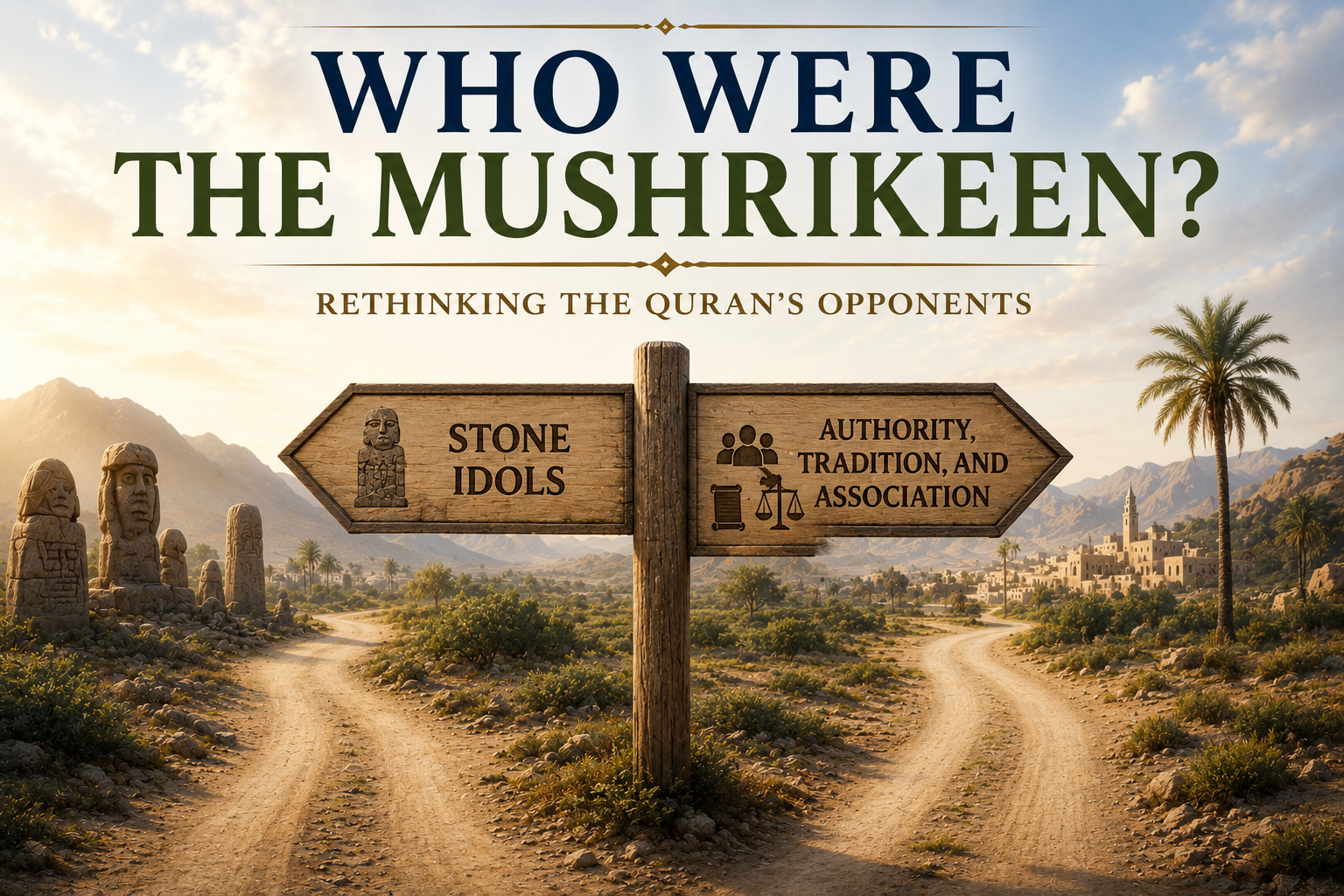
Ask most Muslims who the mushrikeen in the Quran were, and the answer is usually immediate: they were pagan Arabs who worshipped statues around the Kaaba.
This picture is deeply embedded in traditional Islamic history. According to the familiar narrative, Muhammad confronted a society immersed in idol worship, smashed the idols in the Kaaba, and restored Abraham’s pure monotheism.
But what happens when we look first at the Quran itself?
Surprisingly, the Quran presents a much more complex picture. The people criticized by the Quran often acknowledge God, recognize Him as Creator, call upon Him in times of distress, and trace their religious heritage to Abraham.
If they already believed in God, why does the Quran condemn them so strongly?
The answer may reveal that the Quran’s concept of shirk is much deeper than merely bowing before statues.
The Mushrikeen Believed in God
Repeatedly, the Quran states that Muhammad’s opponents acknowledged God as Creator.
If you ask them who created the heavens and the earth, they will say, “God.” (29:61)
If you ask them who created the heavens and the earth, they will say, “God.” (31:25)
If you ask them who created the heavens and the earth, they will say, “God.” (39:38)
These are not descriptions of atheists. Nor are they descriptions of people who deny God’s existence.
The Quran’s opponents already believed in God.
They Called Upon God in Times of Distress
The Quran also describes them praying directly to God when facing danger.
When they ride aboard a ship, they sincerely implore God, devoting the religion absolutely to Him. But as soon as He saves them to the shore, they revert. (29:65)
Again, this is not the behavior of people who reject God altogether.
The problem lies elsewhere.
The Puzzle
If these people:
- believed in God,
- recognized Him as Creator,
- prayed to Him during crises,
why are they called mushrikeen?
The traditional explanation often points to statues and idols.
But when we examine the Quran’s arguments, something striking emerges.
The Quran spends surprisingly little time discussing statues.
Where Does the Quran Mention Physical Idols?
The Quran explicitly discusses physical idols primarily in historical narratives.
Abraham
Abraham confronts his father and his people regarding their idols.
“Do you worship what neither hears nor sees?” (6:74; 21:52-67)
Moses
The Israelites encounter a people devoted to idols and later worship the calf.
(7:138; 20:88)
Elias
Elias asks his people:
“Do you worship Baal?” (37:125)
Noah
The Quran preserves the names Wadd, Suwa’, Yaghuth, Ya’uq, and Nasr.
(71:23)
The Quran does not explicitly identify Wadd, Suwa’, Yaghuth, Ya’uq, and Nasr as statues. It merely identifies them as gods worshipped by Noah’s people. The common claim that they were statues originates from later traditions, not from the Quranic text itself.
Yet when addressing Muhammad’s contemporaries, the Quran’s criticism is usually different.
The Real Issue: Association
The Quran repeatedly condemns people for assigning partners to God.
But these partners are often not described as statues.
Instead, the Quran criticizes:
- religious authorities,
- inherited traditions,
- invented religious laws,
- intercessors,
- human judgments competing with God’s revelation.
The question shifts from:
“Do you worship statues?”
to:
“Who has the right to legislate religion?”
Following Forefathers
One of the Quran’s most repeated criticisms is not statue worship but blind adherence to tradition.
When they are told, “Follow what God has revealed,” they say, “No. We follow what we found our parents following.” (2:170)
The Quran presents inherited tradition as one of the greatest obstacles to monotheism.
Religious Authority and Shirk
The Quran goes even further.
They have set up their religious leaders and scholars as lords beside God. (9:31)
Who is better than God as a lawgiver? (6:114)
Or do they have partners who legislate for them religious laws never authorized by God? (42:21)
These verses suggest that association can occur through authority and legislation, not merely through statues.
Abraham’s Religion Had Already Been Corrupted
The Quran portrays Muhammad not as introducing a new religion, but as restoring Abraham’s religion.
This implies that the religious practices inherited by the people had already become corrupted.
The same pattern appears throughout the Quran:
- Revelation is given.
- Human additions accumulate.
- Religious authority grows.
- Corruption enters.
- God sends a messenger to restore the original message.
A Question Worth Considering
The traditional image of pagan Arabs surrounded by statues is deeply familiar.
Yet the Quran’s arguments focus overwhelmingly on:
- association,
- invented religious laws,
- inherited traditions,
- religious intermediaries,
- authority besides God.
Could it be that the Quran’s primary battle was not against stone idols, but against a deeper form of idolatry—associating others with God in religion?
That question deserves careful reflection because the answer affects not only the past, but also the present.
Related Reading
If you found this article helpful, you may also enjoy:
- Who Were the Mushrikeen in the Quran? – Examining whether the Quran’s opponents were merely idol worshippers or something more complex.
- The Forgotten Meaning of Idolatry – How the Quran’s concept of shirk extends beyond statues and physical idols.
- Did the Quran Confront Pagans or Corrupted Monotheists? – Exploring the religious landscape addressed by the Quran.
- From Believers to Sectarian Islam – How a movement centered on believers and submitters became associated with sectarian identities.
- The Kaaba Before Muhammad: What Does the Quran Actually Say? – Investigating Abraham’s sanctuary through the Quran’s own testimony.
- How Did the Traditional Story of Pagan Arabia Arise? – Comparing the traditional narrative with the Quran’s emphasis.
- The Idols of Noah and the Idols of Arabia: What Does the Quran Say? – Examining what the Quran actually reveals about ancient idols and religious corruption.